
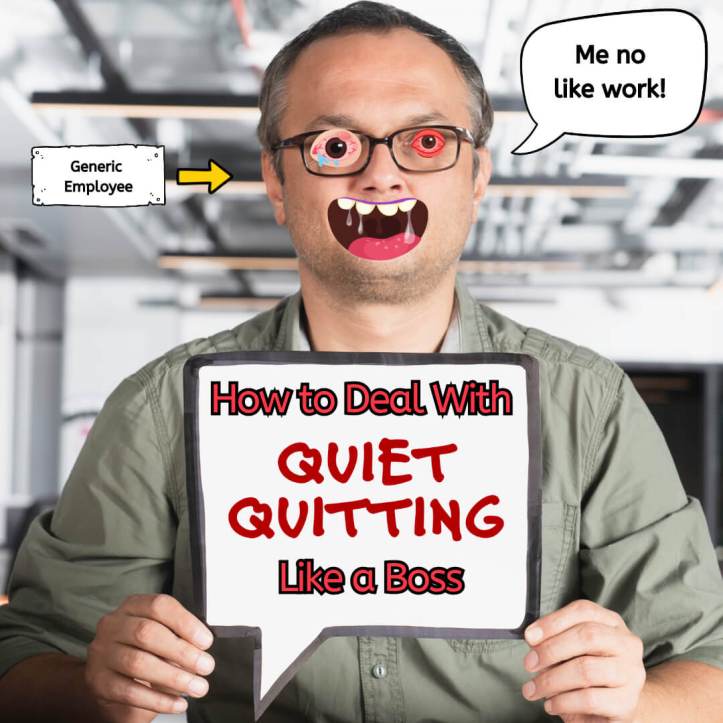
Today, The Financial Times was baffled in a feature article: ‘Quiet quitting’ is real and may be hitting British productivity. Quiet quitting is where employees perform the bare minimum in their roles (i.e. just doing their jobs), whilst not taking on extra tasks, unpaid overtime, or going “above and beyond”.
Capitalism is mightily confused by this state of affairs.
But if you treat staff like crap, underpay everyone, overload them with work, then lay loads of them off at random intervals, what the hell do you expect, darlings? Here’s an insight on how to correct this phenomenon with actionable and thought-provoking tactics.
An Employer’s Friendly Guide to DESTROYING the Quiet Quitting Frenzy
Okay, so this follows on from my how to deal with the redundancy chaos feature yesterday. From the Financial Times piece, here’s an excerpt:
“British workers are increasingly disengaged from their jobs and have become less willing to go the extra mile to help their employer, according to a survey that lends substance to claims that productivity has suffered from a wave of so-called quiet quitting in the aftermath of the pandemic.
Analysis of data from the British Social Attitudes Survey, published on Tuesday [November 2026] by the Resolution Foundation think-tank, shows employees have become more disengaged in the past 10 years and less willing to put in extra effort. There is also a sharp drop in the proportion who want full-time hours, driven by men.
One-in-four workers were not even fairly satisfied with their main job — the gloomiest in the survey’s 35-year history and up from one in five when the question was last asked in 2015.”
It does show how hopelessly detached from reality these people on their massively overinflated wages are. They just cannot comprehend why overworking and underpaying employees doesn’t result in undying loyalty. In the UK, CEOs in FTSE 100 companies earn on average 130 times the salary of the average full-time employee. More general UK CEOs earn between £90,000 and £300,000+.
Couple that with how trigger happy these people are with redundancies in 2026 and, gee, I wonder why so many professionals are half-arsing it?
Let’s break this down based on quantitative and qualitative buzzword hoo-hahs:
- It doesn’t matter how hard employees work, it typically isn’t rewarded with anything
- Many employees are expected to work multiple roles at once, for much lower pay than should be expected
- Unpaid overtime and going “above and beyond” are exploited and/or ignored by upper management
- Redundancies are rampant and come out of nowhere with no warning and seemingly no logic
One narrative invented on the capitalists’ side is staff are a bit lazy and are freeloading it. But there are other employers confused by it all and genuinely want to make amends, so do something stupid like add a ping-pong table to the office.
Excellent! That’ll overcome the cost-of-living crisis, job market crisis, housing crisis, and economic crisis in one swipe of one’s bat.
The solutions are very simple, but will be totally ignored by CEOs:
- Pay staff properly and according to their roles and workload
- Hire enough staff to cover what you need completing for your busines
- Treat staff like valued professionals and human beings, not just a bit of Excel data to eradicate when best suits your needs for a bonus
- Offer genuine work-life balance perks such as hybrid working and/or remote working
- Be transparent about your business plans, rather than just pretending to be
And with hybrid working, don’t have it as non-negotiable. If you’re a London business forcing staff to be in the office three days a week, in the expensive city in the UK, of course staff are going to be demoralised. They aren’t saving any money, it’s all being pissed away on the housing crisis as the average rent in London is £1,400 a month.
Oh, Yeah, Then There’s AI
Some businesses are automating processes to save money. For employees, that’s adding to the malaise. The sense their boss is about to replace them with tools. Why wouldn’t you quiet quit over that?
Yes, AI offers some short-term cost savings.
But in the long-term it has hidden costs. It’s unreliable and makes errors, such as through hallucinations. That can lead to flawed outputs, corrupt databases, inaccurate business intelligence etc. It also ruins customer interactions. You reading this are a consumer, like I am, and I’m sure you find the explosion of AI-driven customer service systems businesses are using as shit. Really shit. And it’s very irritating businesses keep using them.
For the remaining staff you can hire, the level of distrust of your business (especially when your website is clearly drenched in generated AI slop) creates an issue with bringing in top-tier talent. You may have to settle for much less (although corner cutting does do the job for many business owners).
There are many examples of American businesses laying off their workforce to bring in AI replacements, everything going to total shit, then they’ve had to rehire employees again. Bravo. We’re sure the CEO got a huge bonus for that.
Enjoy This Half-Arsed Quiet Quitting Conclusion
The quiet quitting situation is all down to out of touch upper management circles getting angry about a situation they’ve created. You spend years overworking, underpaying, and randomly laying off employees and then get angry when everyone else can’t really be bothered.
Whilst, internally, also having “company values” going on about how staff are treated with respect etc. etc. It’s mismanagement and it’s lazy.
I foresee a future where a small business that commits to paying staff properly, uses talented creatives for web design and branding, and hires employees for a personalised customer service experience, will be rewarded with great success. That will stand your brand out amongst an army of bosses with soulless, automated businesses drenched in AI slop.
That may also mean the CEO can’t earn £500,000 a year, but more like £100,000. Oh, god, the communistic horror!
