
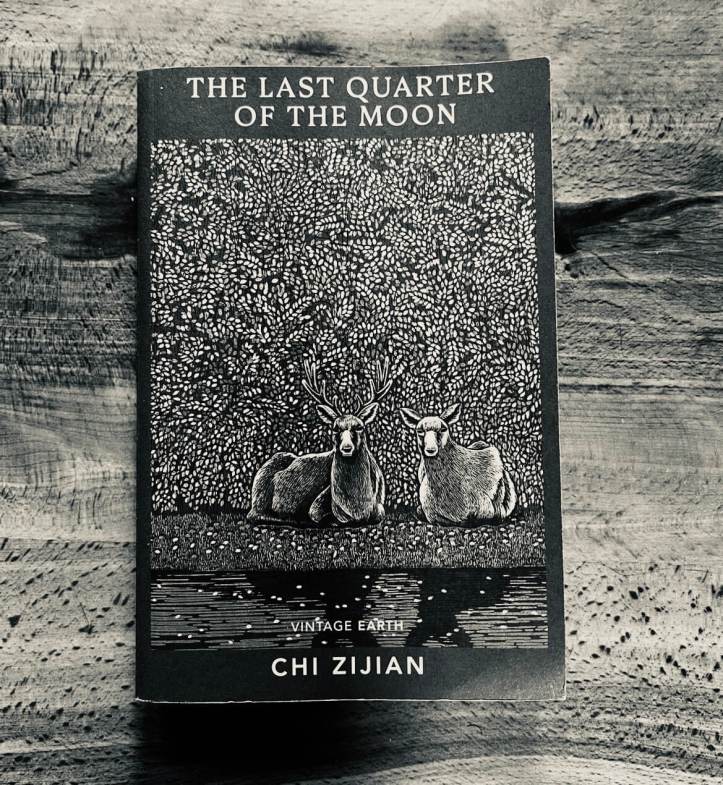
This is a 2005 novel by Chinese writer Chi Zijian. The Last Quarter of the Moon (额尔古纳河右岸) follows the life of a 90-year-old woman telling the story of a nomadic Evenki clan in Heilongjiang, northeast China. The work was translated into English for the first time in 2013 by Bruce Humes.
It’s a slow read with a narrative that mulls over every finer detail. If you can deal with its pacing then this will be a fascinating time of it, one that reveals an ancient way of life clashing with an unexpectedly modern setting.
90 Years of Observation in The Last Quarter of the Moon
“A long-time confidante of the rain and snow, I am ninety years old. The rain and snow have weathered me, and I too have weathered them.”
One of the key things with this book is the unsure sense of time. Reading the opening 50 pages, you’d think it’s set 300 years ago or some such. It’s only when you get into the second Part Two: Mid-Day that Chi Zijian drops a few contemporary notes.
It’s the 1930s and the Japanese invade China, then the Chinese go to war with Russia, and all the while the unnamed narrator provides details of her life well lived. And she has a lyrical, mystical way with words.
“I’m not a woman who excels at storytelling, but at this moment as I listen to the swishing of the rain and watch the dancing flames, I long for someone with whom to speak … Then let the rain and the fire listen to my tale. For I know these, like human beings, have ears too.”
The book is written from the perspective of circa 2000, the lady now having reached age 90. But everything she writes of, with the often primitive lifestyle of the Evenki people, harks back to ages gone. It’s an interesting offset, yet it does cover familiar cultural territory.
The decline of an indigenous way of life is something we’ve seen quite a lot of (think of the 1988 novel Dances With Wolves and its subsequent film adaptation).
Where The Last Quarter of the Moon differs is with its pacing. There are intricate details about the Evenki way of life, often focussing on how they lived off the land, but with particular emphasis on their sacred bond to the natural world (particularly with the local reindeer).
The heavy toll of globalisation is made clear. The secluded world of the Evenki people ends in the 1930s when Japan invades China and they’re dragged into it all, through which they attempt to maintain their close bonds as a nomadic clan. At one with nature, living off the land.
“We were unable to leave this river. We always treated it as our centre, living alongside its main tributaries. If the Argun is the palm of a hand, then its tributaries are five open fingers. They extend in different directions, illuminating our lives like flashes of lightning.”
The Last Quarter of the Moon is an insight into a disappearing way of life. Yet it is very meticulous in its focus on the Evenki people, to the point where we should think many readers will tire of the repetition. There are only so many times you want to re-read what they do with the reindeer and how much they rely on them.
The work is spread across only 300 pages, so if you’re willing to commit to that the pay off may feel profound. But it is a literary plodding way to get there, even if we must note Bruce Humes’ translation as a cosmic wonder. To make the story feel convincing for western readers took some real skill and passion.
A Bit About Chi Zijian
There’s a documentary above about Zijian that explores her family lineage. She was born in Mohe County, Heilongjiang, back in February 1964. She’s had novels published as early as 1991.
The Last Quarter of the Moon won Chi Zijian the Mao Dun Literary Prize in 2008. The award is based on the noted Chinese writer Mao Don (obviously) and is sponsored by the Chinese Writers Association.
More recently, she’s been actively involved in politics. She was a member of the Chinese People’s Political Consultative Conference (CPPCC) and in 2020 became a vice-chairwoman of the Heilongjiang province. Her most recent novel launched in the same year as Smoke Fire Sweeps Through (烟火漫卷).
She’s had 12 novels published in total, but is likely a relative unknown to many readers in the west. She certainly was to us until we spotted this book on a Waterstones shelf a few months ago. We gave it a whirl and we’re glad we did, whilst the story can falter a little at times she certainly has a poetic, lyrical way with words.

A wonderful review. This sounds intriguing but I’m afraid my little book club would venturing off to something more fast moving. Still, I’ll put this out there. 😊
LikeLiked by 1 person
You could try aggressively waving a copy at them to change their minds? Anyway, glad you’re in a book club. I am not, for I fear I’d just end up engaged in fisticuffs with most members.
LikeLiked by 1 person
It happens and it’s not pretty 📚
LikeLiked by 1 person