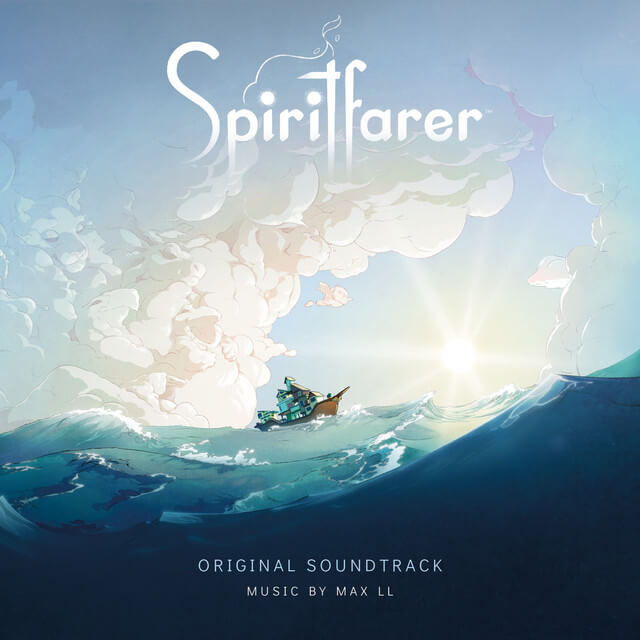
After taking to the seas once again in the magnificent indie game Spiritfarer: Farewell Edition (2021) we were struck by the amazing score.
It’s all the work of Canadian composer Maxime Lacoste-Lebuis (Max LL). It’s a gorgeous score, with lush orchestral sweeps to recreate the magnitude of rolling oceans and the game’s challenging themes.
It’s a fantastic game, too, complemented wonderfully by this music. It’d seem very stupid of us not to flag it up on our website, thus here we are. 😊
The Sweeping Score of Spiritfarer
Max LL and the indie studio behind the title (Thunder Lotus Games) have kindly released the album for free on YouTube. Both are based in Montreal of that there Canada (he was good friends with the game studio’s founder growing up).
You can hear from the opening track Spiritfarer, which merges into Charon’s Burden, the quality of work here. The composer notes in the video description:
“The times we are living through have made the experience of writing music for this project all the more meaningful and I feel like Spiritfarer couldn’t have come at a better moment. The connections and relationships we develop with our friends and families stay with us, we have to treasure them, be more compassionate as individuals and a society, and better learn to say goodbye when the time comes.”
Despite its cartoony visual style, the game deals with weighty topics—grief and death. It balances these out very well with a life-affirming tone and sense of perspective on these natural occurrences.
But it is, ultimately, a cosy genre management game about dying.
Thunder Lotus ran a dev blog on the score and its creation called Making Spiritfarer’s Soundtrack. Max LL noted how he went about performing this balancing act of respecting the topic.
“It was important for the music to have both complexity and simplicity at the same time and an intrinsic emotional duality, even sometimes dichotomy. Grief is a complex and difficult subject matter that the studio wanted to portray in a cosy and light-hearted way. Thunder Lotus wanted the game to help us free ourselves from some of the taboos surrounding death and passing. The music needed to reflect that, so it could never be just happy, angry, or sad. Sometimes, moments of happiness needed to be accompanied by a form of melancholy, moments of fear and sadness by nostalgia. Finding the right tone for some of the game’s moments was definitely a challenge but I think I eventually landed in an emotional space that felt right. I tried deeply reconnecting with all the moments of grief I had gone through in my life to summon the appropriate musical energy.”
The composer used a wide variety of instruments to achieve the unique sounds and sweeps. There’s dulcimer, singing bowls, mandolin, sitar, and shakuhachi.
Upon researching that, we didn’t even know what some of them are. For context:
- Shakuhachi is a Japanese longitudinal end-blown flute.
- Appalachian dulcimer is a fretted string instrument.
- Tibetan singing bowls are inverted bells.
All of which add up to fantastic pieces such as personal favourite Song of Growth.
Peaceful numbers such as At Night.
Then there’s the likes of Into the Mines.
Alongside that type of thing, there are also more playful numbers.
It’s no surprise Studio Ghibli’s work was an influence for the team. Particularly those busybody moments, the little details of characterisation the Japanese studio build on through music. You can hear that in Shipyards.
The whole score is packed with gems and makes for one of the best indie game soundtracks we’ve ever heard.
All of this music creates a wonderful emotive force behind the gameplay, making Spiritfarer much, much more than just a “cosy” management sim. The game has celebrated over one million sales worldwide, making it an unequivocal indie game hit. Fans love the game and Max LL’s score is a big part of that.
And a Nod to Max LL’s Other Work
Lacoste-Lebuis is an ambience specialist whose other albums include In the Silence (2024) and Anthropocene (2023). He’s done other video game scores, too, but mainly focuses in on his solo works.
Away from his various musical projects, he also directs and produces documentary films. He keeps a pretty low profile on his social media accounts. No regular spamming everyone with news, but we’re sure he’s busy working away on many new projects.
Spiritfarer’s Score Slowed Down for an Ambient Mix
Last but not least, the composer has also released the above. This is the score slowed down slightly for an even more ambient, relaxed vibe.

Loved it!
LikeLiked by 1 person
It is fab, eh? 🌊
LikeLiked by 1 person