
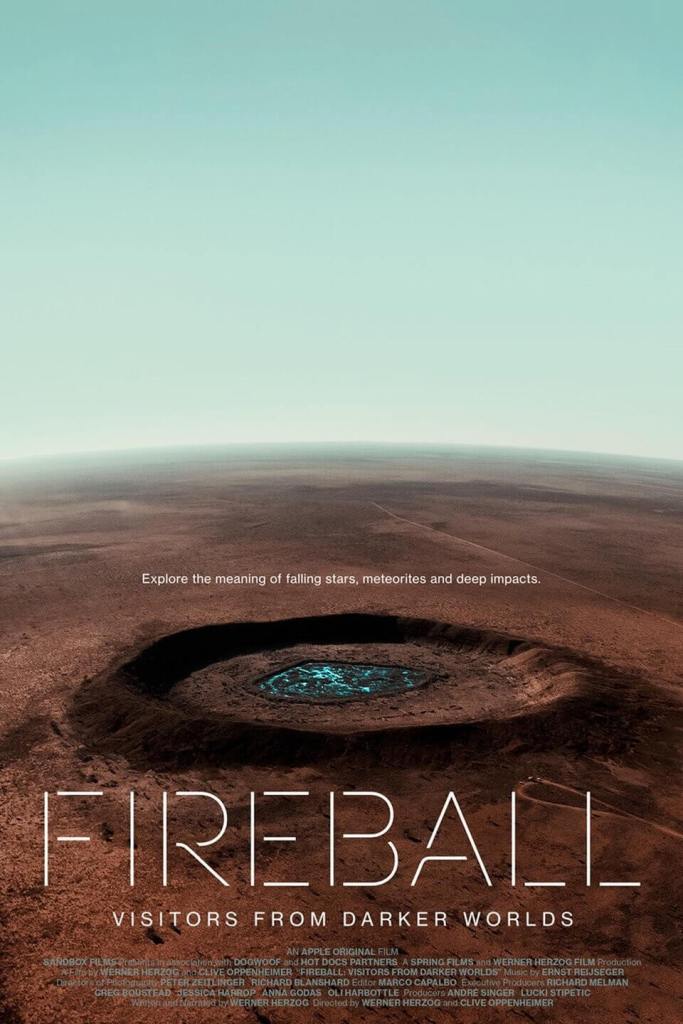
Fireball: Visitors from Darker Worlds launched in September 2020 on AppleTV+. It’s the only place you can watch it, well worth a look if you’re a science geek as legendary director Werner Herzog got access to some incredible locations for this.
Whilst it features his particular, and unusual, brand of documentary making, as the film progresses Fireball becomes a fascinating, otherworldly look into how destructive events from space have shaped humanity.
Cosmic Conversations in Fireball: Visitors from Darker Worlds
We must note this was co-directed with English volcanologist, and Professor of Volcanology at the University of Cambridge, Clive Oppenheimer. He’s seen on camera often interviewing various people, whereas Herzog narrates.
Meteorites have long fascinated us, ever since we watched the BBC Horizon documentary series in 1993 when it ran (and then re-ran in 1999) the episode New Asteroid Danger. In our autistic way, we watched and re-watched that episode so many times it’s imprinted verbatim in our brains even 30 years later.
And we’ve covered this topic before in a 1972 Great Daylight fireball feature.
But it is fascinating. These chunks of rock/ice/whatever hurtling around space on bizarre trajectories. And 66 million years ago, an asteroid six miles in diameter smacked into Earth. The crater is 120 miles in diameter, but erosion and dense undergrowth make it barely visible.
It was only definitively located in the 1970s.
Yet the purpose of Fireball isn’t to do the usual “OMG if one hits the planet us ‘uns is done for!” stuff. In his standard and unique way, Herzog wants to explore how impact events have shaped human activities.
He travels from notable location to notable location, one in a tiny village of France Ensisheim that runs a museum to honour the November 7th, 1492 event.
Herzog is also on darkly humourous form, noting the location of the dinosaur era ending Chicxulub crater in the Yucatán Peninsula is now a poverty-stricken seaside town. He notes:
“This godforsaken place is enough to make you cry.”
It is incredible such a remarkable location is now a seedy looking resort where locals’ houses appear ready to fall over. At least he acknowledges it, rather than brushes over the fact with pontifications.
Accompanying the exploration of various destinations is an excellent soundtrack. It’s from various artists, such as this number Indian Summer by Jonsi & Alex.
That’s set alongside some stunning footage, not least here when visiting a remote Antarctic scientific expedition.
Despite a faltering start, as Fireball gains momentum we were won over by this one. Herzog is a master documentary maker (see 2005’s remarkable Grizzly Man for further proof) and with input from scientists, he sheds intriguing light on what has made us all human.
These visitors from space, the massive ones often separated by 50+ million years, mark the planet. Yet we don’t think about it much, we need reminders like this of how we’re very much vulnerable in the universe. And not an all-dominant species as many like to pretend.
The Production of Fireball
The documentary didn’t get a cinematic release, which is a shame. As some of the scenery would look amazing on the big screen. Regardless, it was well received by critics and got a Best Narration nomination at the Critics’ Choice Documentary Awards.
Herzog’s narration style is unusual and takes a bit of getting used to. But that’s what makes his work so distinct, bordering on pretentiousness at all times but (usually) getting away with it as he’s so smart.
But this is well worth hunting down if you ever have an AppleTV+ subscription. Five years after its release, it’s a hidden gem in Herzog’s canon and further proof we think his skills are best served as a documentary maker.
