
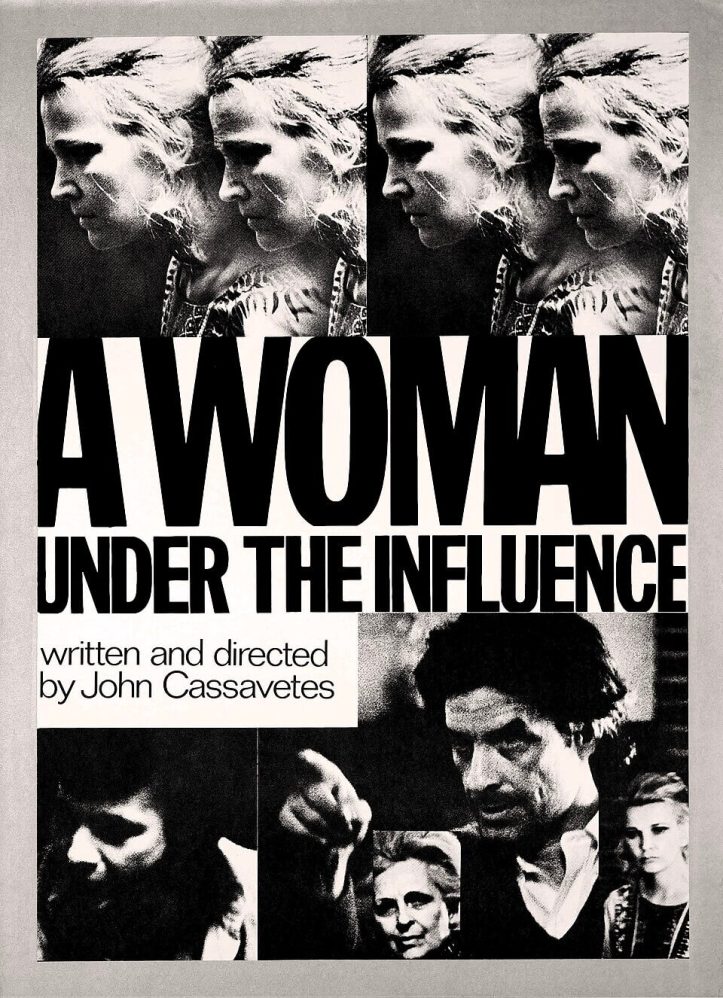
This Oscar nominated 1974 production was written and directed by the legendary John Cassavetes (1929-1989). A Woman Under the Influence is considered his best film, featuring an incredible central performance from his wife Gena Rowlands.
Using a naturalistic style of acting that had emerged in 1970s cinema, the film is an unflinching depiction of mental illness that does not hold back. Depressing viewing for many, we’re sure, but it does represent the type of challenging cinema that can provide some with understanding in similar situations.
’70s Social Realism in A Woman Under the Influence
The plot is very simple. There’s a working class family living in Los Angeles in 1974. We have housewife Mabel Longhetti (Gena Rowlands) and her blue collar working husband Nick (Peter Falk). Together they have three young kids.
They have a nice home together and a pleasant enough existence, although Mabel is bored with her humdrum housewife role.
A Woman Under the Influence plays that setup out in methodical fashion over 146 minutes.
The first 30 show Mabel to be bored, lonely, and eccentric. She drinks heavily and is disappointed her husband misses date night due to his busy work schedule. What follows is her increasingly erratic behaviour, which gets more and more alarming, leads to major concerns from her friends, family, and anyone visiting her home.
Mental health struggles had been covered before by Hollywood. Even in the 1950s you had movies such as The Three Faces of Eve (1957), Harvey (1950), and Angry Boy (1951). Then in the 1960s there was David and Lisa (1962) and The Boston Strangler (1968).
These films played out with the, now unusual, style of acting at the time. Where actors go around clearly acting in that uptight, repressed, Conservative style old films have.
The naturalistic focus of the ’70s onward brought real life to cinema screens. And it does so with alarming, quite shocking fashion in A Woman Under the Influence. It’s more shocking than One Flew Over the Cuckoo’s Nest (1975), which launched shortly after Cassavetes’ film.
Some scenes drag on for an unnatural amount of time, heightening the awkwardness, unpleasantness, and realism. As below, when Mabel realises she’s about to be drugged and committed.
Cassavetes cast many of his friends and family in the film. There’s his real life wife as Mabel, plus his mother is in the above scene. Peter Falk stars as Mabel’s husband Nick, with Falk a close friend of Cassavetes.
Falk is brilliant in the role, but Nick isn’t depicted favourably.
He struggles to comprehend his wife’s mental decline. He’s ill-equipped at handling the situation and so has abusive and violent outbursts, highlighting this man isn’t a suitable husband for Mabel. After she returns from her six month stay in hospital, the very same night there’s a relentless scene about just that.
It’s domestic abuse, but it comes from a position of ignorance and fear. Nick just doesn’t know what to do, at a time in society where understanding and treatment for this situation wasn’t good enough.
The film ends on an unclear note, as after the extended argument Mabel and Nick clear up for the night and head off to bed. For us, it’s pretty clear a very difficult future awaits the family.
Now, some people may wonder why anyone would make a film like this. Well, it’s a serious drama depicting real life issues. We still get productions like this, such as with Manchester by the Sea (2016) that’s just as brutal a watch (it was also a hit film).
Granted, it’s a bleak film. But it’s a realistic one and directors like Cassavetes knew people out there can take solace in this sort of project. It helps society understand such a situation, learn about mental illness, and be enlightened about it for the real world.
A difficult watch, then, but an impressive film for the time.
The Production of A Woman Under the Influence
The two lead actors are no longer with us, sadly, but above they’re discussing the film in 2004 for its 30th anniversary.
It was Cassavetes’ wife who inspired him to make the film, as she wanted to star in a play about the pressures of early ’70s life for women. A Woman Under the Influence was intended as a play, but when Cassavetes finished the script he realised it’d be too psychologically demanding for Rowlands to do the performance night after night.
He adapted the words for cinema and tried to fund the production, which was met with a shut door from Hollywood. Undeterred, Cassavetes remortgaged his house and got loans from family/friends (including lead actor Peter Falk).
Tangent here, but that’s somewhat similar to how Monty Python got their 1979 film Life of Brian made. Beatles star George Harrison stepped in to save the project, funding it with £3 million after setting up HandMade Films. Makes you wonder how many other great films have been lost due to a lack of similar good fortune.
Anyway, back with Cassavetes’ project and the budget was low and forced the crew to film in a real house (rather than a studio). There was no makeup team and Gena Rowlands did all that by herself. Everything was shot from November to December 1972, minus any rehearsals to force the actors into more realistic performances. The director also often delayed shouting “Cut!” for scenes, dragging them out for what feels awkward amounts of time, which unsettles the audience.
However, the problems continued when he tried to find a distributor for his project. Luckily for him, Martin Scorsese stepped in to help get it into cinemas. All of these issues are what caused the delay from its 1972 filming to 1974 release.
Once the film launched, off its $1 million budget it recouped $6.1 million.
A Woman Under the Influence is hailed as one of the best films ever. Plus, Gena Rowlands’ lead role is considered one of the best in cinema history. Contemporary praise was high, too, with two Oscar nominations yet no wins, although Rowlands did win a Golden Globe.
On a final note, there’s a scene where Mabel goes to a bar and the drinks tab winds up being $3.50 in late 1972 cash. Converted into modern day money, that’s $22.40 she spent at the bar.
