
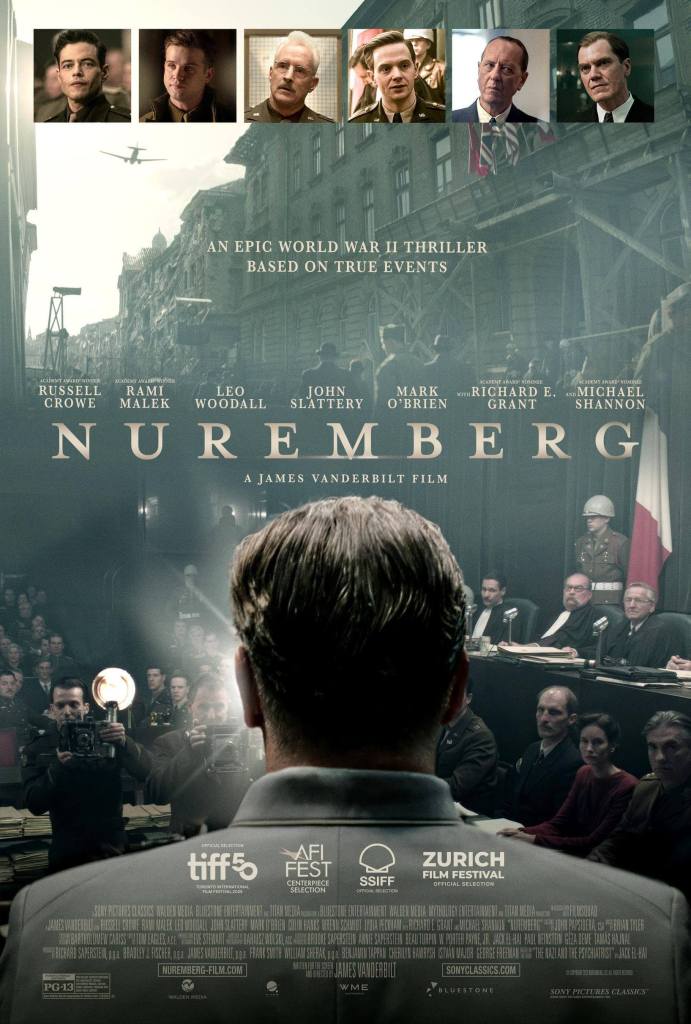
Okay, we were eager to watch the 2025 psychological thriller Nuremberg despite its mixed reviews. With Russel Crowe taking an unlikely starring role as Hermann Göring, the film documents the 1945 Nuremberg trials and prosecution of Nazi war criminals.
Whilst the film can be hit and miss, with an odd tone that doesn’t quite sit well, it’s worth it for Crowe’s excellent performance as the highly intelligent, narcissistic Reichsmarschall.
Psychiatric Examinations and Court Room Drama in Nuremberg
The Nuremberg trials have been made into films before, such as in 1996. Where this one differs is the psychiatric focus, with a post-WWII round-up of leading Nazi party figures needing a psychological assessment.
Doctor Douglas Kelley (Rami Malek) is drafted in to analyse 22 such individuals. One of whom is the second-in-command Nazi Hermann Göring (Russell Crowe).
Dr. Kelley sets about trying to analyse the highly intelligent, manipulative Göring who tries on a major charm offensive. He denies many claims and often, instead, talks about his wife and young daughter Edda (1938-2918).
And this makes the film for us, as Crowe is on excellent form.
Russell Crowe aside, we have issues with the film. The downsides? It’s overproduced. The budget was only around $10 million, but sets often feel lavish and overdone. The film quality is also modernised, so it’s like watching a glossy TV show that’s overdone it on a studio set.
It often feels very much like you’re watching a film, although the courtroom scenes are convincing. Some of the dialogue in these scenes was taken from exact extracts from the Nuremberg trails, such as with Sir David Maxwell Fyfe (Richard E. Grant) and his exchange with Göring.
Compare it to the real trails below. Regarding Göring’s size (Crowe remains BIG in the film), in real life during his incarceration Göring was put on a diet and lost a huge amount of weight.
He could speak English perfectly well, incidentally, but chose to talk in German during the trials.
Its peaks aside, at its worst Nuremberg is genuinely quite bad. Thankfully, there’s enough good stuff to balance it all out, but we did consider it a missed opportunity.
One of the major problems is Rami Malek.
Director/writer James Vanderbilt’s handling of the Lieutenant Colonel Douglas McGlashan Kelley (1912-1958) character is odd. Malek works with what he was given, but we still think his portrayal of Kelley is out of place in the film and at times just weird. Like he should be wise cracking in a superhero film.
He plays it as this cocksure, somewhat charming, arrogant guy who occasionally gets it right. But it’s like a kind of caper film with him at times, he’s smooth-talking and quipping away. The character arc feels unfulfilled and unbelievable (in part as Vanderbilt did invent a load of stuff so Malek has more to do).
It just feels out of sorts, as Nuremberg is trying to be a big dramatic, meaningful film. But the big dramatic moments don’t work when the tone is all over the place. As a result, some of the big Nazi shrieking, mental instability moments came across as borderline comical.
Again, what saves it all, and makes the film a solid enough watch, is Russell Crowe.
Who’d have ever thought this New Zealand born actor would wind up playing Hermann Göring? And he nails it. Capturing the high intelligence (Göring was very smart), charm, narcissism, manipulative nature etc. As the film progresses, the true man comes out and what we have is a monster.
Göring was supposed to be hanged, but was able to procure cyanide pills the night before his execution and went out that way. It’s still unclear how he got access to them.
This the film portrays with accuracy, whilst playing around with history in bizarre fashion (making out Rami Malek’s character was on close terms with Göring and his family… when he wasn’t). The end result is a very mixed bag, held aloft by Crowe’s performance.
But… we do also think films like this, a big 2025 blockbuster that grabbed a lot of headlines, remains very important for younger generations. So they can get a sense of history, what happened, and not to lose sight of moral justice.
That’s what, despite its flaws, Nuremberg does deliver—a timely sense of morality.
Notes on Edda Göring
This is an interesting side topic here, one we covered for the excellent film The Zone of Interest (2023). That’s about Rudolf Höss and his family, who lived right next to Auschwitz. Höss was also at Nuremberg and eventually executed, leaving behind his young kids to carry the weight of it all for the rest of their lives.
Edda Göring had a similar problem. Born in June 1938, by the time of her father’s death she was eight. The US had interned Edda and her mother, but they were released in earlier 1946 and lied in the Sackdilling, quite a way out from Nuremberg in the countryside.
In the aftermath of this, she went on to lead a pretty normal life (unlike Gudrun Himmler and others), not speaking in public about her family legacy until a one-off interview on a Swedish TV show in 1986.
Earlier in her life, she attended a school in Bavaria and the family then moved to Etzelwang in November 1948. She studied at university and became a law clerk and then worked for a doctor. By 1959 the family was in Munich city centre; she was well on with her life and noted by relatives to be fair-haired and attractive.
Later in her life she did make a few more interviews. During these she was pro-democracy, but appears to have been devoted to her father, in a 1991 interview for a book called Hitler’s Children she said (of her father):
“I loved him very much, and it was obvious how much he loved me. My only memories of him are such loving ones, I cannot see him any other way.”
She died in December 2018 and didn’t acknowledge her father’s role in the Holocaust during her life. Her stance was always to defend him as a loving father, suggesting his loyalty to Adolf Hitler was his comeuppance.
The Production of Nuremberg
Yes, so the film had quite a small budget by modern standards ($10 million) and made $60 million at the global box office. It’s exclusively available on NowTV’s cinema service to rent.
James Vanderbilt began writing the film in 2023. The shoot took place in Budapest of Hungary from February to May 2024.
The courtroom scenes were very intensive for the actors. Everything was filmed in complete takes, so at times supporting actors Russell Crowe, Richard E. Grant, and Michael Shannon had to be mentally on it for 25 minutes straight.
Crowe gained a lot of weight for the role. 50 pounds, in fact, which considering in his early 60s is committed… but not great for his health. Although he has since lost all the weight.
To note, the Nuremberg trials was the first public showcase of films and photographs from various concentration camps. Until then, it was unclear if various atrocities had indeed taken place. For many in the audience in 1945, that was the first time they saw what had happened. For this film, the original footage shown in 1945 is used.
We should add as well there are a lot of historical inconsistencies during the film, which are classic Hollywood stuff. For instance, at the start of the film they make out Göring surrendered on 7th May 1945 (it was actually on the 8th of May). Plus, the various scenes with his doctor are largely nonsense and invented for dramatic effect.
That’s a bit irritating as making a more factually accurate film was entirely possible. But, hey ho, this is about making a profit ultimately and that has to be on the director’s mind, too.
