
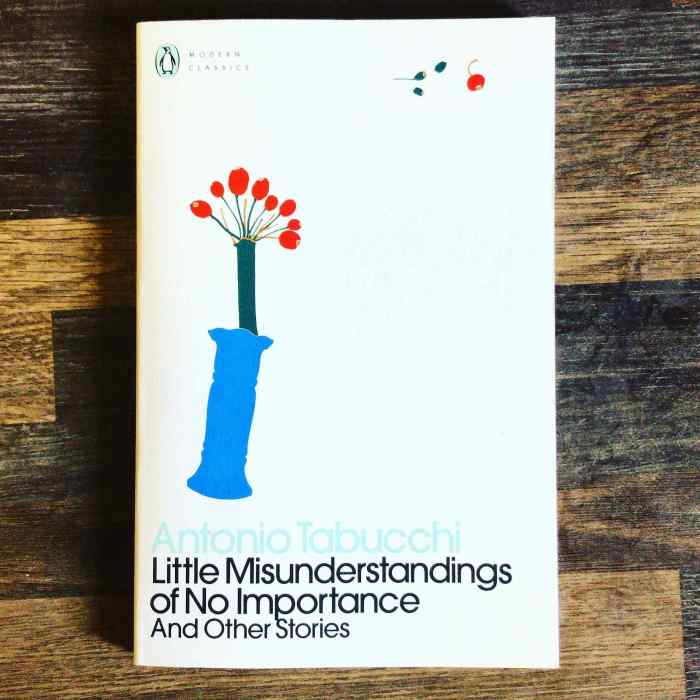
Antonio Tabucchi (1943-2012) was an Italian academic who worked at the University of Siena teaching students Portuguese.
He was also a writer, one inspired by the work of Fernando Pessoa (see The Book of Disquiet) from which he took the literary concept saudade—an emotional state of melancholy and nostalgia.
This collection of short stories was published in 1985 and has Little Misunderstandings of No Importance as its centrepiece. Let’s take a look as this was one of the 20th century’s more intriguing (if obscure) writers.
Discover Life’s Ambiguities in Little Misunderstandings of No Importance and Other Stories
Consisting of 11 works, of the collection the writer noted how his Baroque writer inspirations made “ambiguity into a metaphor for the world”.
In his brief introduction he states:
“I, too, speak of ambiguities, but it’s not so much that I like them; I am drive, rather, to seek them out. Misunderstandings, uncertainties, belated understandings, useless remorse, treacherous memories, stupid and irredeemable mistakes, all these irresistibly fascinate me, as if they constituted a vocation, a sort of lowly stigmata. The fact the attraction is mutual is not exactly a consolation. I might be consoled by the conviction that life is by nature ambiguous and distributes ambiguities among all of us. But this would be, perhaps, a presumptuous axiom, not unlike the baroque metaphor. “
Little Misunderstandings of No Importance (Piccoli equivoci senza importanza) kicks off this preoccupation with fleeting moments shaping human identity.
“From one dance to another a year went by, a year marked by a certain phrase, one that we ran into the ground because it fitted any and every occasion. Missing an appointment, spending money you didn’t have in the bank, forgetting a solemn promise, finding a highly recommended book a total bore, all these mistakes and ambiguities were described as ‘little misunderstandings of no importance.'”
Mundanities. As with his hero Pessoa, he wanted to find the magical moments in otherwise mundane situations.
As these are the moments that shape our lives.
Whilst landing a big job or winning the lottery (the latter has happened to us many times) may seem like life defining occurrences, really your life is defined be the little things.
An offhand comment someone made to you decades ago, your daily routine in the area you grew up in, the quality of the tea in your local teashop, the news source you turn to etc.
The other short stories include:
- Spells
- A Riddle
- Any Where Our of the World
- The Trains that Go to Madras
- Bitterness and Clouds
Spells is a fine story about two children joking around about the supernatural world. This one is about the capacity for children to shift from the imaginary world to the real to help adapt to life.
But they all follow the same concept—following a lead character’s life across brief stories whilst considering if it’s an accident, choice, fate, or something else shaping their trajectories.
Characters are grappling with memory and time as life marches on.
Nostalgia, the benefit of hindsight, and a sense of longing hang over many of the works. Brief as they are, Tabucchi’s misunderstandings are memorable and remind you of the
It’s that slight nature of each story that makes the book easy reading as you dip in and out of the Tabucchi’s musings. Ambiguity in page turning form.
Little Misunderstandings of No Importance and Other Stories is contemplative and lively. We enjoyed the stories and the ease of which the writer makes you more at ease with the passage of time.
A Little Bit About Antonio Tabucchi
There are many other works in Tabucchi’s collection. These include Pereira Maintains (1994), Requeim: A Hallucination (1991 and what he’s referring to above), and The Woman of Porto Pim (1983).
Although born in Pisa he travelled across Europe during his formative years and developed a strong passion for Portugal.
This was, in part, developed by his love for Fernando Pessoa’s work and led him to learn Portuguese. The irony here is Pessoa (deliberately) kept himself in obscurity and made no efforts to try and publish his work.
Tabucchi went off and did the opposite and his works are now published in over 40 languages. Not just in fiction, also across history and politics.
He pursued his work with a strong moral compass. He once told La Stampa (an Italian daily newspaper):
“This correction of history which is frequently produced by a rich, cynical society, totally insensitive to moral questions, is repellent to me … I think fascism is a great historical wound which is not yet healed.”
His most famous work remains 1994’s Pereira Maintains (Sostiene Pereira), which was adapted into a 1995 Italian film. It has a staunch anti-fascist message.
