

Hieronymus Bosch—with a name like that you’re only ever going to be an excellent artist.
Real name Jheronimus van Aken (1450-1516), the Dutch painter was from the state of Brabant and he grew up in the city of s’Hertogenbosch. Part of that led to him using the moniker he became famous for.
That and the spectacular weirdness of his paintings, which mixed in bizarre and nightmarish creatures to promote a puritanical existence. Hurray.
Hieronymus Bosch and the Pursuit of Early Surrealism
Bosch spent decades working on this piece between 1490 and 1510, ageing as he did from age 40 through to 60. It’s been housed at the Museo del Prado in Madrid since 1939.
The attention to detail in Bosch’s art is quite staggering. It’s also quite alarming when you take a closer look at what he was painting.
You’ll find disturbing visions of nightmarish creatures, which have led some art buffs to conclude Bosch was completely out of his mind.
This is unsettling stuff to watch, as opposed to the outright horror of other artist’s work (such as Goya’s Saturn Devouring His Son).
Bosch was a master triptych painter, paintings as an altarpiece or carving with three panels layered alongside each other.
The whole section of the Garden of Earthly Delights is at the top of this feature, but here’s the Hell panel for your inspection (click on these images for a close up view).

At first glance everything may appear as a standard Medieval styled painting, but when you really look a bit closer you’ll see all manner of bizarre stuff.
Check out that thing in the bottom right—some squat animal wearing armour next to a pig wearing a nun’s headdress whilst pestering some poor sinner. This dude.
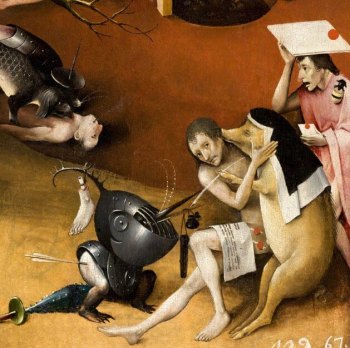
Further up on the mid-left and you’ll see a pink monster seemingly inscribing lyrics onto a sinner’s buttocks.
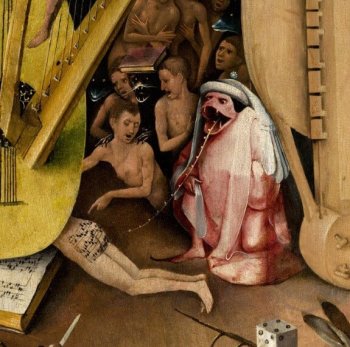
Now, someone has transcribed that music and played it. What’s been called Hieronymus Bosch Butt Music can be heard below played across harp, lute, and hurdy-gurdy.
It says a lot about Bosch’s commitment as an artist that he used real sheet music in his artwork.
As for some critical assessments Bosch was insane, the piece was painted at a time of incredible religious fervour.
Across various depictions of lust and gluttony in the central pane, humans frolicking with wild abandon and engaging in sinful behaviour, that’s followed by images of Hellish punishment in the right panel.
Such depictions of Hell were common in contemporary art, it’s just Bosch expressed himself with all that grotesque imagery.
You can see the influence of Bosch’s work in surrealist movements, especially in the 20th century Oulipo movement (see exquisite corpse).
That and the likes of Codex Seraphinianus by Luigi Serafini (1981). This in particular revelled in the abnormal and malformed creations of the (perfectly sane) Serafini who just wanted to create something weird.
Bosch’s other famous works, such as Triptych of the Temptation of St. Anthony (circa 1501) maintain that surreal element. Note the weird flying beasts (fish and other stuff) in the rampaging skies above the repentance below.

His artwork is now distributed across various galleries. The Guardian reviewed one in 2016 at the Noordbrabants Museum in Den Bosch: a heavenly host of delights on the road to hell:
“The public face of Bosch, walking the streets of this little city, was that of a good townsman and Catholic. His private thoughts emerge in the most unexpected and miraculous of all the treasures assembled – his drawings. Twenty survive in the entire world, according to the Bosch Research and Conservation Project, whose findings this exhibition reveals – and 19 of them are on view here. They show us the secret Bosch, a man with a mind full of monsters. One drawing is called The Wood Has Ears, The Field Has Eyes – a saying inscribed as on Goya’s Caprichos. Human ears hang from the trees. Human eyes stare out of the ground. It is like a Magritte. Only much scarier.
Bosch’s drawings reveal that within the respectable citizen with his big house on the market square festered a paranoid mind revolted by much of human behaviour. The darkness of these designs is tangible. Even a brilliantly accurate sketch of an owl’s nest has something hellish about it. A man hides himself inside a basket, with only his arse visible. Out of it he shits live birds, which playful children chase about. When they catch one, they pin it down with unbarbed cruelty: they are no innocents. In another drawing an audience gathers, their faces cold and mean. Perhaps they are watching Christ’s sufferings as in Bosch’s painting Ecce Homo, where a similarly callous crowd contemplates the tortured messiah’s bloodied body.”
For its exhibition the museum really ramped up the sense of pulse-pounding drama! Check out the trailer for it. Like a ruddy action movie.
As weirdly beautiful as this artwork all is, it seems to be a reflection of the extreme religious paranoia of the times.
Where Earth folk were in a constant state of dread wondering if God would punish them and society for some reason. Maybe with another plague outbreak or some such.
When you’ve got no idea what’s going on in the world it’s no surprise you’d turn to religion and find some escape through a puritanical existence. Repent, wretched sinner, and you shall find your escape from such wrath.
Perhaps Bosch just wanted to make that very, very clear indeed.
Intrigued? If you want a closer look at his artwork head to the Bosch Project where you can zoom in and marvel at the pieces.
The Mystery of Hieronymus Bosch
To add to the painter’s mystique is the lack of information regarding his life. Plus, the total number of his surviving works is debated (such mystique makes for much pontificating).
Only seven pieces have his confirmed signature.
This means many pieces once believed to be his are now questioned as potential imitations by other artists. Bosch’s style was so influential it led to widespread imitations and that’s led to much confusion.
Over the last 100 years art history scholars have continued to remove pieces from the official Bosch canon.
20th century art historians, such as the excellently named Ludwig von Baldass (this feature is all about the epic names) did claim to identify 30-50 paintings by Hieronymus Bosch.
More recent research has been so intensive The Bosch Research and Conservation Project used dendrochronological analysis (the process used for tree rings) to try and pinpoint the age of some paintings under analysis. The results were published in 2016.
The figure is currently accepted as 20 confirmed paintings.
Considering the likes of Russian great Ivan Aivazovsky painted over 6,000 pieces in his lifetime there’s surely more Bosch artwork out there. It’s just difficult to confirm any of it.
What’s known about Bosch’s life is he travelled little.
Most of his time was spent in and around ‘s-Hertogenbosch. His grandfather was a painter (Jan van Aken) whose historical record dates back to 1430. None of his grandfather’s work appears to have survived the passage of time.
Bosch turns up in history from a municipal record dated 5th April 1474.
The city he lived in was a flourishing and lively hub of activity. As his reputation grew he became a famous local painter and he joined the Brotherhood of Our Lady (a religious group which was highly coveted) from 1486.
He also married Aleid Goyaerts van den Meervenne circa 1479 and the couple moved to the local town Oirschot.
She was from a wealthy family, so Bosch will have led a comfortable life (rather than the poverty-stricken existence of your average working artist).
Other than these basic details there’s no information about what his personality was like. But we can confidently claim he wasn’t a heretic. Which is a bonus.
The final entry of his existence dates to 1516 when he died, where it’s noted a funeral mass was held on 9th August to honour him.

As a bit of a surrealist fan, I really enjoyed this excellent narrative and series of paintings. Well done!
LikeLiked by 1 person
Cheers! But “well done”? I didn’t paint these pictures, madam, that was Sir Hieronymus himself. I’m not breaching copyright here!
LikeLike
Bosch is very interesting, yeah. I’m a big fan of a lot of early 20th century surrealism, and it makes sense to bring up Magritte — Bosch seemed to be way ahead of his time. Though if I’d seen his work as a kid, I probably would have thought of it like a really bloody Where’s Waldo. I’m sure someone’s done a parody like that.
LikeLiked by 1 person
Fun fact is it’s called Where’s Wally? in England. And many variations around the world… for some reason.
Magritte’s work isn’t quite as disturbing as Bosch, but I do like all the surrealist stuff.
I also see you em dash there and salute it.
LikeLiked by 1 person
Didn’t know that about those books, but it makes sense. The only other Waldo I’ve heard of anyway was Ralph Waldo Emerson.
And thanks! I use em dashes much more often than I probably should.
LikeLiked by 1 person
The em dash addiction is real. Anyone who uses a hyphen instead is a wretched sinner worthy of surrealist art.
LikeLiked by 1 person