
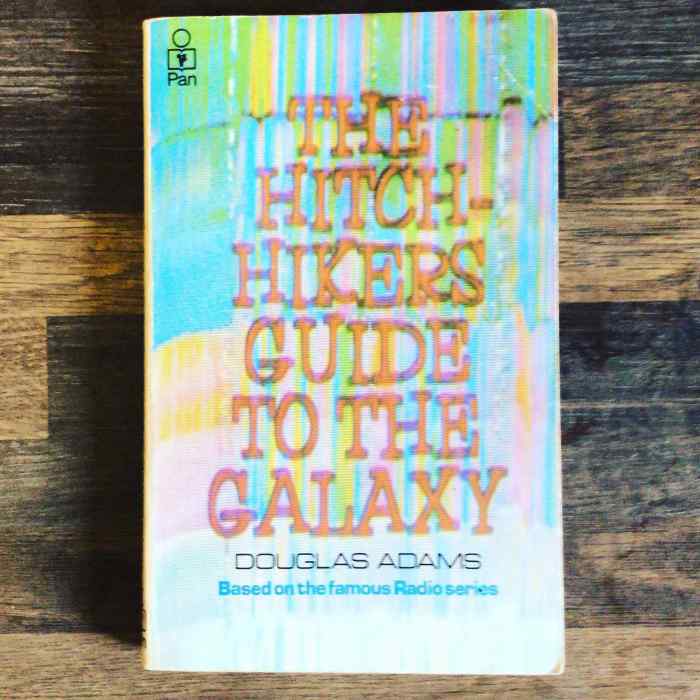
You’ve probably heard of The Hitchhiker’s Guide to the Galaxy. It’s a full sci-fi comedy franchise that began in 1978 on BBC Radio 4, all from the mind of Douglas Adams (1952-2001).
The eponymous novel launched in 1979 with the front cover above.
Yes, that’s what book covers used to look like, kids! It was the first in a “trilogy of five books” and sold 250,000 copies within three months of launch. Groovy.
The Hitchhiker’s Guide to the Galaxy (the very first book)
As big Red Dwarf fans from the ’90s, it’s a bit surprising we hadn’t read this until now. The influence of this on the BBC sitcom is very clear.
And the book is packed with that kind of British, daft wit you may be familiar with elsewhere (such as on our idiotic website). The work opens with an intro to humanity and the general behaviour of our species.
This includes insights such as:
“On the planet Earth, man had always assumed that he was more intelligent than dolphins because he had achieved so much—the wheel, New York, wars and so on—whilst all the dolphins had ever done was muck about in the water having a good time. But conversely, the dolphins had always believed that they were far more intelligent than man—for precisely the same reasons.”
We soon encounter Englishman Arthur Dent, who wakes up in his home prior to having it bulldozed to make way for a bypass.
Whilst that’s going on a fleet of spaceships arrives in the form of The Vogons, demented slug-like civil servants who announce they’ve arrived to demolish Earth to make way for a hyperspace expressway. Earth is promptly demolished (a running theme in the other popular US series Futurama).
After this Arthur Dent, in a permanent state of befuddlement, wanders around the Universe with alien journalist friend Ford Prefect.
As they travel they discover all manner of bizarre things, such as a two-headed galactic overlord who goes by the name of Zaphod Beeblebrox.
This is all, of course, rather silly and stupid. Themes we enjoy a great deal (*ahem*) with a light sense of existential dread used as humour. The work does constantly hint at the absurdity of the human presence in the cosmos and our total irrelevance.
There are some fantastic lines to go with the plot, including the famous:
“Isn’t it enough to see that a garden is beautiful without having to believe that there are fairies at the bottom of it too?”
As a quip, it’s one that’s been picked up by the likes of Richard Dawkins in The God Delusion (2006) to contemplate the nature of a Godless existence.
But other stuff is just sillier:
“The ships hung in the sky in much the same way that bricks don’t.”
It’s a daft work, but also one loaded with British pathos and other sensibilities. We nod to the likes of Withnail & I (1987) and This is Spinal Tap (1984) as two other British stalwarts in this realm of distinctly English humour.
The Hitchhiker’s Guide to the Galaxy is a notably short work.
It’s funny—in a light way. We did often find its twee English merriment a bit tedious (this typed out by some world-weary Brits here), when something like Monty Python could pull this off without being annoyingly British.
You can compare it to something like the far less renowned book The Ascent of Rum Doodle (1956) by W. E. Bowman, which we consider a much better parody of the English person experience.
But The Hitchhiker’s Guide to the Galaxy was a book of its time and we should imagine groundbreaking in 1979.
It’s supposed to be a breezy read. It’s packed with wit, knowing taps to the nose, and should help you feel a little bit securer with your lot in this Universe (or the next one).
But since its launch the likes of Red Dwarf, Futurama, and other sci-fi have advanced its formula considerably. That’s left it looking a little old hat, yet we still enjoyed it! Silliness is always good.
The Hitchhiker’s Guide to the Galaxy Radio Show and Text Adventure Game
Yeah, so this ran as a cult radio show for quite a while. Then came the book and that’s launched a series that continues to rumble with some life to this day.
Some of the work that’s been created around the series is intriguing. For example, a text adventure game version launched in 1984.
A TV series also accompanied the book, which ran on BBC 2 in 1981. It starred actors Simon Jones and David Dixon. Reviews were a bit mixed and only six episodes were commissioned by the Beeb.
But in 2005 a film adaptation went full steam ahead, with a cast headed by Office star Martin Freeman.
This film also met with mixed reviews. American film critic Roger Ebert gave it 2/4 and noted:
“You will find the movie tiresomely twee, and notice that it obviously thinks it is being funny at times when you do not have the slightest clue why that should be.”
Although we haven’t seen the film, it’s a comment that reflects our feelings on the novel. Despite this, there’s a still a lot of generational love for the series.
It’s been a while since anything new emerged, but we’re willing to bet something else will turn up in the not too distance future.

One of my personal faves!
LikeLiked by 1 person
Glad you like it! Did you enjoy the film?
LikeLiked by 1 person
The “newer” film? It was…okay. I thought it was missing a lot of stuff that I wanted to see from the book, but there’s really only so much you can cram into a few hours. I wish we would get film versions of all the other connected stories!
LikeLiked by 1 person
Time to petition for a new series, I think! Netflix can take it up. They greenlight everything.
LikeLiked by 1 person
They green light one season of everything and then cut it off when it’s just getting good 😂 but seriously, I’d love to see this series get another chance! (Have you watched any of the BBC version? It’s a little low budget but the heart is there)
LikeLiked by 1 person
I’ve only seen clips of the BBC series, but I’m sure it’s on YouTube in full. So I shall give it a go!
LikeLiked by 1 person