
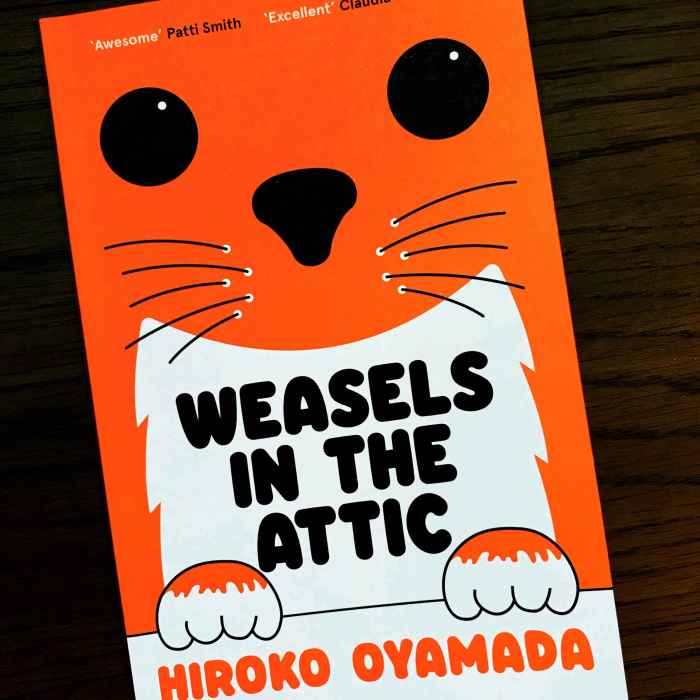
The UK debut of award-winning Japanese writer Hiroki Oyamada, here we have the slight work of Weasels in the Attic (2022).
Although only 80 pages long, its surreal narrative still manages to cram in a lot of action. With themes of fertility, masculinity, friendship, and marriage it’s a complex little tome about modern Japanese culture. Think Tanizaki’s Some Prefer Nettles (1929), but modernised with semi-surreal twists.
But one with an active tone between old friends, whose dinner discussions become increasingly warped, it makes for engaging reading.
Dusting Down Japanese Social Conventions in Weasels in the Attic
There are three sections to Weasels in the Attic. Each one is a different encounter between a couple and their two friends.
This is the first Oyamada work we’ve read, but her other works include The Hole and The Factory.
Apparently she has a style that doesn’t lean heavily into the absurd. More on the edge of plausibility; unlikely scenarios creating unusual situations. Just odd situations in general. For example, one of the friends in the book lives above an exotic fish shop.
Do you live above an exotic fish shop?
Exactly, that would be an odd place to live.
Another of the friends lives in the countryside in a house overrun by weasels. They also keep a room with scleropages jardinii (fish) in tanks.
Human idiosyncrasies, then, the surprising little twists that mark people out.
The narrative runs along interconnected, with the individuals meeting for dinners at different phases of their lives. One dinner party takes place during a blizzard, which paves the way for a dreamy night in a room of aquariums (more fish).
Along the way we get musings such as this.
“We meet at school, or work, or maybe a store. Wherever it is, there’s just a random group of individuals, right? Within that group, you find your mate. If you were in a different group, you’ d end up with a different mate, right? But we never dwell on that. We live our lives in the groups we have – in our cities, our countries, even though we didn’t choose them. Know what I mean? We like to tell ourselves it’s love, that we’re choosing our own partners. But in reality, we’re just playing the cards we’ve been dealt.”
The comparison to Tanizaki, we think, is relevant. The writer was fascinated (and troubled) by the direction of Japan in the early 20th century.
It led him to Some Prefer Nettles and the essay In Praise of Shadows (1933), which criticised then modern technology (such as lightbulbs and electrical gadgets) as invasive and psychologically damaging.
Weasels in the Attic represents a fully modernised Japan now, with all the bells and whistles of life. Tanizaki would hate it, but this is the way of things and Oyamada’s world conveys the preferences of Japan with its existing mindset.
This includes discussions on family life and having kids.
“I’m shocked,” I growled. The Saiki I knew wasn’t the type who voluntarily took care of any child—even his own. I was pretty sure he didn’t like kids. “Didn’t know he had it in him.”
“It isn’t like that for women… Every baby is adorable to us… Maybe it’s different for men. They only see their own babies that way. Sorry, I shouldn’t have…” Yoko looked at me and held one hand over her mouth.
“No,” I said. “Anyway, I think you’re right. Maybe it doesn’t affect us the same way. Maybe it should, but…”
Troubles and musings, of course, all of which is written from a man’s perspective. That’s the narration style Oyamada uses.
She just does this with a surreal approach, nudging towards uneasy situations and anxiety told out through heightening surrealism. It is, above everything else, a social commentary book—just one hidden behind an unusual title and an eye-catching front cover.
We enjoyed it, but certainly weren’t bowled over.
Oyamada is a great writer, but the story is so brief and vague. It’s an unexplainably bizarre story, mixed with musings on modern life, so if it sounds intriguing give it a whirl. You’ll read it within an hour.
The outcome? You’ll either fit it strange and endearing or plodding in its 80 pages and too quirky for its own good.
Goodreads Online Feedback to Weasels in the Attic
My copy is marked with strikethroughs and marginal notes like “not necessary,” “reader knows,” “timing is wrong.” You don’t need to be an editor like Gordon Lish (famous for cutting dialogue to bare bones) to find fault here. A reader who needs this long passage in order to relish the idea that someone might inadvertently eat fish food is a reader whose attention, whose capacity for imaginative engagement, is significantly different from mine. The book asks me to be a reader who does not pay full attention to the writing, who treats the story or novella format as a screenplay, storyboard, or graphic novel.
Out of interest, we had a look at the feedback for Oyamada’s work on Goodreads. It’s an online book community, kind of like a Facebook for readers.
There, as with the example above, you can find user reviews.
And that bloke didn’t hold back. Whilst criticising the work for unnecessary content, he uses unnecessary statements such as “in order to”… doesn’t he know about fillers!?!? You don’t need to be an editor such as Gordon Fish to understand that.
This sort of thing intrigues us. Most of the user reviews are on the 3/5 and 4/5 scales and are complimentary. That bloke totally went off on one, refusing to provide a score, and concluding his 753 word rant with:
As long as I’m likely to get some sour replies for my sourness, I’ll go a couple of steps farther. “Weasels in the Attic” has the kind of writing errors and missed possibilities that would be flagged by many literary magazines and MFA programs. New Directions should not have published it. Maybe publishers with the luxury of a good reputation should think twice about accepting projects like this one.
We’d like to flag up his opening sentence:
“As long as I’m likely to get some sour replies for my sourness, I’ll go a couple of steps farther.”
We mean, that’s a bollocks mess of a sentence right there. Very poor job.
Overall, it’s tempting to suggest his comment is a tad on the pompous side. But we’ll leave you to decide on that one.
Yet his prolixity does highlight just how subjective writing is.
We get it in our day job as content writers/copywriters. Some businesses react very well to your copy. Others almost literally foul themselves in horror and respond as if the apocalypse is upon them.
Our approach is much more relaxed about things.
To respond to Weasels in the Attic, the work of an award-winning writer, in the way that bloke did is really more about his egomania issues than anything else.
But as we’ve covered before with commenting on online comments, we continue to find the internet era’s capacity to let everyone have their say… well, it’s not always a good thing, eh?
