
There’s a maritime legend of the Friendly Floatees spill of 1992, where oceanographer Dr. Curtis Ebbesmeyer tracked some 28,800 rubber ducks as currents swept them around the world.
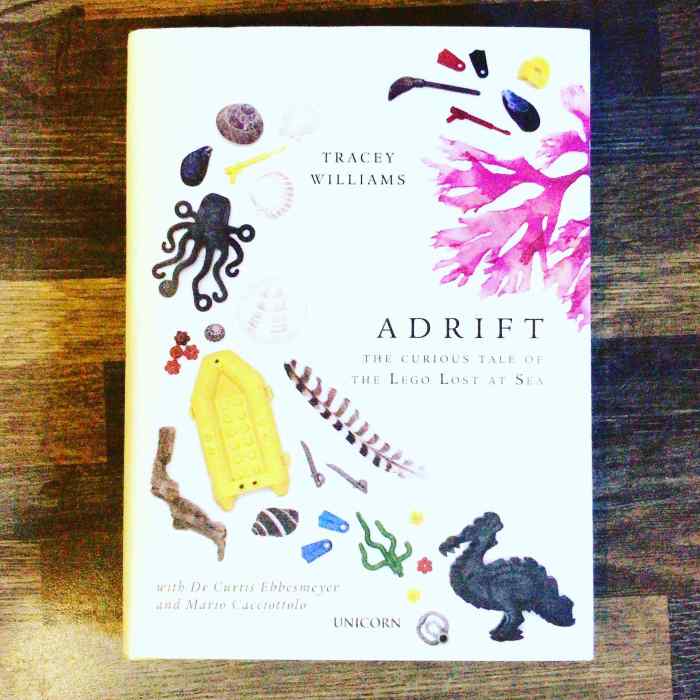
Adrift: The Curious Tale of the Lego Lost at Sea offers a similar story.
It’s about millions of tiny Lego pieces washing ashore across the UK, Europe, and worldwide. This acts as an insight into the modern nature of consumerism, pollution, and the fascination with beachcombing.
Beachcombing, Consumerism, and the Curious Tale of the Lego Lost at Sea
On the 23th February 1997 a storm off the coast of Cornwall knocked 62 cargo containers off the ship Tokio Express. With five million pieces of Lego lost to the water, all manner of
In a significant moment of irony, a huge proportion of the Lego pieces just so happened to have a theme of the sea.
“If you search carefully along the strandline after a wild winter storm, you might still find them. Tiny yellow life jackets and grey scuba tanks. Bright green plastic sea grass and little spear guns in red and yellow. Blue, black and red divers’ flippers and miniature cutlasses. Perhaps a dragon or an octopus, just 3 inches long. Maybe even a small yellow life raft. They’re from an armada of Lego that fell off a ship in 1997. And they’re still turning up today.”
Back in February 1997 it was a rogue wave that whacked the Tokio Express, causing it to tilt 60 degrees one way before 40 degrees back. Overboard went some 62 containers, one of which contained the five million bits of Lego.
The local press called it a “Lego Bonanza for Beach-Goers”.
Williams began collecting these items and in the early 2010s started a Facebook account about the cause. After BBC journalist Mario Cacciottolo ran a 2014 news story about the Lego, that’s when things really took off.
She now makes artistic arrangements out of plastic pieces she finds. These go up on Twitter like this, but are also featured heavily in the book.
— Lego Lost At Sea (@LegoLostAtSea) May 24, 2023
Dr. Curtis Ebbesmeyer enters the fray again here as he, as you’d expect, took an interest in the Lego spill. He notes in this book:
“Tracking currents is like tracking ghosts. You can’t see them; all you have to work with is where flotsam starts and where it ends up …
I’m often asked how long plastic can survive in the sea. Well, in 1944 a military aircraft crashed into the ocean near the Philippines and sixty years later a piece of plastic the size of a thumbnail from the plane was discovered in the stomach of a dead albatross chick, which is a sad reality of what plastic pollution can do to wildlife.”
Such is the scale of the pollution, environmentalist and artist Rob Arnold gathered 25 million pieces of plastic between 2017 and 2020.
He turned these into a plastic Moai Easter Island replica head to demonstrate the extent of human pollution.
That’s kind of what’s at the heart of this great little book. People turning a rather stark and disturbing reminder of mass pollution into something thought-provoking.
Adrift: The Curious Tale of the Lego Lost at Sea in one part is about artistic expression. There’s something uniquely artistic about these little Lego pieces lost at sea for 25 years and then being turned into flotsam pieces.
Yet the message behind them is awful.
This is just the stuff that washes up on a few beaches in Cornwall, England. Think of the mass scale mess across the rest of the world. And the billions of plastic pieces that don’t wind up on beaches and just clog up the oceans.
It’s alarming stuff, presented in an accessible book for all ages.
For adults with young kids concerned about the future regarding climate crisis etc., this is a wonderful book to take your children through.
Adrift: The Curious Tale of the Lego Lost at Sea is vibrant and tells a fantastic story of environmentalists and scientists uniting to do something good.
At the same time, it’s a lesson about the dangers of capitalist excess. Lots of people like to ignore this issue and pretend it’s not there, but this plastic will come back to bite humanity on the ass in 100+ years unless the situation changes.
We can see The Curious Tale of the Lego Lost at Sea standing as something of a polite warning to history on the steps that, most likely, won’t be taken to avoid worse pollution.
A Bit About the Friendly Floatees Spill (🦆)
There’s nothing better than a massive consignment of rubber ducks abandoning ship and making a break for it on the open seas.
That’s what the Friendly Floatees spill was all about.
Whilst it does make for an amusing story, it also highlights the pointlessness of modern capitalism. We’re so used to this now, and it happens away from the public conscience, but millions of tonnes of pointless crap is shipped across the Earths’ oceans annually.
Spills and wider pollution issues also created the Great Pacific Garbage Patch.
It’s a massive wodge of debris that covers around 1.6 million square kilometres and some 45,000-129,000 metric tonnes of trash.
The Friendly Floatees spill is accessible for people as it’s cute yellow rubber duckies. That massive patch of crap floating across the Pacific isn’t quite as appealing.
Dr. Ebbesmeyer did at least use the ducks to develop a computer modelling system to track, and then predict, the movements of the Earth’s ocean currents.
Some of these ducks even floated over the location of the Titanic’s final resting spot. Others ended up frozen in Arctic ice, before melting it heading off to the American Eastern Seaboard and the UK.
You have to presume they’ll be out there for 100s more years, floating about the place for curious future generations to discover.
A rubber duck from the past. Truly, that’ll teach those future people we had our priorities set right in our era. Rubber ducks for one and all! Quack. 🦆
