
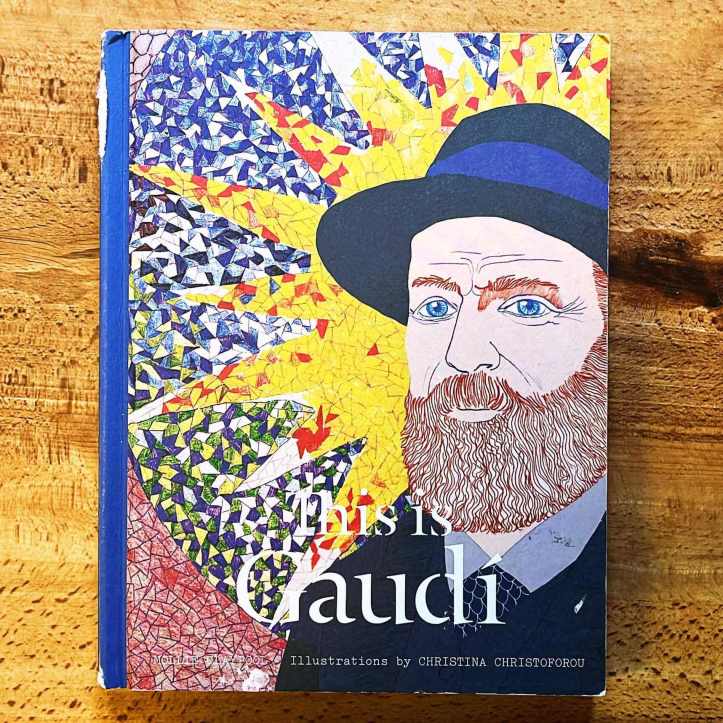
Here we have This is Gaudí (2017) by Mollie Claypool, a work on the life of Catalan architect Antoni Gaudí i Cornet (1852-1926). His reputation for being reclusive and eccentric was backed by a devotion to religion and nature, which contributed to his shaping the Modernisme movement.
Claypool’s brief artbook is a colourful insight into Gaudí’s life and times, his unusual hermetic behaviour, and the lasting legacy of his architectural achievements. Let’s have a gander, then, at all this wonder.
The Spectacular Architecture of This is Gaudí
“Antoni Gaudí produced one of the strangest and most unorthodox architectural legacies to be found in the modern period. At his graduation from the University of Barcelona’s School of Architecture in 1878, the director Elies Rogent exclaimed, ‘Gentlemen, we are here today either in the presence of a genius or a madman!
During his lifetime he did become known as ‘that mad, monkish architect’ – and response to Gaudi’s work was always drawn along the lines of love or hate. There was rarely a middle ground. The Bauhaus radical writer Walter Gropius considered Gaudí a technical genius, but Pablo Picasso thought him a sanctimonious reactionary.”
That sets the scene in Claypool’s opening paragraphs. The loner, genius artist is part of the romanticism some people lean into with all of this stuff. Whether with Vincent van Gogh or (as we’ve covered before) the lunacy around Caravaggio’s artistic genius.
Gaudí’s work is still very much present. If you go to Barcelona, there are around 20 buildings (employing the sui generis style, meaning “of their own kind”) still standing from his day. These include:
- El Capricho
- Casa Vicens
- Güell Pavilions
- Casa Botines
- Bodegas Güell
- Sagrada Familia (the world’s tallest church)
- Casa Batlló
If you have a look around online you’ll find many images of his work. But look at Casa Batlló (The Dragon House), located in the centre of Barcelona, and you’ll see immediately with this architect is so iconic.
Claypool explores how he came to have these vibrant ideas. His first work post-university was on a set of lampposts (commissioned by city of Barcelona in 1878).
With his style already having been influenced by English polymath John Ruskin, French restorationist Eugène Viollet-le-Duc, and Owen Jones’ work The Grammar of Ornament (1856). Gaudí used the city’s colours of red, gold, and blue. The city was impressed and more work followed.
In 1883, he designed what became the Casa Vicens. This was his first major building in Barcelona, so has a particular resonance with his fans. This was the architect starting to stretch his legs, kind of thing.
Casa Vicens also brought about scrutiny on his professional style.
“Gaudí’s working habits first came under proper scrutiny during tis project – and myths about them (often true!) would follow him for the rest of his life. At Casa Vicens, he would tear down walls and build them elsewhere in a single day, completely contradictory to the normal practice of constructing according to carefully drawn-up plans. [It] was much more of an organic process. It was rumoured this approach almost bankrupted his client, but the men remained close friends.”
His confidence growing, Gaudí would go on to experiment with parabolic extremes, pillar structures, undulating surfaces, and intriguing colour combinations.
This is Gaudí (part of an accessible This Is series of artbooks) is a fun and enjoyable work, ideally suited as an introduction to the man and his legacy. It doesn’t expert his character extensively, so we dug around a bit further to understand where the Catalonian was coming from.
Notes on Gaudí’s Unusual Personality
The architect was self-aware and upfront about his impulsive characteristics, which he had tried to control (with limited success).
He changed a great deal across his life, being a stylish young man concerned about his appearance and enjoying high society living, before becoming increasingly reclusive and unkempt as he got older.
In Cada Batlló’s Guadi feature, it states this.
“In a progressive withdrawal from his social life, Gaudí, who in his youth had frequented theaters, concerts, and gatherings, went from being a young dandy with gourmet tastes to neglecting his personal appearance, eating frugally, and distancing himself from social life while dedicating himself with more fervor to a mystical and religious feeling, focusing exclusively on the Sagrada Família.”
In later life, his appearance was so poor he was sometimes believed to be a beggar.
He’d adopted vegetarianism as a young man to combat health problems such as rheumatism which, backed by his deeply religious state, led to periods of ritualistic habits such as fasting. These were severe and almost led to an early death in 1894.
Gaudí also remained single for his entire life. There are no records of any relationship with women. He instead turned to religion and obsessed over his grand church structure Sagrada Família. Construction began in 1882 under the vision of one Francisco de Paula del Villar, but Gaudí took over the project in 1883 and made major changes (notably with Gothic and Art Nouveau themes). It was unfinished during his lifetime.
This building was loved by the architect and he frequented it regularly.
In early June 1926 (at age 73), he was struck by a tram. Again, as his appearance was gaunt and he appeared homeless, many citizens thought little of it. He lay unconscious in the street for some time and, upon arriving to hospital, received care until his death on 10th June.
As the architect never underwent any psychological examinations, with that sort of thing very limited anyway during his era, there are now suggestions he could have been autistic. A May 2024 thesis by Micheal Fitzgerald (Autism and Antoni Gaudi – God’s architect) argues.
“Gaudí was a genius and a most extraordinary artistic architect. He was very well trained but also used the autistic collage technique, particularly in finishing his structures. He was eccentric, enigmatic, ritualistic, egocentric, incredibly singular, with preservation of sameness, narrow interests and social relationship issues. He was massively visual and had a tremendous capacity for visual memory. He was rigid and had an autistic superego.”
That’s up for debate, but for neurodevelopmental conditions you look for extremes in behaviour. And little about Gaudí’s life fitted into social norms.
Take a Tour of Gaudí’s Barcelona
Almost 100 years after his passing and the work of this visionary still dominates Barcelona’s tourism spots. His legacy in architecture is also very influential.
It takes a unique mind to be so far ahead of everyone else and there’s no denying, just looking at his structures, there’s something captivating about them.
Unfortunately, the Spanish Civil War of 1936 led to much destruction across the country, with Gaudí’s original Barcelona workshop destroyed (along with many of his original paperwork, sketches, and drawings).
Despite that loss, there are still plenty of his buildings around. Plus, the Gaudí House Museum that operates at Parc Güell, Gràcia, 08013 Barcelona.

A wonderful review! Thank you 😊
LikeLiked by 1 person
Ta very much! The secret to great architecture? Pillars, angles, colour, and being weird. 👍
LikeLiked by 1 person
A super combination!
LikeLiked by 1 person