
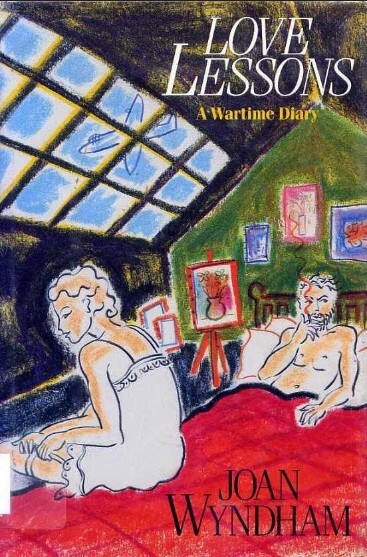
During the week we watched the 2025 Netflix Documentary Britain and the Blitz, directed by Ella Wright. The bombing campaign from the far-right Nazi Germany and Fascist Italy began on 7th September 1940 and ran through to May 1941.
Various witness accounts are included in the documentary. The one that piqued our interest was that of 17 year old art student Joan Wyndham, who kept a diary during the bombings of her dating antics.
After WWII she moved on with her life, but in the early 1980s her daughter encouraged her to have the works published. They were in 1985 and 1986, capturing a unique moment in history.
Joan Wyndham: Love Lessons and Love is Blue
Joan Wyndham (1921-2007) was living in Fulham when The Blitz began. During the war she worked in the Women’s Auxiliary Air Force (WAAF) and led an active social life (when possible), which included entering London’s Bohemian lifestyle set.
A good looking young woman, the diary entries documented her dating life and fears about the war.
“The tempo’s speeding up. Tonight the blitz started. The sky over by the docks was red as if it was an enormous sunset. What a life! Never knowing if you’re going to be bombed or seduced from one moment to the next … I can’t help feeling that each moment may be my last. And as the opposite of death is life, I think I shall get seduced by Rupert tomorrow.”
The documentary particularly notes her exploits with the “caddish” Rupert who lived next door to her. But her two books cover various other men, notably creative types in artistic circles (she had a place at the Royal Academy of Dramatic Arts in 1938).
What interested us here is Wyndham’s focus on keeping a somewhat normal life in amongst the chaos, sizing up men she thought were worthwhile of her time. All whilst this carnage was playing out night after night.
The Britain and the Blitz documentary notes that, after a while, the public stopped giving much of a toss about the mayhem. A kind of denial meets gallows humour and existential acceptance. Londoners partied hard and, in particular on one heavy night of bombing, were too busy drinking and dancing to give a damn.
It’s fairly standard with the human condition, we believe, as a similar outcome occurred with the Black Death and its subsequent outbreaks (once every decade or so) during Medieval times.
The public became so used to the outbreaks, and what it meant, they took a more fast and loose approach to life. Cultural records (paintings, plays) are more frivolous, suggesting more people were burning the candle at both ends to make the most of what life may be available to them (i.e. a bit of hedonism).
Some of Wyndham’s writing reflect that hedonism, but in a kind of Carry On films, Some Mothers Do ‘Ave ’em, “Oooh Betty” sort of stuff.
“I lay on the sofa with Rupert and got into some rather peculiar positions, howling: ‘I wanna seduce you, I wanna seduce you!’ At that interesting moment, the sirens blew off. I jumped up to check the black-out, pulling my blouse on and looking for my shoes. ‘Gosh!’ I said, ‘Mummy thought I’d be back by ten!’ Rupert didn’t answer. He was lying on the bed, face downwards making strange groaning noises. As I was walking home, I heard bombs in the distance and flares.”
It paints a more fun, friendly aspect of life under The Blitz. Even if Wyndham’s version is a little kitsch at times. But keep in mind Anne Frank’s iconic diary, she shared details (dated April 1944, when hiding in the Secret Annex) of her first kiss with Peter van Pels.
Early in her diary she boasts confidently about her many male admirers at her school.
It’s another glimpse into the lives of young people and their emotional reckoning with an unprecedented situation. Humanity in extremes.
But Love Lessons is a step further, with clear signs of the self-confidence and newfound female liberation WWII allowed. With a lot of men off fighting, women could step up to prove they aren’t just objects for the male gaze.
It’s not clear how heavily edited the finished diary entries are, but there are more candid moments of reflection and potential doom. But we’ve seen some book critics offer a not so favourable review of Love Lessons (see Captive Reader):
“The writing throughout is good, though I suspect the diaries were heavily edited/rewritten for publication. There is too much dialogue to seem natural in a diary format and every so often the older author obviously inserts herself to provide hindsight commentary (such as “this was the night that such-and-such famous event occurred”. Why this wasn’t done in a footnote I have no idea). Frustratingly, the entries aren’t properly dated – they have the day of the week and the day of the month but generally not the month itself or the year.”
After WWII, Joan Wyndham moved on with life and didn’t do anything with the diaries.
And so they sat there, in increasing disarray, for 40 years. Up until one of Wyndham’s younger daughters found them and suggested they be edited and published. The London-based publisher William Heinemann, Ltd. (now defunct) launched Love Lessons in 1985 and then Love Is Blue followed in 1986.
It stayed vaguely on the public conscience, as there was a BBC Radio 4 series of 10 episodes narrated by Prunella Scales. That went out in February 1999. It was adapted again in December 2003.
The first time we heard of Wyndham was in the Netflix documentary (her diary entries appear frequently).
There’s something about her youthful take on the war that’s reassuring. She had no idea if she’d live to see 20 and balanced out that visceral fear with an intensified focus on teenage impulses. It’s an act of defiance, really, living for the moment and finding fun in even one of the darkest moments of human history.
