
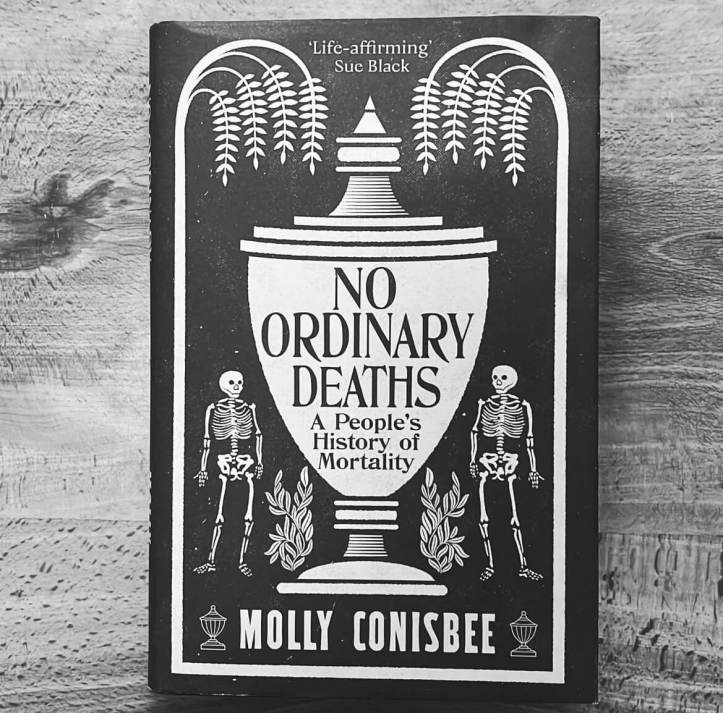
First published in May 2025, this intriguing work is by the social historian Molly Conisbee. No Ordinary Deaths: A People’s History of Mortality examines historical records of ordinary people who died across the last 500+ years, using all available records to piece together a sense of their existence.
Across human history, it’s the big names who dominate the nature of death. From King Henry VIII to Cleopatra or Tutankhamen, they’re the kings, queens, or famous folks whose status got them nailed into posterity.
But what of the everyday people? The billions who have lived, died, and have fallen into obscurity? That’s where this book enters the fray, allowing us a glimpse into the lost lives of the distant past.
No Ordinary Deaths: A People’s History of Mortality
“The people in this book did not live and die as statistics. They lived and loved, had and lost children, worked and struggled, and, as most of us will, died in obscurity. In the following pages we reanimate them, to explore how they, and their families, friends, and communities, responded to death.”
On 11th July 1184, in the German city of Erfurt, the floor of a building collapsed. It plunged 60 local nobles through the ground floor and into the cesspit below it, where some of them drowned in effluence.
This darkly absurd fate is called the Erfurt Latrine Disaster. We know this as the Chronicle of Saint Peter’s in Erfurt, which ran from 1072 to 1335, recorded the incident and listed some of the dead:
- Count Friedrich I of Abenberg
- Count Heinrich I of Schwarzburg
- Count Gozmar III of Ziegenhain
- Gozmar’s brother-in-law Burgrave Friedrich I of Kirchberg
- Count Burchard of Wartburg, Behringer von Wellingen
There you have five men who were born, grew up, had families, different personalities, and were probably having a decent time of it until that flooring gave way on them. Yet we know nothing about them. They’re just names lost to time.
Their stories aren’t included in Molly Conisbee’s book, but we feel its inclusion conveys what Conisbee has done with this excellent book. Conisbee’s focus is on the history of details. With meticulous research, she uncovers real people, digs deep into available records, a provides a sense of who these men and women likely were.
A lot of people over the ages have met an unfortunate end, whether through infection that’d now be easily averted, during childbirth, or drowning in excrement. Most are lost to time.
But available historical records in the UK show there was some attempt at maintaining evidence of lived lives In the Medieval era, for example, churches and local parishes kept written records of local citizens. Many of these records have been lost to time, but the ones that remain have allowed Conisbee to discover what people made of it all back then.
“Although we will all die, the ways in which we do so are historically, socially, and culturally located. As medical certification of death did not become a legal requirement until 1837, and even then, was sometimes rather vague I have seen death certificates that say things like ‘decline’, ‘apoplexy’, ‘Act of God’, all which could cover a host of conditions – much of our information about historical causes of death has come from burial excavations, forensic archaeology, contemporary medical accounts, and epidemiological studies.”
If you’re wondering why we picked this booked up, we picked up a copy at London’s excellent Wellcome Museum (see No Ordinary Deaths). The museum interviewed Conisbee on-site in the reading room we recognise near the top of the building.
As it’s a medical museum dedicated to curiosities, we’ve picked up some excellent anatomical books there. Not least in Roy Porter’s brilliant Blood and Guts: A Short History of Medicine (2002). As, you know, it’s important to aware and open about this sort of stuff.
Conisbee’s work is far from a miserable time of it, by the way, it’s a life-affirming tale of lives lived and the minor triumphs through the ages. There are 11 chapters, ranging across:
- Body and Soul
- Disembodied
- Cwylnos/Wake
- Funeral
- Memorial
- Afterlife
But what interested us most about No Ordinary Deaths is the examination of distant people from the past.
It’s only in the last 150 years or so that photography and audio/film recording devices have come to be. In the present day, we can look back to around 1838 and see the very first photographs. One of the first portrait pictures dates to 1839 and is of American photographer Robert Cornelius.
Yet for the first time, future generations will be able to look back at our era and get a thorough understanding of how many of us got by. This blog we’ve run since 2012, for example, if it’s still around online in 100 years. Well, people can read it, study it, hand us a belated Nobel Prize, and also deem the site to be run by professional morons.
But not so for 300, 500, 700, or 1,000 years ago.
It’s frustrating that so much of human history has no written records, or those that were available were destroyed or lost, and yet here we have Conisbee digging deep to piece together various lives from the past. And this is a big part of the appeal of the book for us, seeing her research process in action and the subsequent results.
Luce Scely: Devon’s Records in 1558
“As with many other Devon records, the manorial pre-1558 parish registers for Morebath were destroyed during the bombing of Exeter in 1942. A further complication when trying to unpick the genealogical bramble patch of even a small village like Morebath in the sixteenth century are inconsistencies in spellings of names, multiple people with the same name, and a flexible use of surnames and descriptors. A person might be referred to by their job (John the carpenter), by their location or property (Mary at Bartonhill), and women were sometimes identified by their father’s or husband’s first or second names. Sometimes several family members had the same name – try reading the famous Norfolk Paston family letters written between 1422 and 1509 and keeping track of which ‘John’ is being referred to. The nomenclature doubtless all made perfect sense if you were part of said community, but several hundred years later some nifty historical detective work is needed to work out who was who.”
The vicar in Morebath, Sir Christopher Trychay, kept very detailed records about life in the village. His tenure ran from 1520 to 1574, including one woman called Luce Scely/Luce at Myll. Likely born around December 1500, she lived in Morebath as a peasant woman and knew Trychay.
Her husband was the village miller and was called William. She worked as a churchwarden, organiser, and fundraiser.
Trychay’s story was documented in the 2001 history book The Voices of Morebath: Reformation and Rebellion in an English Village by Eamon Duffy. To note, Sir Christopher Trychay was a notable priest (he died in 1574) and now has a Wikipedia page dedicated to him.
His churchwarden accounts are a vital historic record, detailing England’s shift from medieval Catholic congregations into the Church of England. This caused major religious and political upheaval.
In 1549, there was an uprising against religious reforms. Called the Prayer Book Rebellion, Trychay actually took sides with locals over the government (as seen in his preserved written account below). He sent five young men from the village to be a part of the rebellion: William Hurley, Thomas Borrage, John Timewell, Christopher Morsse, and Robert Zaer.
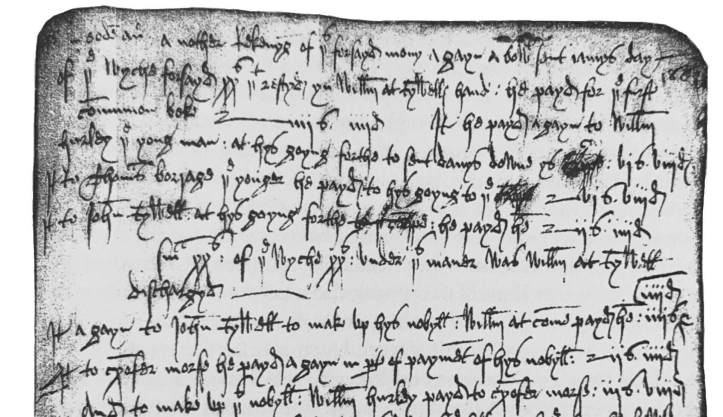
In August of 1549, the rebellion was crushed violently by the British government and in mid-August of 1549 the bodies of peasants lined up across highways all the way up to Bath. Such was the hideous way of things in the Tudor times.
But it’s interesting, then, that a man of his status, a man of the cloth, could criticise the government and not face ramifications.
As for Luce, after her husband died she infuriated Trychay by selling off church goods to cover familial costs. The date of her death is unclear, but Conisbee notes:
“Almost everything about her life would seem alien to most of us today: the limitations of her diet and dress, her lack of formal education, the sheer effort it took for her to keep clean, warm and dry, the extent to which her day-to-day was determined by the needs and expectations of the church and an inextricably intertwined community utterly dependent on one another for survival.”
This example is early on in the book. There are few details of Luce beyond her general work and marriage status. Her age at the time of her death is lost to history. But this is why she’s ideal for No Ordinary Deaths.
Barely a statistic lost to in time, uncovered 500+ years later by chance in this book. So, for a brief moment, reading Luce’s story brought her back to life. Intriguing, non?
As for this book, if it sounds bleak and macabre then that’s the wrong take. It’s a celebration of life and well worth your reading time.
