
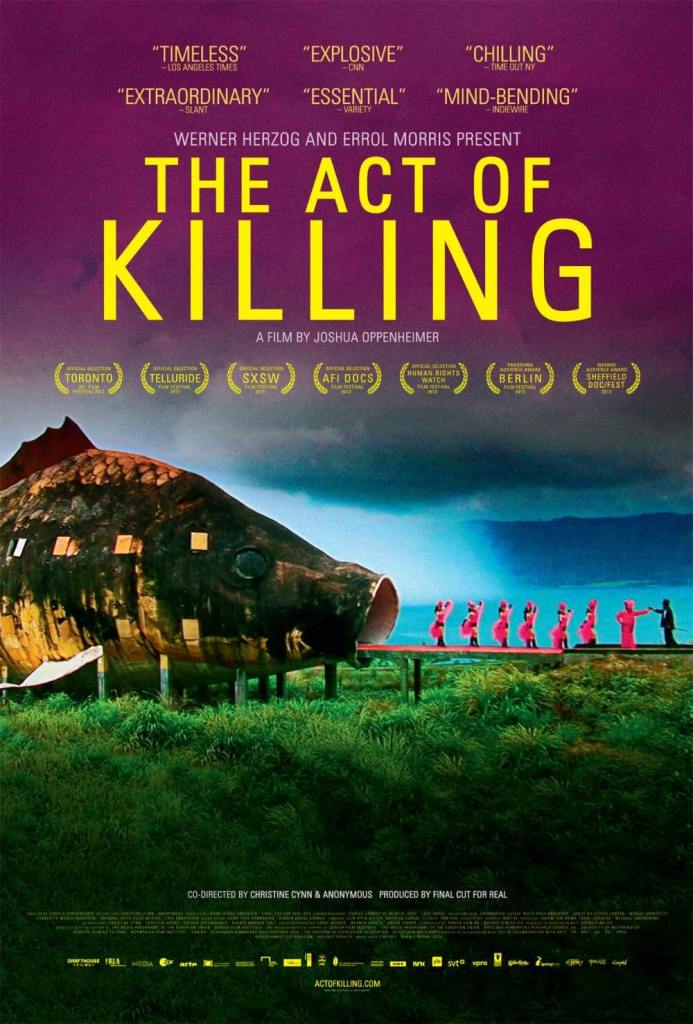
This is a haunting 2012 documentary by American-British director Joshua Oppenheimer. The Act of Killing follows a group of individuals involved in the 1965-1966 Indonesian mass killings of “communists”.
The main focus is Anwar Congo (1937-2019). The documentary explores his feelings 30+ years after the event, where he re-enacts torture/execution methods onscreen. What initially starts as an ego boost turns into a reality check where his past finally catches up with him.
Exploring the Delusions of Murderers in The Act of Killing
Between October 1965 and March 1966, civil unrest and large-scale killings occurred in Indonesia. These were instigated by the Indonesia Army under the general Suharto (1921-2008). In the violent politicide that occurred, anyone deemed as a “communist” was tortured and killed.
This extended to atheists, the ethnic Chinese, anyone with any sort of left-wing leaning, and trade unionists. Basically, it was a free-for-all with a far-right regime wiping out anyone at random (to this day, this event is left out of national Indonesian textbooks).
Hired thugs were used for some of the killings. Anwar Congo is one, but some focus is also provided to his bizarre friend Herman Koto.
Oppenheimer began filming around 2005 and this ran through to around 2010. The result is a window into the psyche of individuals involved in genocide. Whilst sporadically visiting Congo in Indonesia over several years, Oppenheimer encouraged Congo and his cohorts to re-enact how they went about murdering their victims. With full creative licence to do whatever they want.
This means we get to see people justifying their actions and wallowing in a world of denial and narcissism.
It’s an absurd documentary at times, driven by Congo and Koto’s various delusions. One scene shows him standing blissfully by a waterfall whilst meditating, whilst ghosts of the people he killed thank him for sending them to heaven.
But then, towards the end of the film, through the re-enactments Congo has a twinge of self-awareness. It dawns on him that he may have caused a lot of suffering.
The end of the film has an astonishing conclusion, where his subconscious rears itself and the full reality hits home. Over five minutes onscreen, he’s left retching and dry heaving as he attempts to process what he’s done. It reminds us of the ending of the modern classic Zone of Interest (2023), where in the final scenes Rudolf Höss (responsible for overseeing daily life in Auschwitz) is seen retching over the floor.
We watched the director’s cut of The Act of Killing, which is a gruelling three hours to spend with these people. It’s unquestionably one of the best documentaries we’ve ever seen, but it’s also one we’ll only ever watch once.
It’s also no surprise the documentary has been studied by scholars, in part for its unique filmmaking approach, but also to document the reasons for genocidal behaviour.
The Production of The Act of Killing
As with most documentaries, the film wasn’t a box office smash. It made $722,714 off its $1 million budget. Most documentaries go on to make their money back via rentals and physical media purchases.
It was a big critical hit, winning the 2013 European Film Award for Best Documentary.
Although the film showed with no problems outside the US, the tense political situation in Indonesia made it difficult to screen the film. The chances of it being banned were high, plus any citizens who watched it could be persecuted. However, it did get a run in late 2012 thanks to screenings by the National Commission on Human Rights (Komnas HAM).
Then in 2013 it had a much wider release, including on DVD, with the documentary also available for free on YouTube.
For the filming process, it was difficult and Oppenheimer found it psychologically exhausting. Once the film was complete, he showed a rough cut to Werner Herzog and Errol Morris and they took executive producer roles to help finalise the publish the documentary.
However, many of the Indonesian crew who helped complete the project are listed as ANONYMOUS across the closing credits. All of which makes for one of the most alarming, unusual, inventive, and important viewing experiences you’ll ever have.
