
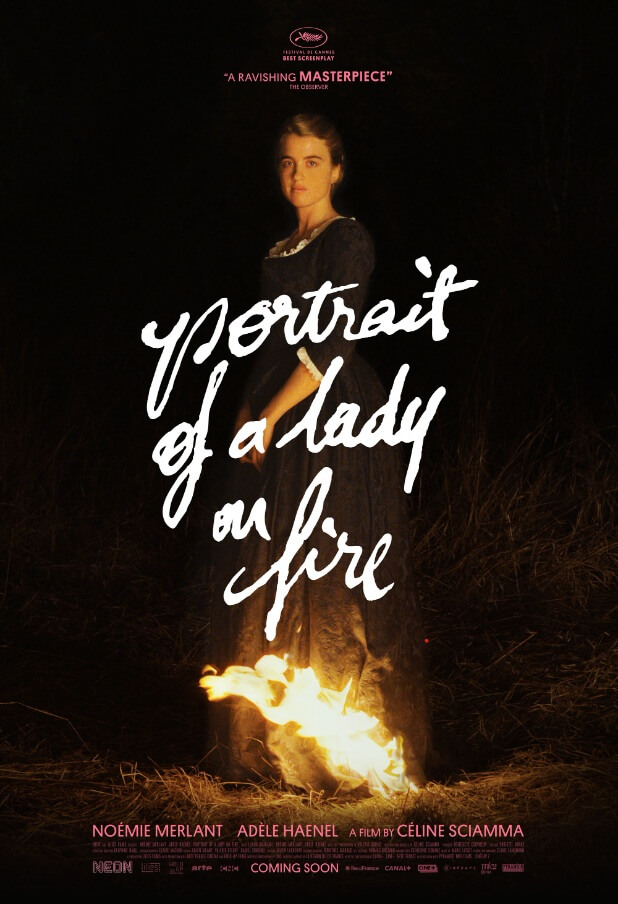
Wow, well this is a masterpiece. Portrait of a Lady on Fire (Portrait de la jeune fille en feu) was written and directed by Céline Sciamma and launched in autumn of 2019. In 2022, it was voted the 30th greatest film of all time in a Sight & Sound poll.
Rightly so, but it annoys us it took so long to finally watch it. Well worth the wait as its lead actors, Noémie Merlant and Adèle Haenel, are outstanding and this is a love story for the ages.
The Female Gaze in Portrait of a Lady on Fire
Set in the 18th century, we find the painter Marianne (Noémie Merlant) heading to an island off Brittany. She’s commissioned to paint a portrait of gentry woman Héloïse (Adèle Haenel), whose Countess mother (Valeria Golino) needs to marry off into a rich Italian nobleman’s life.
The portrait must be very good so it convinces the man to take Héloïse’s hand in marriage.
However, the problem is Héloïse has refused to pose for any portraits. She’s depressed her life is simply about being married off to some rich bloke. To get around the refusal, Marianne is hired to surreptitiously spend time with Héloïse, memorise her features, and do the painting.
In time, the pair bond and Héloïse even agrees to pose for the portrait.
She and Marianne begin to fall in love, with the big problem being it’s 18th century France and not socially acceptable. When Héloïse’s mother must briefly leave the island, they’re able to spend five days together. But all with the knowledge they’ll be parted from each other forever once the Countess returns.
Of which, much has been written elsewhere online about the female gaze. The two lead characters have agency, but are ultimately restrained by tedious social conventions (sadly, to devastating effect).
We’re not adding in any scenes to this review, but we’re going to going to highlight how stunning the film is thanks to cinematography by Claire Mathon.
Now, we’re sure some types watched the film in 2019 and found it “boring” or whatever as there aren’t car chases and explosions. But in terms of a slow burner tragic love story, Portrait of a Lady on Fire is a modern classic.
Everything about it is perfect from start to finish, which is rare in any form of culture.
Alongside the brilliant performances and excellent script, the little details make it stand out. We didn’t notice until after the film, but there’s almost no music at all. There’s a segment from a single written for the production called La Jeune Fille en Feu, which is a capella. Plus, twice Summer from Vivaldi’s Four Seasons is used in the film (the second time to devastating effect).
The frequent peace and quiet lends itself to the conclusion of the narrative. Thinking of other modern classics, Portrait of a Lady on Fire’s ending is as emotionally devastating as the finale to Charlotte Well’s Aftersun (2022). Wherever we go online to look at feedback from film fans, the discussion point is all about director Céline Sciamma’s ending.
It’s an incredible demonstration of Adèle Haenel’s acting abilities and is a closing scene for the ages. Sadly, Haenel retired from the film industry in 2023 as a protest against ingrained sexism and patriarchy. She now works in theatre.
And that does, abruptly, cut back to the core nature of what the film is about. How ingrained sexism in society prevents two people from leading the lives they want to lead.
Very possibly the best film of the 2010s, then, and one to watch in total concertation.
The Production of Portrait of a Lady on Fire
Off its €4.48 million budget the film made €8.48 million at the global box office. However, it was a big critical hit at Cannes Film Festival and was picked as one of three films by the French Ministry of Culture for entry to the 2020 Academy Awards.
However, it was Ladj Ly’s adaptation of Les Miserables that was ultimately submitted.
Of course, the Oscars isn’t about what is the best film in any given year, but if there was any justice Portrait of a Lady on Fire would’ve swept the board and won everything. The Women Film Critics Circle awarded it a bunch of gongs, though, and it won the Queer Palm award at Cannes.
Plus, our favourite film critic (Dr. Mark Kermode) had this to say.
The film was shot across October and November 2018 with everything wrapped up in 38 days. The commune of Saint-Pierre-Quiberon in Brittany was used for external shots, with a château in La Chapelle-Gauthier in Seine-et-Marne for the indoor shots.
Saint-Pierre-Quibero is classically French in every single way. Very peaceful looking and sleepy, in that quaint French way where it feels like no one actually lives there (or they’re just hiding from you).
Anyway, seven years after its release and the film is now considered an outright classic. Certainly, it’s one of the best films we’ve seen this century and we can highly recommend you indulge in its luxuries.

I watched this very beautiful film. Classic indeed.
LikeLiked by 1 person
Yes! There’s a special edition Blu-ray release coming up in October. Be sure to get yourself a copy.
LikeLike