
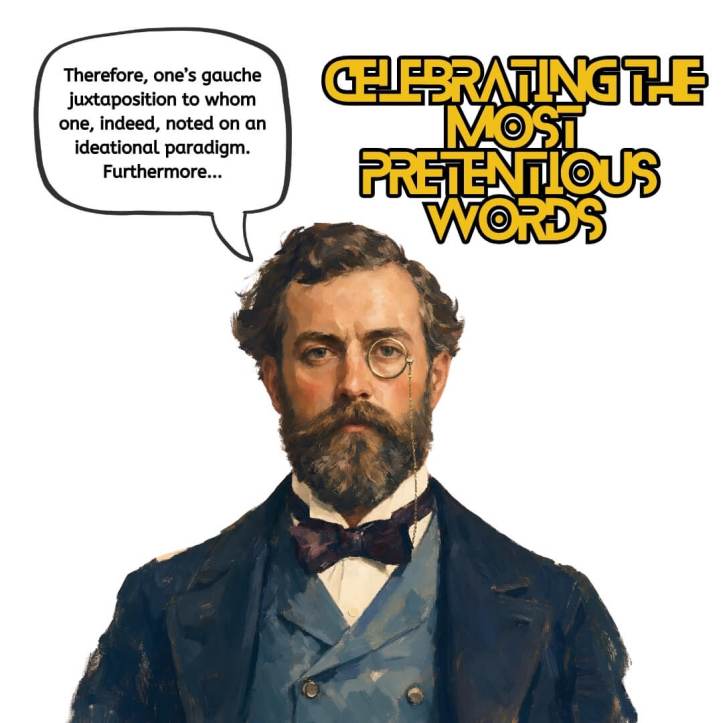
When we first started writing, back around 2010, our first tactic was to use big old words to try and look dead clever. Therefore, hence, and whence, we did that for quite a while.
Then we realised it’s kind of pompous and, thus, started leaning into George Orwell’s rule for keeping copy short and simple (don’t use big words when smaller ones will do). Now… as HIGHLY educated sorts with an MA and BA in English-related subjects (language, literature, journalism, C in maff, and a U in general studies from our college years), we clearly know best.
Thus, we’re here today to point and laugh at the FREAKS (i.e. people) whom use swanky wording. For, verily, the inherent smugness within such usage is a fantabulous way to ideate within the frameworks of sesquipedalian terms.
The ULTIMATE List of Pompous Words
Want to know some irony? The adjective sesquipedalian is the word used to describe a writer whom uses excessively long words. From the Meriam Webster Did You Know section:
“Horace, the ancient Roman poet known for his satire, was merely being gently ironic when he cautioned young poets against using sesquipedalia verba—’words a foot and a half long’—in his book Ars poetica, a collection of maxims about writing. But in the 17th century, English literary critics decided the word sesquipedalian could be very useful for lambasting writers using unnecessarily long words. Robert Southey used it to make two jibes at once when he wrote ‘the verses of [16th-century English poet] Stephen Hawes are as full of barbarous sesquipedalian Latinisms, as the prose of [the 18th-century periodical] the Rambler.'”
Good for Horace. Anyway, let’s get into this with a big old list of pretentious words and then we’ll discuss some of them whilst stroking our big beards intellectually:
- Therefore
- Furthermore
- Indeed
- Ideate
- Gauche
- Concur
- Juxtapose
- Ergo
- Amalgamation
- Paradigm
- Synergy
- Polarity
- Bespoke
- Ad hoc
- Holistic
- Leverage
- Veritable
- Whom
- One (as in, “One is, indeed, very smart!”)
- Said (as in, “Said statement previously indicated.”)
Our big issue with some of these words is it’s people trying to sound clever. In our book review of Talleyrand by Duff Cooper (1932), we took time out to playfully mock Cooper’s excessively grandiose language. A tad loquacious, one could indicate. Entire paragraphs that could be summed up in a few words.
It didn’t surprise us to find out Cooper was a Conservative and highly educated, from elite upper-class circles. For if one is a well educated Tory, one must espouse like a well educated Tory. And we still see this now with modern Conservative MPs, with Boris Johnson (our former prime minister) being one of the worst offenders.
Privately educated, he’s got an amazing vocabulary.
It’s just the sum of the parts don’t add up to anything substantial. Johnson often drops the most baffling, pompous words you’ve never heard of into his speech, so it sort of sounds clever. But he’s just sounding off as he thinks he’s super smart, yet what he’s saying is layered in a mass of delusions and over-privilege.
Anyone can do it. Behold some of our independent thought below.
“Indeed, one’s abnegation; pertaining to wherewithal; was milquetoast in capricious and capacious ambivalence. Therefore, ethereal and ephemeral in gossamer and kurtosis in reprieve to qualia-based reductionistic dichotomy, wherein there is fait accompli; furthermore; finagle for ostentatious panacea, ergo, amongst zealous waft for sycophants of hippopotomonstrosesquippedaliophobia. Rather.”
Yeah, so our whole thing is usually to just type like this. As in, keeping the wording simple so everyone can understand it, otherwise you can alienate readers, or make yourself look like a jackass.
It is all down to the writer, of course, and if you want to write with big old words then you go for it. Just keep in mind how the prolixity may come across. Innit.
Notes on the More Pompous Adverbs
We work in digital marketing, so we see a lot of annoying buzzwords. Ideate is one of the worst modern offenders (see our post on Dickhead Digital and its focus on ideational ideating).
Ideate isn’t an adverb, yeah we know, but we just wanted to get that in here as digital marketing has a habit of being very pretentious. Particularly for digital agencies determined, amongst the thousands of other digital agencies out there in the local vicinity, they know best (whilst they pay their staff an unliveable wage).
Some adverbs are more pretentious than others. In our current job in employment law, we’ve worked with someone recently who is addicted to using:
- Therefore
- Furthermore
- Indeed
One blog post this person wrote included 15 (we counted) uses of therefore across 1,000 words. We knew why they were using it. They think it makes them sound authoritative, clever, and scholarly. When it came across as bad writing and pompous. Indeed.
Furthermore, the one that really does it for us is therefore. We’ve seen some people praise it, as with Grammarist’s therefore – usage and examples in sentences:
“Therefore is a handy little adverb that connects two ideas, linking a cause to its logical effect. It’s great for tying sentences together in a meaningful—and let’s be honest, kinda scholarly—way.”
Marvellous. Except we think it’s pretentious as all hell and, also, irrelevant filler. Remove therefore from the sentence and everything still makes sense, you’re just trying to sound like a clever clogs.
Yes, then, what we’re stating is DEATH TO THEREFORE.
Maybe a little extreme, but it’s not 1844 and the total obliteration of certain adverbs can only do the world a… world of good. Good, we’re glad you’re in agreement with us on this matter.

I hate a bunch of those words add I concur
LikeLiked by 2 people
Hate to say, k.w., but I think “concur” is on the list…
LikeLiked by 1 person
It wasn’t, but I’ve added it in now.
LikeLiked by 1 person
👍
LikeLike
Indeed, therefore, I have added concur to The List.
LikeLiked by 2 people
Tardily done, but done nonetheless.
LikeLiked by 1 person
Er ~ hippopoto wha, now?
LikeLike
Hippopotamus.
LikeLiked by 1 person
damit I need to clean my glasses
LikeLike