
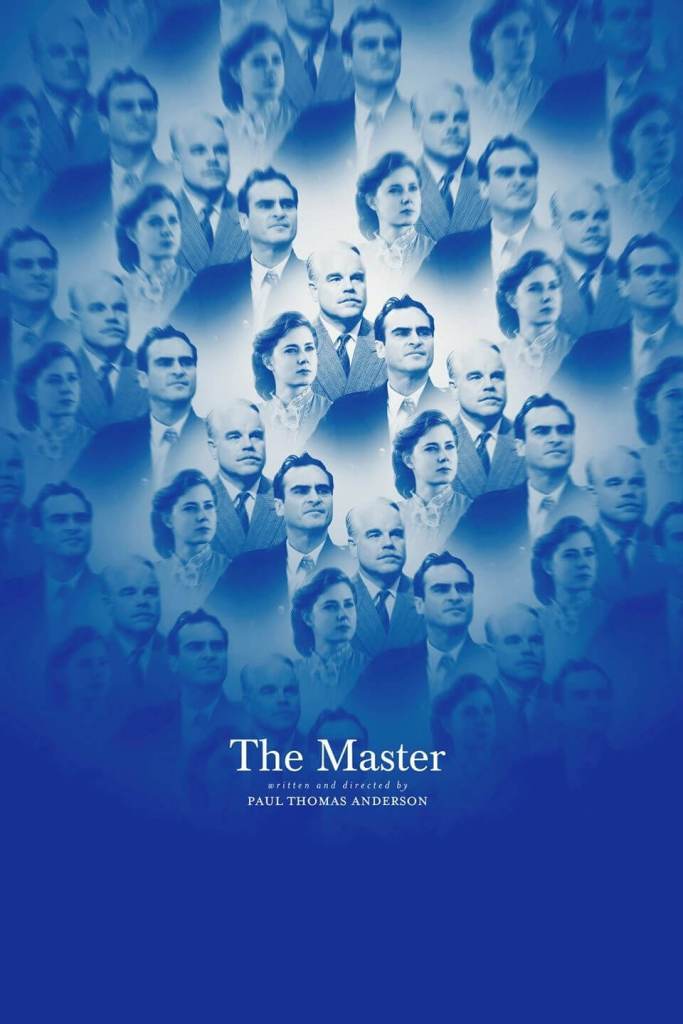
Cited as one of the best films of the 2010s, Paul Thomas Anderson’s period psychological drama is a trip into masculinity and PTSD. Set in 1950, The Master (2012) follows the life of a Navy veteran chaotically drifting through post-WWII America.
With a cast led by Joaquin Phoenix and Philip Seymour Hoffman, it’s a film that goes for many gut punches through the insidious nature of cultish charisma.
Charisma Meets Trauma in The Master
Paul Thomas Anderson wrote and directed the film. He based the screenplay loosely on Scientology founder L. Ron Hubbard, whilst also factoring in real life WWII Navy stories he’d heard from actor Jason Robards (the sailors used ethanol from torpedoes to make moonshine).
The shadow of WWII plays its huge part in the narrative, even if it’s rarely mentioned outright, with Navy veteran Freddie Quell (Joaquin Phoenix) attempting to return to civilian life.
Struggling with severe post-traumatic stress disorder, his behaviour is bizarre and erratic. He drinks heavily, including his own weird moonshine concoction, and struggles to hold down any normal work.
Anderson shot the whole film in gorgeous fashion, with cinematography by Mihai Mălaimare Jr. on peak form. Even when Quell is fleeing for his life after briefly working on a farm, it all looks stylish to the extreme.
Eventually, he stumbles onto a yacht and meets the charismatic leader of The Cause.
This is Lancaster Dodd (Philip Seymour Hoffman), who classes Freddie as “aberrated” and often talks in word salad and makes grand claims about the human mind. His followers, including his wife Peggy Dodd (Amy Adams), think he’s a genius.
The Master never explicitly states it’s a cult. But it’s pretty obvious, as soon Dodd uses a “processing” questioning technique to try and emotionally destroy Freddie and get him to join The Cause.
Other members of The Cause view Freddie as dangerous, unstable, and they want him removed from the organisation. However, Dodd sees something in him, a sort of a challenge, and believes he can cure him of his inner demons.
Dodd is very charismatic. With his somewhat laidback and charming personality, he can sing, dance, entertain, and basically schmooze his way in and out of any situation. However, he does have the habit of exploding in rage when confronted about The Cause’s claims.
What plays out with the unconventional narrative structure is Dodd’s persistent efforts to contain Quell’s erratic behaviour, all whilst he builds out a thesis for his concepts.
Viewers see the inner workings of a cult, how people operate in a normal and friendly way, it’s just Lancaster Dodd is a conman and he’s manipulating everyone.
SOMEWHAT OF A SPOILER HERE, but Quell eventually decides to leave The Cause for good. The best scenes of the film are Hoffman and Phoenix sizing each other up, with their final encounter covering the major theme of Dodd’s need for control against Quell’s animal instincts. He can’t be tamed or cured, he simply has to be himself.
The Master is a great film and one of Paul Thomas Anderson’s finest. His canon of work is phenomenal at this point and you can make a strong argument he’s the best Hollywood director of his generation.
Hoffman leads the show with his unexpectedly brilliant performance. Phoenix’s Quell is kind of a disturbing and unlikeable character, but in the frame of PTSD the viewer understands why and we see his disillusioned, tortured soul trying to find a release in The Cause. Yet he can’t, ultimately, find true solace in any of it or anything.
Control. That’s what the film is all about. The various individuals trying, or giving up on, getting things in order. The 137 minute runtime does occasionally drag that out too much, but for a production as lush as this, with a cast as great as that, you can excuse its excesses.
The Production of The Master
The Master was a commercial failure, earning $28.3 million back from its $32 million budget. This was put down to its lack of mainstream appeal and unsettling tone but, you know, sometimes stuff just don’t do as well as expected for random reasons.
It certainly was a critical darling, topping many Best Film of 2012 lists and gaining three Oscar nominations.
The BBC has since ranked the film 24th in its list of Greatest Films of the 21st Century. Since the sad passing of the amazing talent Philip Seymour Hoffman in February 2014, the film has extra emotional resonance as it was in the final batch of films he was in before he died (and undoubtedly his final truly great performance).
Anderson frequently collaborated with Hoffman and had him in mind for Lancaster Dodd from first script session in 2009. He undertook research into Dianetics (pseudoscientific ideas about the human mind L. Ron Hubbard invented in the 1950s) and actively involved Hoffman in scriptwriting feedback.
During these various rewrites, Hoffman stated the Freddie Quell character should be the main focus of the film, rather than Lancaster Dodd. And so it came to be.
Filming began in June 2011 in the Californian cities of Sacramento and Vallejo and was shot on 65 mm film, the first film to do that since 1996. Joaquin Phoenix lost a chunk of weight for the role, added in the weird gait the character has, and often improvised on set.
This created an unusual working relationship with Hoffman, which Anderson compared to being like the rivalry between tennis stars John McEnroe and Björn Borg (i.e. one hothead, the other more controlled). The characters are sparring with each other. Yet it’s Dodd whose manipulation tactics are more consistent, even if they’re doomed to failure.
