
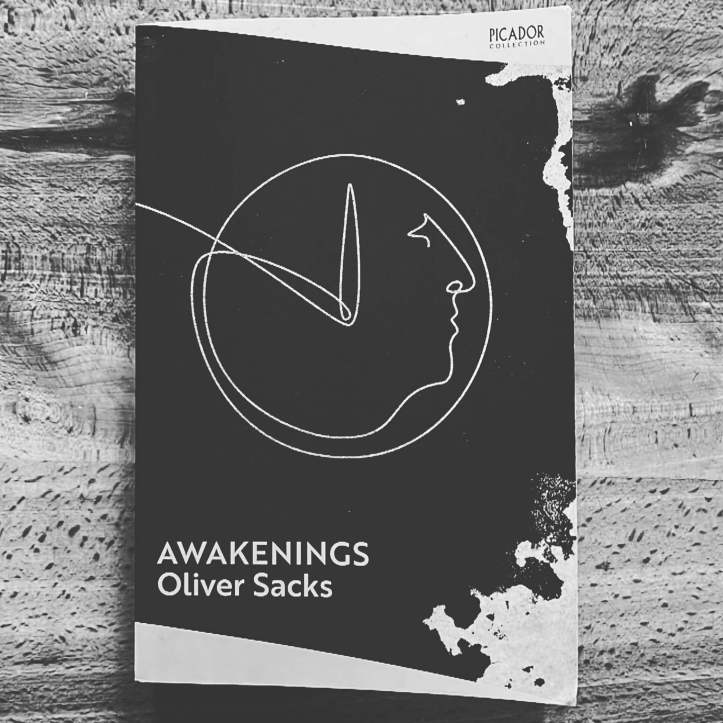
Neurologist Dr. Oliver Sacks (1933-2015) found global fame with The Man Who Mistook His Wife for a Hat (1985), a collection of fascinating case studies.
Prior to that, he came to public attention with his 1973 work Awakenings. This was his second book and the non-fiction text is a really quite astonishing look into the complexity of the human mind.
It explores Dr. Sacks’ encounters with stricken patients in 1960s New York, where the drug L-DOPA suddenly brought back to life long-comatose patients.
Encephalitis Lethargica and the Continuation to Awakenings
“We rationalise, we dissimilate, we pretend: we pretend that modern medicine is a rational science, all facts, no nonsense, and just what it seems. But we have only to tap its glossy veneer for it to split wide open, and reveal to us its roots and foundations, its old dark heart of metaphysics, mysticism, magic, and myth. Medicine is the oldest of the arts, and the oldest of the sciences: would one not expect it to spring from the deepest knowledge and feelings we have?”
The 2002 medical book Blood and Guts: A Short History of Medicine by Roy Porter has fascinated us over the last decade. We read it in 2015 after visiting the medical curiosity Wellcome museum in London.
It highlights that medical understanding has really only leapt forward to in the last 125 years or so. You really didn’t want to be alive before that, with the likes of hospitals viewed as terrifying destinations you desperately wanted to avoid.
Even in the early 20th century there were many mysteries. Baffling diseases that left medical minds stumped about the peculiarities of epidemics. As Dr. Sacks notes:
“Diseases have a character of their own, but they also partake of our character; we have a character of our own, but we also partake of the world’s character: character is monadic or microcosmic, worlds within worlds within worlds, worlds which express worlds. The disease-the man-the world go together, and cannot be considered separately as things-in-themselves.”
In 1917, the “sleeping sickness” called encephalitis lethargica struck and was first documented by Austrian neurologist Constantin von Economo and the French pathologist Jean-René Cruchet. This disease attacked the human brain and left victims speechless, motionless, and stuck like a statue.
Seemingly no longer alive, but very much so—in one way or another.
Encephalitis lethargica stuck between 1915 and 1926 and spread worldwide, causing over 500,000 deaths after around one million people were affected.
The disease promptly vanished in 1927 and hasn’t returned since. It’s still unclear what caused the issue.
But those who survived (in most cases) were left in a state of rigor mortis. Some of them stuck like statues in time and placed on medical wards to receive 24/7 care. And that’s where they stayed for the next 30 years.
L-DOPA Brings Catatonic Patients Back to Life
This is where Dr. Sacks’ work comes in. He was a British neurologist born in London, but spent much of his career in America. Whilst working at the Beth Abraham Hospital in the Bronx, New York, he first encountered the victims of encephalitis lethargica.
It was the 1960s and Dr. Sacks encountered 20 patients in a state of motionlessness, where some had been for the last 40 years. As the synopsis of this edition points out, they were:
“Aware of the world around them, but exhibiting no interest in it.”
The first 30 pages of Awakenings covers Parkinson’s disease (as explained shortly), followed by detailing the sleeping sickness outbreak, and Dr. Sacks’ arrival at L-DOPA.
From page 39 onward, this is where he begins detailing the case studies of:
- Frances D.
- Magda B.
- Rose R.
- Robert O.
- Hester Y.
- Rolando P.
- Leonard L.
There are many more, that’s just a summary—these case study snippets, told with a carefully crafted sense of care and understanding, are what became Dr. Sacks’ speciality as a writer.
As what follows is a genuinely astonishing account of patients brought back to life. Once administered L-DOPA, there was a kind of explosive reawakening in them and they came to.
Reunited with family members again, Dr. Sacks was then able to (in typically compassionate style) tell the life stories of these individuals. All of whom, of course, suddenly had to adopt to modern life in the late 1960s.
The fascinating element of returning to life aside, L-DOPA’s incredible impact eventually came with a shocking development—uncontrollable tremors and an unliveable life. And this was no more obvious, and tragic, in the case of Leonard L. (his story was adapted into the 1990 film adaptation, more on that further below).
The Case of Leonard L. and L-DOPA’s Flaw
“I am a living candle. I am consumed that you may learn. New things will be seen in the light of my suffering.”
Dr. Sacks met Leonard L. in the spring of 1966, with his patient 46 years of age. The man was motionless, other than occasional movements from his right hand, which he painstakingly used to spell out messages on a letter-board—his only means of communication.
Despite his condition, he’d become an avid reader—books were placed in front of him and the pages turned by a nurse.
Leonard L. received L-DOPA in the spring of 1969. This brought him out of his catatonic state and Dr. Sacks noted:
“It was obvious to me, from my first meeting with Mr. L – and this impression was reinforced by all subsequent meetings with him – that this was a man of most unusual intelligence, cultivation, and sophistication; a man who seemed to have an almost total recall for whatever he had read, thought, or experienced; and, not least, a man with an introspective and investigative passion which exceeded that of almost any patient I had ever seen.”
Two weeks after administration, L-DOPA restored in Leonard L. the power to stand up, walk , talk, type—things he hadn’t experienced in over 20 years.
Delighted, he kept a diary that was packed with expressions of amazement (written in Latin) for this new lease of life. His mother was still alive and, of course, was delighted to have her son so animated once again.
Dr. Sacks noted the patient deserved a book all to himself (eventually, again, the film was based on him) but the unfortunate course of L-DOPA was for development of severe tics (very similar to Parkinson’s disease) that made his life unbearable, alongside extreme paranoia. It’s a tragic development to consider—the joy of his return and experiencing life, followed by a horrendous slide into misery. In March 1972, Leonard L. told Dr. Sacks:
“This is the end of the line. I have had it with drugs. There is no more you can do with me.”
And then told his doctor:
“I thought L-DOPA was the most wonderful thing in the world and I blessed you for giving me the first Elixir of Life. Then, when everything went bad, I thought it was the worst thing in the world, a deathly poison, a drug which sent one down to the depths of hell; and I cursed you for giving it to me. I was terribly mixed in my feelings between fear and hope, and hatred and love … Now I accept the whole situation. It was wonderful, terrible, dramatic, and comic. I’m best left alone – no more drugs. I’ve learned a great deal in the last three years. I’ve broken through barriers which I had all my life. And now, I’ll stay myself, and you can keep your L-DOPA.”
He eventually returned to his catatonic state, where he remained until his death in 1981.
This, unfortunately, is the legacy of L-DOPA. A return to life, experienced newfound joys, followed by a kind of internal torture, before returning to a sleeping sickness. All watched by Dr. Sacks, initially overjoyed before horrified.
But it wasn’t all failure. In 1982, Dr. Socks noted this of his efforts in the late 1960s.
“I have become much more optimistic than I was when I … wrote Awakenings, for there has been a significant number of patients who, following the vicissitudes of their first years on L-DOPA, came to do – and still do – extremely well. Such patients have undergone an enduring awakening, and enjoy possibilities of life which had been impossible, unthinkable, before the coming of L-DOPA.”
The 1990 Hollywood Adaptation of Awakenings
There’s a famous 1990 film adaptation of Awakenings, which starred Robin Williams and Robert de Niro. For the former, it was a chance to play against type and showcase his wider dramatic acting skills.
It’s an impressively muted and slow-paced film, which was also a minor hit (making $108.7 million at the box office off its $29 million budget).
The cast was on incredible form and also included Julie Kavner (famous for being the voice of Marge Simpson). Robin Williams starred as Dr. Malcolm Sayer, a fictionalised version based on Dr. Sacks.
It’s a fine film if you haven’t seen it, with some of de Niro’s best work as an actor. A bittersweet experience offering a unique adaptation of Leonard’s experiences. Well worth revisiting 30+ years later.

I read this book thirty years ago, and it made such a deep impression on me.
LikeLiked by 1 person
Like a lot of his books, yes! Once you’ve read them you don’t forget. Dr. Sacks was a marvel.
LikeLiked by 1 person
Did you see the movie? The woman who played the little nurse was quietly brilliant.
LikeLike
Yeah, one left a note about the film at the bottom of the review. Julie Kavner is the voice of Marge Simpson, but also a fine actress.
LikeLiked by 1 person
Oh, that was her you mentioned! Sorry, sorry.
LikeLiked by 1 person
Aye, it’s Marge Simpson. 😊
LikeLiked by 1 person
Gosh, you can really hear it, once you know about it.
LikeLiked by 1 person