
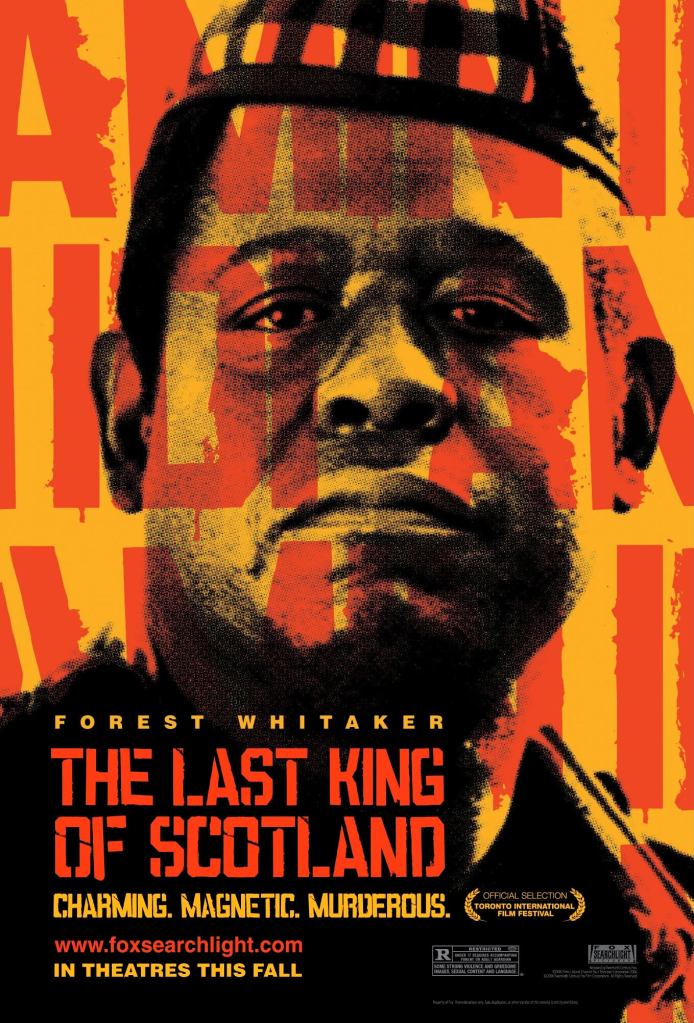
It’s alarming to us this 2006 historical drama is almost 20 years old. What the hell!? Well, there we go as The Last King of Scotland is heading for that status.
Starring Forest Whitaker on career best form, and directed by Kevin Macdonald, it follows the life and times of Ugandan President Idi Amin (1928-2003). A dictator through and through, his regime involved many human rights abuses and political unrest, which the film explores in increasingly tragic detail.
Heatwaves and Horrors in The Last King of Scotland
Set in 1970, the film begins with young Dr. Nicholas Garrigan (James McAvoy) bored with his boring existence in small town Scotland. He’s just qualified from university and so decides to become a medical missionary in Uganda.
For the record, Dr. Garrigan is a fictitious character set to an, otherwise, historical account of Idi Amin.
Dr. Garrigan is loosely based on the Englishman Bob Astles (1924-2012), a soldier who was an associate of Amin. Dr. Garrigan arrives in Uganda to discover a fractious country, with charismatic General Amin (Forest Whitaker) overthrowing President Milton Obote through the 1971 Ugandan coup d’état.
What follows is Dr. Garrigan has a chance meeting with Amin, who takes a shine to the young doctor as he’s from Scotland.
Now this is true, Amin had a love for Scottish culture, in part as this helped to distance himself from Great Britain and its Conservative government. He chose to align with Scottish independence as this aligned with his, later very delusional, goals of independence and self-determination.
Dr. Garrigan is flattered by Amin’s interest in him and soon rises to a position as his personal physician, whilst overseeing support for the Ugandan healthcare system.
The pair become trusted confidants and friends, but this situation begins to deteriorate as Amin’s increasingly disturbed leadership style takes hold.
For example, in 1972 Amin enacted a total expulsion of the Asian community from Uganda.
The result was a disaster for the economy, leading to a massive labour shortage and a recession for the economy. Yet another indicator of how vital emigrants/immigrants are for any country, amongst all the ongoing panic about foreigners amongst a certain sect of people.
The Last King of Scotland’s plot is Shakespearean in structure—different personalities becoming friends, confidants, close allies, and then it all starts to fall apart.
Now, the main draw of this film is with Forest Whitaker. Bloody hell is he good in this film, capable of channelling Idi Amin’s famous charisma and energy, whilst also demonstrating his delusions, paranoia, and crazed temper.
In comparison, below is Amin in 1973.
To highlight just how out of it this guy was, the full title he assigned himself was: His Excellency President for Life, Field Marshal Al Hadji Doctor Idi Amin, VC, DSO, MC, Lord of All the Beasts of the Earth and Fishes of the Sea, and Conqueror of the British Empire in Africa in General and Uganda in Particular.
In the film, the situation with Dr. Garrigan reaches a point of execution. Whilst in real life, Amin invaded Tanzania in 1979. The result was Tanzania counter-attacked and overthrew Amin, forcing him into exile in Saudi Arabia. There he remained until he died in August 2003.
It’s an increasingly brutal film, one that follows somewhat familiar territory to a film such as Spielberg’s Schindler’s List (1993).
We used to wonder why directors would display such acts of evil on film, commit them there for audience members to watch. But with the volatile global situation right now, we think it’s all with vital purpose—to remind people of how politics can wreak havoc, to not fall for the (seemingly) charismatic.
Roger Ebert claimed that cinema is a tool for empathy and it, along with wider culture, is more important than ever. Almost 20 years on from this often excellent film and it’s an impressive addition to the canon of anti-authoritarian texts.
The Production of Last King of Scotland
The film was adapted from Giles Foden’s 1998 book, with the author having a cameo as a journalist. Peter Morgan and Jeremy Brock adapted it for the screenplay.
Off its $6 million budget it had an impressive return of $55.8 million at the box office.
Forest Whitaker claimed the Best Actor award at the Oscars for his brilliant performance. He gained a lot of weight for the role (49 pounds—three stone) and refused to leave character in between takes (method acting), meaning he was a pain in the arse for everyone else on set.
But one of his reasons for this was, being American, struggling to maintain his Ugandan accent. Here’s a contemporary interview with Whitaker with further details on his processes.
The directors met with long-term Ugandan president Yoweri Museveni (still in power as of 2025) for permission to film in Uganda. He agreed to that and the filming went ahead, being able to film in various parliamentary buildings and having full support from the army.
That made it the first Western film shot in Uganda since 1990.
The Last King of Scotland did run in Uganda, opening in February of 2007, which included a full Swahili dub for the East African audience.

Hard to believe it’s been 20 years since that film came out. Thanks for the reminder. Seems like a worthy re-watch.
LikeLiked by 1 person
It stands up well, mainly thanks to Forest Whitaker’s performance… that and the, unfortunately, ever-worsening political situation in Europe and NA. Ho hum.
LikeLiked by 1 person