
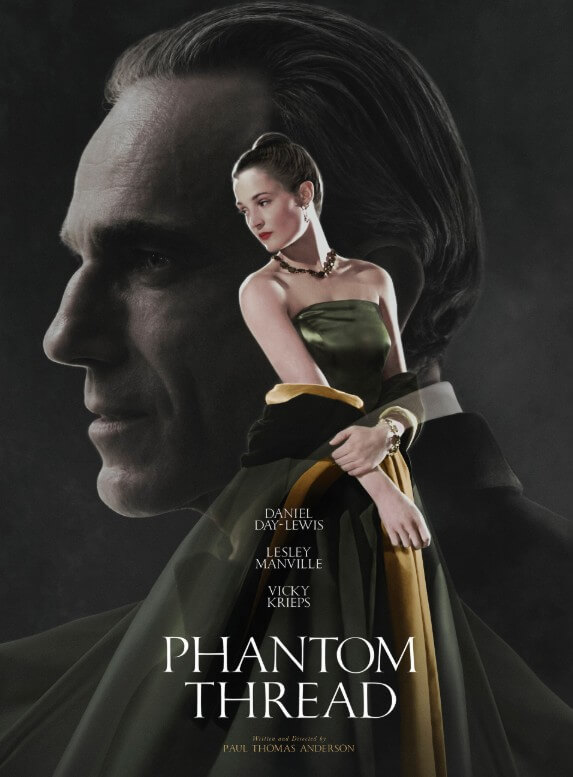
This is a 2017 period drama with psychological stuffs, directed by the legendary Paul Thomas Anderson and starring the legendary Daniel Day-Lewis. This was supposed to by the latter’s final role, but he’s since come out of retirement (good!).
When you’ve got talent like that on a project, you’re guaranteed a grand time of it. And Phantom Thread delivers in many areas, offering and elegant take on two genres with a rather exquisite central performance from Day-Lewis.
Lots of Psychology and Drama in Phantom Thread
Set in London, 1954, we meet fashion designer Reynolds Woodcock (Day-Lewis). His job is to create fancy dresses for high society across the UK, with his clients considering him an empowering genius.
Despite his talents, he’s an obsessive man struggling with a controlling personality.
One day he takes a drive to a local restaurant where he meets the foreign waitress Alma Elson (Vicky Krieps in her breakout role). He woos her with his British charms and
Tangent here, but in the build-up to their meeting director Paul Thomas Anderson uses his typical flair to capture England. It’s there in all its misty, murky, pomp, and glory. There’s a car scene (Reynolds drives a maroon Bristol 405) that’s enough spectacle to match even the fanciest CGI.
Then follows what’s since become the iconic breakfast order scene. Where Reynolds, in a kind of quietly child-like way (with lots of impish glee) makes an extended and specific order. Commence casual flirting.
The pair hit it off and their relationship moves fast, with Alma moving in with Reynolds. In turn he also finds in her a new muse and model.
A tacit element to the plot is Kriep’s German background. This is 1954, only nine years after WWII ended, and her background involves the scars of those she’s seen killed. And the nation she’s seen destroyed.
The theme of the film follows along the lines of Behind the Candelabra (2013). Where boogie-woogie wizard Liberace takes on younger lovers, manipulates them, gets bored, then ditches them for someone else. Reynolds isn’t a womaniser abusing his power, but he is so introverted and hyperfocused on his work that long-term relationships seem impossible.
Here, a romantic interest re-inspires his creativity, but once the creativity wanes the love interest seems pointless. And there’s a reason for that, with the sense Reynolds has undiagnosed issues.
In Paul Thomas Anderson’s fantastic Punch-Drunk Love (2002), Adam Sandler’s character Barry Egan is clearly autistic. For Phantom Thread, we have Reynolds across various breakfast scenes becoming very agitated about certain normal noises at the table (with his sister Cyril there, played by the awesome Lesley Manville).
As soon as we saw Reynolds’ reaction to the toast scraping, we knew.
Now, we’ve been pretty upfront about the autism 101 of our esteemed editor Mr. Wapojif. For him, this is a clear cut showcase of ASD. Even though it isn’t stated in the film (it wasn’t a common diagnosis in 1954, of course), many observers and fans of the film have since theorised this.
It’s played perfectly by Day-Lewis and Krieps. Reynolds:
“It’s as if you rode a horse across the room.”
Alma doesn’t understand why such a normal activity could be “loud”, for Reynolds it’s Hell on Earth (as those noises play havoc with your sensory processing).
Then, on another night, Alma surprises him with a romantic dinner. He’s upset about this and they argue. Cyril actually warned her against the idea, highlighting he doesn’t like surprises (FYI from us, never surprise autistic people with anything… it isn’t appreciated).
There’s an often magnificent score to go with this, which was composed by Radiohead star Johnny Greenwood.
It has a dreamlike quality, swooning over the surface. Playing out like some classical Hollywood romance, all whilst something lingers under the surface. Brooding away as Reynolds’ unpredictable personality takes its toll on everyone.
Phantom Thread is a very intriguing film, brilliant in so many places. Anderson excels with these peculiar love stories, which audiences have seen before in Punch-Drunk Love.
This is arguably just as good, but in a more elegant and austere sort of way. But not lacking its moments of joy, fun, and ludicrous pomposity. As if Withnail from Withnail & I made it in his career, got his own way, and let a world of obsession overtake him.
Excellent viewing, then, and it simply demands more than one watch.
The Production of Phantom Thread
Above is an interview with the two lead actors. Note Day-Lewis there having morphed into a FOOTBALL HOOLIGAN SKINHEAD! That man sure is method acting supreme (and he suits the bald look).
This was supposed to be Day-Lewis’ final film (he’s since returned to acting in 2025 with Anemone, directed by his son). He plays an obsessive man finicky about details… seems kind of apt, as Day-Lewis is definitely obsessive in his pursuit of acting perfection.
He’s said he knows people think he’s nuts with his approach. But there’s also no denying he’s a genius and arguably the best actor of his generation.
And he was at it again here, insisting that Vicky Krieps (unknown at the time of getting this role) not meet him at all until they were on set. That means the first scenes recorded between the two are, indeed, the first time they met. Krieps said in a 2018 interview this lack of rehearsing:
“More nervous than I might otherwise have been. [It was a] powerful experience to discover someone as you are working. I think this is what he [Day-Lewis] intended.”
Continuing his method acting approach, Day-Lewis spent a year learning the dressmaking process from Marc Happel (Director of Costumes at New York City Ballet). Everything was also shot in England, with the main location being Lythe in North Yorkshire. There’s a scene in a ballroom that was filmed in Blackpool Tower, not too far from where we live!
As brilliant as the film is, it wasn’t a critical success. Off its £35 million budget (modest, for this era of filmmaking) it earned $52.2 million at the global box office.
But it was considered one of the best films of 2017, is recognised as one of the best films of the 2010s, and also earned a bunch of Oscar nominations. It won one… for Best Costume Design.
Seems apt enough. 👗
