
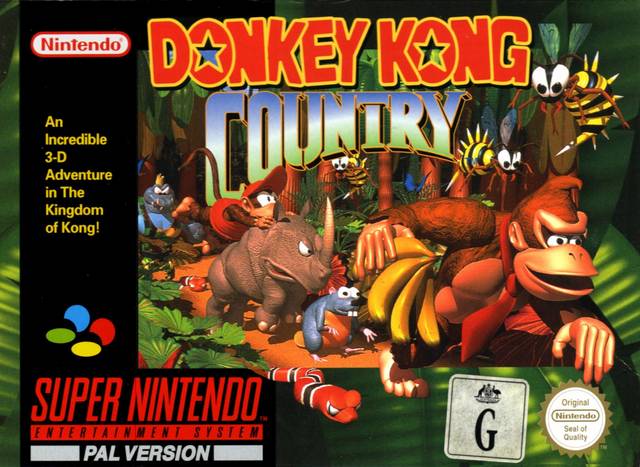
For any Super Nintendo owner in 1994, Rare’s Donkey Kong Country was the must have game for the winter season.
If you were around at the time to play it, you’ll know what we mean.
This legendary platformer, although the weakest in the iconic SNES DKC trilogy, is still iconic for so many reasons. And we’re documenting its emotional impact on us, aged nine at the time, and the 30 year journey it’s had since.
Donkey Kong Country and its Legendary Impact on the Gaming Industry
Of course, it all looks so simple now. It’s dwarfed by the excellence of modern 2D platformers that pelt out from the indie scene.
But it was one of the first console games to feature pre-rendered graphics, which meant it had the most remarkable and dynamic appearance. The technology was so advanced British developer Rare had 12 developers working on it over 18 months after Nintendo handed them the official IP.
Since the Arcade game Donkey Kong (1981), Nintendo hadn’t done much with the character. Rare totally overhauled the IP in a way that’s going strong now (just check out the brilliance of Donkey Kong Country: Tropical Freeze).
Even Shigeru Miyamoto contributed little to Donkey Kong Country. Nintendo just left Rare to get on with it.
The hype was very real, we remember British gaming TV show Bad Influence recording a segment on it.
Advertisers didn’t hold back on it. We mean, look at the US commercial for this. Drama overload or what? Making games look cool!
In 1994 we remember it well in the UK. We got it for Christmas Day and you can imagine our bricking it excitement to play this thing.
Massively overexcited is what we remember. But when we started playing it (and we remember those opening moments so well) we thought the level select screen was the game.
That’s stupid kids for you! Or perhaps a little bit of overenthusiasm stopping our logic glands from working.
Either way, once we got into that iconic first level (Jungle Hijinxs) we got to grips with it what felt like a revolutionary game.
First off, that music was something a bit different. Just very good quality! But not yet hinting at what lay ahead with the game. Instead, it was mainly us gawping in wonder at those pre-rendered graphics.
As a first level, it really introduces you very well to the basics.
The use of Rambo the rhinoceros, the way the baddies move, and that dynamic shift to night in the closing few seconds. As kids, we used to love looking at the multi-layered background and seeing the jungle sweep off into the distance. It felt immersive.
But then we got round to level four—Coral Capers. That’s when something very unusual happened indeed.
Now, as gamers we actually like water levels. Many don’t. Many hate them. But what seems like a standard water level in Donkey Kong Country gives way to some serious sounds.
Listen to that music! It’s Aquatic Ambiance and it’s a masterpiece.
We consider that a landmark moment in gaming, even more important than the impressive graphics on show. The pre-rendered graphics have now aged and are little to talk about, but David Wise’s music (more on it further below) is just astonishing.
It set the scene for the rest of the trilogy, peaking with Donkey Kong Country 2 in 1995. A rapid turnaround for Rare.
We must note as well that Donkey Kong Country, although receiving strong reviews in 1994, is quite a weak platforming game. Certainly nothing compared to Nintendo’s efforts like Super Metroid from the same year.
DKC was a massive hit for Nintendo, and the talk of the town, but even Shigeru Miyamoto was quite critical of its gameplay flaws.
Rare did a solid job, but it is just a bit easy most of the time. Although some levels, like the Indiana Jones styled Mine Cart Carnage, remain a blast to play.
Despite some serious highs, the gameplay remains unremarkable and has a serious lack depth to it.
However, and to Rare’s immense credit, they addressed that immediately and DKC 2 was just a colossal step forward and one of the Super Nintendo’s best games.
Despite that, it’s usually the first Donkey Kong Country that gets the retro gaming glory. It was, for example, the only DKC game to make it onto Nintendo’s SNES Mini Classic in 2017.
We feel that’s down to the hype from 1994, and the impact the game had on its immediate release, creating some seriously strong nostalgia pangs.
Despite its shortcomings as a game, its cultural impact on the industry can’t be denied. Arguably thanks to one composition from David Wise! But we must acknowledge it for what it now is.
A special title that, yes, revels in its nostalgia kick whilst not being an outstanding game. But sometimes it’s not always about the gameplay.
The Revolutionary Nature of Donkey Kong Country’s Soundtrack
At this point, British composer David Wise is a legend. But back in 1994 he had a bit of a problem. How do you make the Super Nintendo’s technical limitations better?
As you can see in the brilliant Nerd Writer video above, he got creative and spent five weeks per composition to ensure Donkey Kong Country had great music.
This was really astonishing stuff. Used to more fun and friendly soundtracks, the impact of Wise’s music on the industry was profound.
Aquatic Ambiance is the one everyone still raves about, an ambient chillout masterpiece that seems enough to make even the hardiest of souls burst into tears.
In summer 1994 we’d been lucky enough to go on holiday to Barbados.
So that level, with its sweeping sandbank ocean floor (which we remember so well from swimming on holiday) and then playing this game at Christmas of that year…
Almost 30 years later and it really hits us quite hard.
Playing Donkey Kong Country, hearing the music, and enjoying the experience is like being whisked back to us aged nine years old all over again. This is the power of video games.
It also taught video game composers they could go off and be dramatic.
The existential crisis of playing a platforming monkey game with astonishing music may seem surreal, but it works so magically well.
And you can see that in the response online to this game, its music, and David Wise’s humble appreciation of all the attention.
