
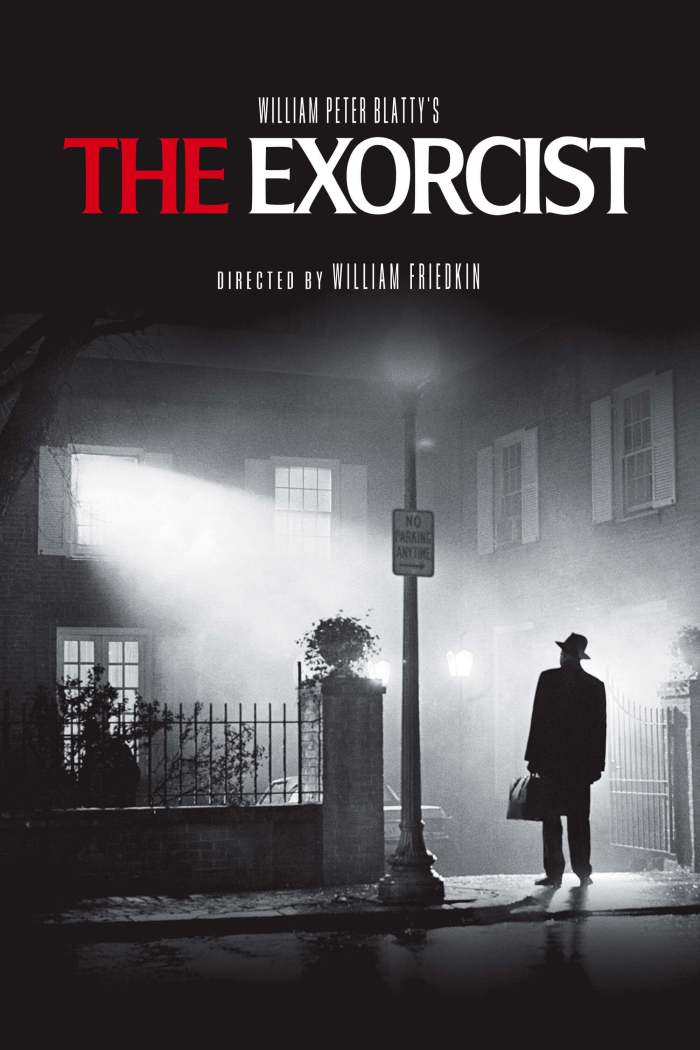
Along with the likes of Spielberg’s Jaws (1975) and Scott’s Alien (1979) The Exorcist is one of those landmark horror flicks from the ’70s.
William Friedkin’s film turns 50 in December, which is a fitting time to pay tribute. Not least as the director died at the age of 87 on August 7th.
Believe it or not (and we’re ashamed by this!) we’d never seen the film until yesterday (14/08/2023). Forgive us, Father, for we have sinned… but here we are ready to review the thing and its legacy.
The Conflict Between Faith and Reason in The Exorcist
The film was adapted from William Peter Blatty’s (1928-2017) eponymous 1971 novel.
The film version was an international sensation (as you’ll probably already know). It really freaked people out and caused a lot of controversy.
We weren’t even around at the time and we’re aware of that. It’s one of the reasons we hadn’t watched the film until now—we’d seen so many famous segments of it played over the years watching it felt irrelevant.
But sitting down to take it all in proved one thing—the film has aged well. That’s primarily down to the outstanding performances from the first-rate cast.
The narrative follows the life of Chris MacNeil (Ellen Burstyn) who’s an actress. She lives in Georgetown, Washington DC, and rents a fancy place with her maid Sharon Spencer (Kitty Winn) who helps raise MacNeil’s 12-year-old daughter Regan (Linda Blair).
After Chris hosts a party for colleagues and friends, Regan’s behaviour changes and she becomes profane and violent.
This behaviour deteriorates rapidly, leading her distressed mother through an endless parade of doctors and psychiatrists. The latter are all convinced Regan is schizophrenic.
However, once Chris sees the supernatural and destructive nature of her daughter’s behaviour she begins to distrust the medical professionals.
During all of this behaviour the doctors refuse to acknowledge the supernatural elements to what they’re seeing, instead sticking to their IDIOTIC scientific principles. Bastards.
But with all medical efforts exhausted, one doctor suggests a radical idea—to perform an exorcism on Regan.
Whilst the above plotline plays out there’s a concurrent side-plot involving Father Damien Karris (Jason Miller), who has a double career as a doctor. However, he’s losing his faith due to his work in SCIENCE.
But once Chris MacNeil requests his help for an exorcism, his faith is brought into sharp focus when he has to confront this demonic little girl.
The good Dr/Father enlists the help of experienced priest Father Lankester Merrin (Max von Sydow) and the pair of them get to work.
The exorcism is a pitched battle in one of cinema’s most iconic extended scenes, with both priests succumbing in their battle to save the young girl.
Despite all the carnage, the film ends on a hopeful note—young Regan is free from Satan and Chris MacNeil is seen moving home to new pastures.
The end (cue hysterical screaming and puke flying everywhere).
Yeah, so chances are over the last 50 years you’ve seen the film. It’s entered into so much pop culture it’s almost impossible to go a day without hearing some sort of reference to it.
Again, we do think the film has aged well.
The special effects on Regan are, on the whole, still terrific. And Friedkin’s use of frosty breath and enclosed locations really ramps up the eerie factor. It does still unsettle you at its peaks, particularly with its bizarre sound effects.
Friedkin brought in a refrigeration system for the chill factor, so the temperatures on set were −20 °F (−29 °C). This meant the actors could only film for three minutes at a time, leading to the iconic closing segment taking a month to nail down.
Regan’s profanity (one of the things so shocking in 1973) is quite tame by modern standards, of course, and it doesn’t help so many horror films have shamelessly ripped off what The Exorcist did. It created a batch of genre tropes that are now getting a bit tired.
However, what carries the film to this day are the performances.
Ellen Burstyn (also outstanding in 2000’s Requiem for a Dream), Jason Miller, Linda Blair, and Mac von Sydow are exceptional here.
Miller’s intensity in particular, his battles with personal grief and the loss of his faith, make his performance arguably the highlight of the film. This was also his first feature performance!
Yes, then, we enjoyed this a great deal. Horror fans delight in The Exorcist to this day. There may have been many sequels (some of them awful) and there’s another one about to launch in 2023.
There’s no denying the best of the lot launched 50 years ago.
The World’s Reaction to The Exorcist
The above clip highlights film fan reactions back in late 1973. As you can see, there’s a mixture of shock and awe. There were widespread reports of:
- Fainting.
- Vomiting.
- Walking out in terror.
- Screaming and running out in terror.
- One bloke lasting 20 minutes before being carried out on a stretcher.
- One woman in London fainting due to nerves before the film even started.
- Religious viewers reporting crises in faith.
During our research for this piece the most prevalent issue was vomit. The reports of this were international. One cinema manager at Toronto’s University Theater reported he had a plumber on-hand 24/7 as customers were creating such a mess in the bathrooms.
The film also caused religious outrage.
For example, and rather explicitly shown in the film, Regan stabs herself with a Crucifix and jams it into her private parts. Even the book’s author was upset about this scene, with William Peter Blatty left depressed it became such a huge talking point.
Other debate revolved around Regan’s head spinning antics and the overall foul-mouthed nature of the 12-year-old’s demonic possession.
Wherever it launched across the world it was accused of blasphemous and salacious content. It also caused a big spike in demands for exorcisms, further hindering its reputation in the press and with religious folks.
There are many essays and dissertations about all of this. We’ll nod to Religious outrage, horrific science, and The Exorcist (2021) by Amy C. Chambers as one example:
“The Exorcist created media frenzy in 1973, with increased reports in the popular press of demon possessions, audience members convulsing and vomiting at screenings, and apparent religious and specifically Catholic moral outrage. However, the official Catholic response to The Exorcist was not as reactionary as the press claimed. The United States Conference of Catholic Bishops’ Office of Film and Broadcasting (USCCB-OFB) officially and publicly condemned the film as being unsuitable for a wide audience, but reviews produced for the office by priests and lay Catholics and correspondence between the Vatican and the USCCB-OFB show that the church at least notionally interpreted it as a positive response to the power of faith.”
Whilst the reaction was undoubtedly strong, and no doubt manic amongst a small sect of viewers, perhaps some of the stories have been exaggerated over time.
It makes for fantastic cinematic lore to ramp up some of these claims.
We weren’t around at the time (1984 was our birth year) so can’t comment on any of the scurrilous antics first-hand. If you were, though, let us know in the comments about whether you passed out or not.
But what we will note is Millennials (our generation) always get whacked with this “snowflake”/”woke mob” nonsense… we can confidently claim we didn’t puke during our viewing last night. So there.
The Exorcist’s UK Launch
As we’re British (rather!) we took an interest in the film’s March 1974 launch in London. The Nationwide Festival of Light (NFL), a grassroots Christian movement, protested against Friedkin’s work.
Members of the organisation handed out religious leaflets to those waiting to see the film. These offered spiritual support pre, and post, viewing.
The film was also banned in certain counties (a fate that also befell Monty Python’s Life of Brian in 1979).
Despite these issues, The Exorcist was a hit and became available on home video in the UK from 1981. However, it was later removed from circulation in 1988 as the British Board of Film Classification (BBFC) feared kids were seeking the film out due to its notoriety.
There’s actually a note on the BBFC’s Exorcist stance on its site:
“Adding to the BBFC’s difficulties were the reports of incidents of hysteria involving young women, which had led to concerns that the film might cause severe emotional problems, particularly among those who believed in the reality of demonic possession.
It was with this concern in mind the BBFC in the 1980s and early 1990s concluded that a video classification – even with an 18 rating (which could not entirely exclude the possibility of the work being seen by younger and susceptible viewers) – was inappropriate.
Therefore, at the beginning of 1988, the video was removed from the shelves (after nearly seven years of free availability) and was to remain unavailable for 11 years. Despite the prohibition on the video version, the film continued to play occasionally in cinemas, its existing X certificate being replaced by a new 18 certificate – for cinema release only – in 1991.”
We note that, but the BBFC had no issue keeping the terrifying Watership Down (1978) as a U for over 40 years. It finally bumped it up to a PG in 2023.
Anyway, from 1999 an uncut 18 certificate of The Exorcist launched again on VHS. Then, FOR THE FIRST TIME, Channel 4 showed the film on TV on the 17th March 2001.
It was such a momentous occasion this made the news on the BBC.
The Production of The Exorcist
The Exorcist was a smash hit. Off its $12 million budget it made over $441 million worldwide and triggered off a (rather misguided) batch of sequels and rip-offs.
Due to the controversies outlined above, people were lining the block to see the film. As it was winter, many queued in freezing temperatures to wait their turn.
Blatty’s book (inspired by a real life 1949 exorcism on a boy dubbed “Roland Doe”) wasn’t a hit. That’s until he promoted the work on The Dick Cavett Show, which made it a best seller.
He adapted the book into screenplay form when the project was greenlit for production. Blatty and Friedkin promptly chose lesser-known actors for the lead roles, rejecting the studio’s request for the likes of Jack Nicholson or Paul Newman.
Audrey Hepburn, Anne Bancroft, and Jane Fonda were also considered but rejected. Ellen Burstyn later convinced Friedkin to cast her as she was so passionate for the role.
Jason Miller was a stage actor and playwright who found much acclaim with his play That Championship Season (1972), which won the 1973 Pullitzer Prize for Drama and a Tony Award.
His role in The Exorcist remained his career defining performance.
As for the casting of Regan, initially Jamie Lee Curtis was considered but her mother Janet Leigh refused to allow it.
Friedkin was thinking of casting older actresses with a youthful appearance, that was until 14-year-old Linda Blair turned up when he mother Elinore brought here in for auditions.
Linda Blair had done some soap operas up to that point. Friedkin described her as “precocious”, so cast the young actress after screen tests with Burstyn.
Blair is now 64 and has enjoyed a long career doing small roles in film and TV. She’s also a keen animal rights activist and was vegan as early as 2001 (before it was trendy).
As for the film, despite the often negative global frenzy (or, perhaps, because of the reaction) it was nominated for 10 Oscars. It won two for Best Screenplay and Best Sound.
50 years later and many horror fans are Exorcist obsessives.
Dr. Mark Kermode of Kermode and Mayo’s Take is always eager to point out it’s his favourite film. He regularly finds even the most random opportunities to mention it in his reviews and/or general discourse.
The Exorcist also kicked off a franchise that continues to this day, with immediate sequels Exorcist II: The Heretic following in 1977 and then with Exorcist III in 1990.
Pequels followed in 2004 and 2005, with sequels set for October 2023 and April 2025. There’s just no stopping this SOB juggernaut series.
A Quick William Friedkin Tribute
Across his long career the American directing legend proved his versatility across a range of genres.
Alongside horror he worked on documentaries and black comedies such as 2011’s Killer Joe with Matthew McConaughey.
He was also famous for his articulation and sense of humour (as you can hear in the above clip about Exorcist II: The Heretic—a notorious disaster directed by John Boorman).
We’d also like to highlight Friedkin’s underrated Sorcerer (1977), which was a colossal box office bomb. Largely as it launched at the same time as the first Star Wars.
Now is the time to head back and check Friedkin’s canon as you’ll be surprised about the range of work he produced. RIP, sir.

I saw ‘The Exorcist’ in a theatre during one of its various re-releases into the cinema circuit in New Zealand, well after its first release. My main memory is of a gentleman somewhere in the auditorium deliberately making Donald Duck quacking noises every time there was a gross or scary bit.
LikeLiked by 1 person
Exorcisms… Donald Duck. I can see the connection, although I presume that gentleman had indulged in some lager prior to the screening.
LikeLike
I went to the cinema with friends to watch The Exorcist when it was re-released at some point while I was a teenager. It messed me up. I didn’t sleep properly for a month and it’s probably the reason why I’m such a coward when it comes to horrors now.
LikeLiked by 1 person
Murray the Skull would not be impressed with this information, Kim. Shame on you. 💀
LikeLike
Well, maybe if he’d been there, he’d realise what I went through.
LikeLiked by 1 person
Yes, it’s definitely not a popcorn bucket type of film. More edge of your seat unpleasantness and, if pushed, maybe one Jaffa Cake you give up on half way through.
LikeLiked by 1 person