
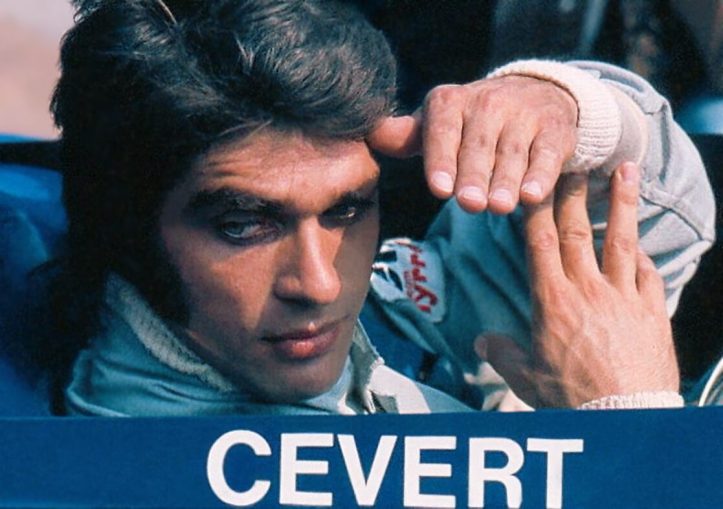
When we were first getting into Formula 1 in the late ’90s we went back and researched the sport’s history at length. It quickly became apparent F1 in the 1970s was a terrifying arena of regular tragedy.
One of the stories that struck us was that of François Cevert. We don’t like to think of him as a tragic figure, but his early death at 29 does hang over any discussion of him. And today marks the 50th anniversary of his death.
And yet Cevert was the embodiment of living life to the full; charismatic, well-mannered, loved by everyone, multi-talented, and ultra-handsome.
Enough to get him dubbed, “The most exciting man in France.” And we want to look back and remember him today.
The Charisma, Speed, and Lust for Life of François Cevert
Looking like F1’s version of Jim Morrison, Cevert was instantly identifiable by his leading man movie star good looks.
But this was backed up by a personable nature and welcoming personality.
In F1, he was mentored by his teammate Sir Jackie Stewart (who also became his great friend). We’ll remind here that Stewart was the sport’s leading driver in the 1970s, eventually bagging three world titles.
The Scotsman saw Cevert race for the first time in 1967 during a Renault Elf Winfield Racing School competition at Paul Ricard.
He was there with his boss Ken Tyrell as they eyed up stars for the future.
“Francois was probably the prime pupil. We had put him down as one of the potentials for the future, but not to drive a Formula 1 car, by any means, at that time.”
After a race together in the 1969 F2 GP of Reims, which Cevert won, Tyrell and Stewart took the driver a little more seriously.
“Ken called me, because Francois was driving at Crystal Palace and he asked me to come along to see him race. I was living in Switzerland at that time, so I went over specially to see him race there. And that was the decision day as to whether we were going to have him as a second driver.”
Cevert entered Formula 1 in 1969 for the Tecno Racing team as a one-off at Hockenheim (a year after the death of Jim Clark in an F2 race).
As he entered the top echelons of motorsport, his teammate was in the midst of a battle to bring greater safety to motorsport.
You can see below (“the good old days” as a bizarre sect of F1 fans continue to reminisce fondly over) from the Spanish GP of 1970 just how pathetically the sport was run.
No one was injured in that incident (although two drivers died in 1970).
But the basic idea could have occurred to those running the sport, “Perhaps we should stop the race! Yes. That would be sensible.”
Four races into the 1970 season and Tyrell, at the time one of the sport’s leading teams, needed a new driver. That’s after Frenchman Johnny Servoz-Gavin injured his eye and had to retire from the sport.
Following Stewart’s recommendation, Cevert was hired and there followed a master and apprentice relationship. That really hasn’t happened in F1 since—some drivers become friends, other times bitter enemies, but Stewart was an open book with his protege.
Looking back now and it was a very special relationship they had, one that’s not going to happen in the sport ever again.
Stewart told Cevert everything with the goal of getting him to title winning level. Of this Cevert said.
“It’s very simple, Jackie did all my education. I was driving like hell and not thinking enough about what I was doing. Jackie stopped all that and taught me how you must analyse a car, how you must think when you are driving, the vision you must have. He did all my education… Jackie is still the maestro for me.”
Back then Stewart always said it took three seasons for a driver to reach their full potential. So the young Cevert had a slow start, only scoring one point in 1970.
In 1971 his progress was obvious, bagging four podiums and his first (and only) win at Watkins Glen, the US Grand Prix. That was the final race of the season.
The following year was disappointing for Tyrell as Emerson Fittipaldi waltzed to the title, despite a solid effort from Stewart to try and win it.
Stewart won four races, Cevert bagged two second places.
But he endeared himself enormously to the team as he developed with his charming personality and work ethic. He didn’t cause arguments or inter-team battles with Stewart, he was the perfect student and continued to learn.
It takes a great deal of intelligence and restraint for an ambitious driver to understand this opportunity. We can’t think of many others who’d take such a stance (most would want to immediately battle for glory and establish themselves).
All the while he was the understudy, learning from Stewart, with the end goal being to get the Frenchman up to World Championship winning standard.
Whilst that was going on, the young François Cevert was off enjoying the limelight. With his easy charm and rockstar flowing hair, he quickly became a favourite in F1.
As you might expect, he became very popular with the ladies. Not least as he was multi-talented (see our F1 driver pianists feature).
Armed with a great car in 1973, Cevert’s situation changed.
Although a dutiful teammate to Stewart, the Scotsman noted the Frenchman was often patiently holding station behind him during the races. Even though it was clear he could have gone faster.
The result was, as Stewart claimed his third and final title, Cevert bagged some seven podiums that season. Six of those were for second place.
All of which indicated the guy was ready to take the next step. But that’s where the frustrating end to his story arrives.
François Cevert didn’t race in 1974 and he remains one of the major what-ifs of Formula 1 history. As well as being, sadly, another victim of the sport’s woefully inadequate safety standards of the 1970s.
Notes on Cevert’s Accident
Cevert was killed two years on at the circuit where he won his only race.
Going into this weekend 50 years ago, Sir Jackie Stewart was set to retire. It was to be his final race, but he hadn’t told Cevert or the F1 paddock. Only his team boss.
Watkins Glen had a dipping, rolling nature to it with an extremely dangerous esses series of bends. Sir Jackie Stewart noted of that years car, the Tyrrell 006, and the section of track where Cevert crashed:
“I don’t think I’ve ever driven a more difficult car. It was very fast, but very difficult to drive. I don’t think many people could have won with that car actually.
I’d worked out that I could go through [the Esses in fourth gear] – maybe a little bit slower but I was still sort of pole position speed. But in third gear, the car became so nervous. And in Francois’ case, I am absolutely convinced… that that overly nervous, short-wheelbase car, being driven as quickly as he could drive, whiplashed and hit the barrier on the right-hand side. It had nearly happened to me and that’s why I went up a gear.”
With it being the end of the season, Cevert wanted to put the car on pole to impress his boss and set the scene for a title challenge in 1974.
What followed was instead arguably the worst accident in F1 history. Certainly one of the few on a different magnitude in its severity.
There’s no footage of the crash, but pictures of the aftermath have made their way online. Thankfully, most are in grainy old newspaper quality. But you can just about see enough to realise how shocking this accident was.
Cevert was killed instantly, so it was everyone else in the aftermath who had to deal with the consequences and suffer.
Stewart stopped at the scene of the crash. He 2018 he recalled the following.
“To this day, I wish that I’d stayed longer with him. But he was dead. It was a horrendous accident, far beyond anything I think there’s ever been in a Formula One race. I mean, it was just horrendous. And to this day, I’m still affected by it. Jody Scheckter [the first driver on the scene of the crash], to this day, is hugely affected by it. To this day. It was a terrible sight and the worst possible thing to happen. And certainly the worst part of my entire career.”
As we’ve covered before about F1 at that time (see the 2013 documentary 1: Life on the Limit), it was just the norm. Safety standards were non-existent and driver deaths were accepted as part of the sport.
Total inaction and indifference says everything you need to know about the attitude of officials back then.
No safety adjustments were made to accommodate for the crash. And exactly a year later at Watkins Glenn, 1974, young Austrian driver Helmuth Koinigg was also killed in another gruesome accident.
Reflections of Cevert’s Career and Youthful Charisma
We’d like to end on a note of positivity for who Cevert was. And you can see that in the clips of him with his relaxed attitude, confidence, and mannerisms.
50 years later and Sir Jackie Stewart, for example, is still full of admiration for Cevert. And that’s perfectly summarised below.
“I don’t think there’s anybody who’s ever been a match to Francois Cevert. In every element: his manners, his presentation skills, his good looks, his driving skills. He became a great friend of the whole family. He stayed with us quite a lot, we travelled together a lot, and we were just awfully good friends. And I think that kind of thing probably is quite rare.”
Stewart still has pictures of Cevert around his home, such is the impact the Frenchman had on his life. Which we think is a fitting tribute to the affect this young Frenchman had on people’s lives.
And we think that’s a good life lesson for anyone.
Go out there and be excellent with people. Aim to be endearing, cool, and well-mannered. That’s certainly something we’ve taken from Cevert’s story, as he had that side perfected.

A great text about FI! Will anyone ever beat Verstappen?
LikeLiked by 3 people
NO! From here until eternity, it shall not occur.
LikeLiked by 2 people
I believe it.
LikeLike