
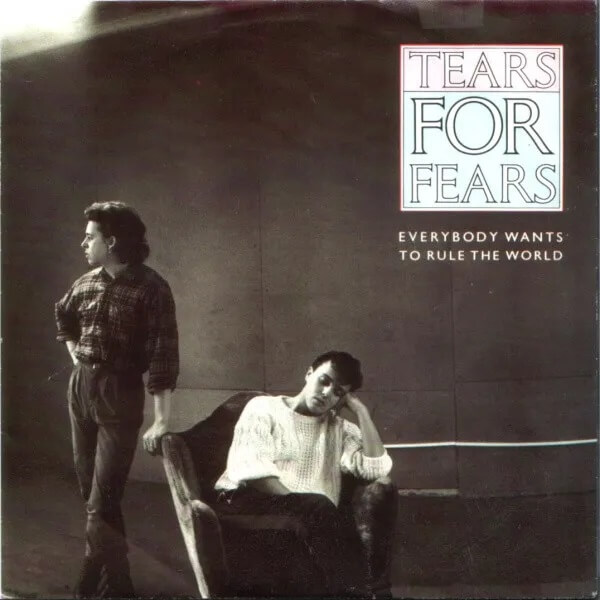
Okay, we’re taking a mini-break this week whilst we prep blogging shizzles for next week. But we’re doing a mid-week song and dance number (an intermission, if you will) with Everybody Wants to Rule the World.
We randomly deciced to listen to this the other day. You’ve no doubt heard it at some point or other.
Once we delved into it and the band behind it (Tears for Fears), we were surprised about its history and the two band members. Here’s everything everybody wanting to rule the world needs to know.
Critiques on Corruption and Power in Everybody Rules the World
First impressions? It’s very ’80s. Lots of synth and mullets to fit neatly around the New Wave, synth pop, dance-rock genres. The song launched on March 22nd 1985 and was a big hit, hitting 2nd in the charts in the UK, Ireland, and Australia.
The ’80s has a reputation (deservedly so, in some instances) of being a decade of astonishing cheesiness and weird cultural movements. But it’d be stupid to suggest nothing noteworthy came from the era.
Alongside other great ’80s bands such as Talking Heads (see Stop Making Sense), Tears for Fears became part of a string of intellectual groups eager to explore the human condition.
So it’s odd the band’s biggest commercial hit is a dig at capitalism, power, corruption, and all wrapped up in a strangely upbeat song. One with some great lyrics.
Welcome to your life,
There’s no turning back,
Even while we sleep,
We will find you,Acting on your best behaviour,
Turn your back on mother nature,
Everybody wants to rule the world.It’s my own design,
It’s my own remorse,
Help me to decide,
Help me make the most,Of freedom and of pleasure,
Nothing ever lasts forever,
Everybody wants to rule the world.
It’s a powerful and uplifting song. The life-affirming stuff is in there amongst the idea the world is falling down, with a message of support in there that there’s always someone to offer you support.
There’s a room where the light won’t find you,
Holding hands while the walls come tumbling down,
When they do I’ll be right behind you.So glad we’ve almost made it,
So sad they had to fade it,
Everybody wants to rule the world.
If you don’t pay attention to the lyrics then this is just another catchy ’80s synth pop song. But this was a strong message being sent out that became a global hit during the Cold War years.
In the US it stormed the charts to number one, propelling Tears for Fears to Biggest Band in the World status.
This was a brief spell at the top as the band’s lead duo, Curt Smith and Roland Orzabal, were rather anti-capitalist in sentiment and weren’t enjoying all the attention. So, they rejected the success and stepped away from the limelight. A follow-up album to Songs from the Big Chair (1985 and the album containing this iconic song) didn’t arrive until 1989.
We mention that to dispel any notions these guys were classic ’80s one hit wonders.
Formed in Bath, Somerset, they released a debut album in 1980. Then the twosome pottered around on the edge of the mainstream for several years, confusing the music press with a mixture of poppy/intellectual music.
A bit like Joy Division, but not really.
Yet then they hit the big time (eventually), but found it to unenjoyable. At that point, for any band, it becomes about running a business rather than anything else.
But the band have a lot of popular songs you’ve no doubt heard—Mad World, Shout, Sowing the Seeds of Love (another number one hit) etc. These guys are bloody good! But global superstardom didn’t appeal, so they took a step back.
Aptly, given their philosophical stance, they didn’t want to rule the world.
The Influence of Psychologist Arthur Janov on Tears for Fears
Tears for Fears (the band name) was taken from psychologist Arthur Janov’s thesis of primal therapy. Curt Smith and Roland Orzabal had endured difficult childhoods and both found solace in Janov’s work.
Janov (1924-2017) hit peak fame in 1970 as John Lennon (always struggling with his own difficult childhood) promoted the psychologist’s work.
The Primal Scream (1970) is a work detailing Janov’s experiences with patients as he fleshed out primal therapy. This remains a trauma-based psychotherapy aimed at challenging repressed pain from childhood. He argued neurosis was a direct result of childhood trauma.
For someone like John Lennon, whose mother was killed in a drunk driving incident in 1958 (Lennon was 17), The Primal Scream was some much-needed therapy. Prior to that, for two years after the death Lennon drank heavily to deal with this personal crisis and was consumed by what he called a “blind rage”.
Tears for Fears’ members sought similar personal refuge from their childhood trauma in the book.
The duo got to meet their hero in the 1980s. However, Curt Smith was left disappointed as Janov requested they turn his work into a musical. For them, the experience was supposed to be more than a moneymaking venture and were left disillusioned.
Everybody Wants to Rule the World Live (and Tears for Fears in 2024)
Yes, so Tears for Fears hit peak stardom from 1985 and were in hot demand. Above is a unique insight at the band at peak stardom—they didn’t take things much further after the above.
In fact, they had a long hiatus away from everything after splitting in 1990 and staying away from touring for a long time.
And here they are now! Below was recorded in 2022 and is a rare live performance from the band. They reformed recently after a long, bitter hiatus (they had fallen out) and are, happily for us all, back touring again.
In fact, the guys continue to record new music. They just released their latest album, Songs for a Nervous Planet, in September 2024. It features 18 live tracks and is a compilation of their 2023 global tour.

Even Skynet listens to this song!
LikeLiked by 1 person
I think most AI software out there has it on a constant loop.
LikeLiked by 1 person
It’s a great song.
Thanks for the interesting post!
LikeLiked by 1 person
No problem, that’ll be £4.50 for the privilege, please.
LikeLiked by 1 person
Would you take a Loonie?
LikeLike
I’m already a loony leftie, as tabloid readers keep helpfully reminding me.
LikeLiked by 1 person
Ah… goodoh… then how about a Toonie?
LikeLike