
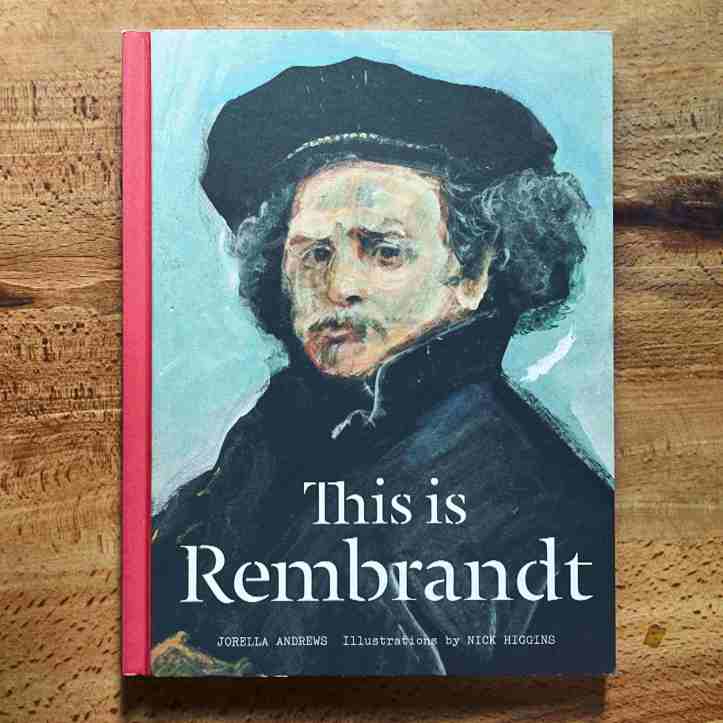
Rembrandt Harmenszoon van Rijn (1606-1669) goes by the mononym title Rembrandt. He’s hailed as one of the great visual artists and his canon of surviving works is 300+ strong. Although he spent his whole life in the Netherlands, his various styles were influenced from across Europe (especially Italy).
In This is Rembrandt (2016), Jorella Andrews explores the life and times of this celebrated painter. He had a tumultuous life marked by early fame, success, but eventually tragedy and financial distress.
Join us, then, as we explore his body of work and marvel at bygone times, by Jove.
Exploring a Chiaroscuro Master in This is Rembrandt
“Rembrandt van Rijnis is the quintessential Old Master. His intimately observed, vivid, and profoundly atmospheric works are what many museum-goers consider traditional painting ought to be. But in his own lifetime Rembrandt was not always so well regarded. The expressive honesty of his paintings and prints could evoke disdain as easily as admiration.”
Looking through Rembrandt’s work and it is, very much, what a surface level consideration of art may be. Really, really good paintings of stuff in intricate detail. Take the Winter Landscape (1646) and how he did the sky, which blends in perfectly with the small town life. It’d definitely get an A in any GCSE art class.

It’s not a big surprise he was influenced by genius artist and full-time lunatic Caravaggio—the use of light, transfixing certain objects with bursts of sunlight and shadows.
The technique is called chiaroscuro (“light-dark”), clearly visible here on The Abduction of Europa (1632).

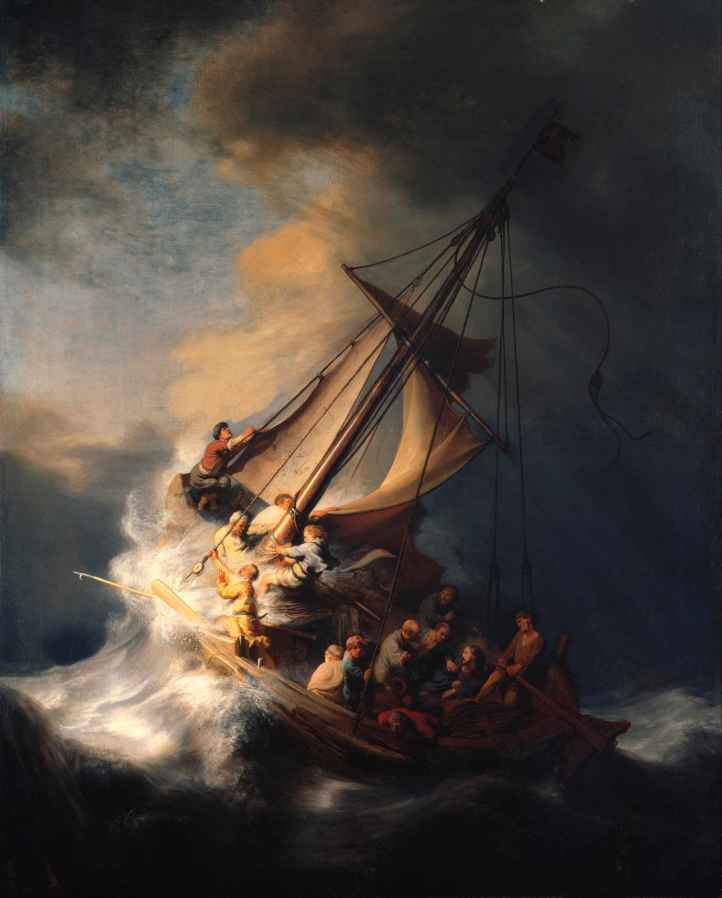
One of the main things that marked him out was his versatility. Rembrandt didn’t stick to one style, he tried everything. For example, he tried one seascape (The Storm on the Sea of Galilee—1633) and then called it a day on that kind of thing.
The painting was hanging in Boston’s Isabella Stewart Gardner Museum, but in 1990 it was swiped by thieves and hasn’t been seen since (true story).
It’s likely Rembrandt painted thousands of drawings and 600+ paintings, but given the chasm of time between his day and ours we don’t have all of those. Only around 300 confirmed pieces. Many of these were portraits and self-portraits (the one style he consistently stuck to across his career).
A genius, then, but This is Rembrandt also documents the story of his excesses. As the painter lived a quite reckless life, spending to extremes much like a modern day rockstar.
Rembrandt’s Life and Times
Born in Leiden in the Dutch Republic, he was one of at least nine children born into the Harman Gerritsz family. Luckily born into a well off home, he had a pious childhood and one enriched by his Latin school attendance.
He also went to university in 1620, back in the days when that really was a massive deal. He had a six-month artistic apprenticeship, too, in Amsterdam.
“There he had discovered the art of Caravaggio , which combined the close observation of physical and emotional detail with dramatic composition and abrupt shifts between light and dark.”
Caravaggio’s influence on Rembrandt would remain for his whole career, although he became more subtle with the technique in later life. And it didn’t take him long to find success and he earned a good income from his career, moving to Amsterdam permanently in 1631.
But then the tragedies began. He lost his wife Saskia in 1642, with whom he had four children. Three of those (Rumbartus, Cornelia, and Cornelia) died in childhood. The last child, Titus, survived into adulthood. That’s a stark reminder of how precarious life was back then. People would have kids in bulk in the hope some of them would survive beyond their early years.
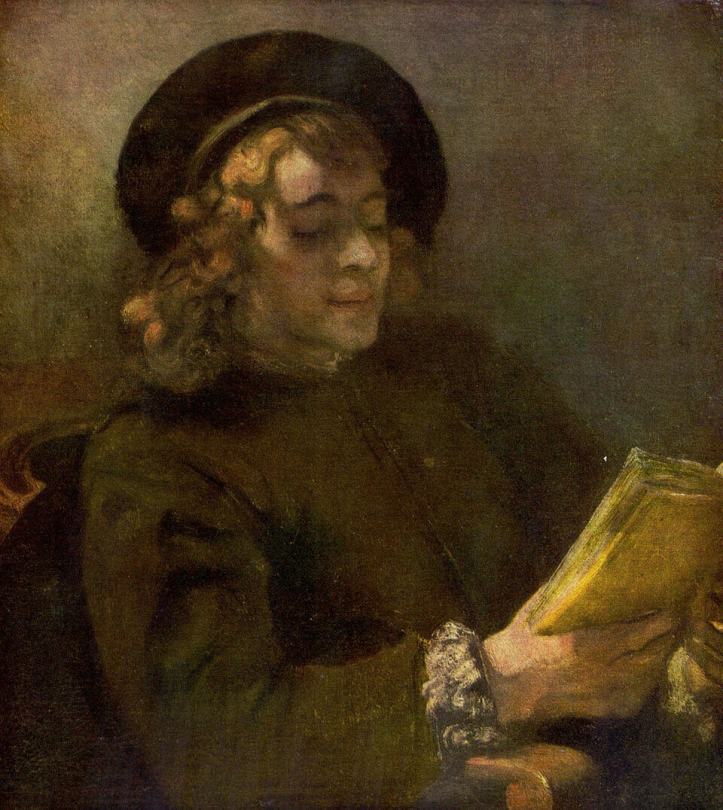
Titus van Rijn (1641-1668) has been immortalised in many of his father’s portraits. His son died at age 26, the cause of death is unknown.
It’s curious looking at these portraits now. It suggests the pair had a close relationship, but here also is this young guy who died at only 26—hundreds of years ago. Now locked in time in paintings such as this.
Around the loss of his children and wife, Rembrandt had to file for insolvency in May 1656.
He’d also begun a relationship with a younger woman in 1649, Hendrickje Stoffels was 23. In July 1663, she died of plague when in her late 30s. Rembrandt had considered her a soulmate and so this death was very hard hitting. It just seems like people’s lives back then were permanently tragic.
By the time Rembrandt died in October 1669, his spending sprees and poor money management had left him poverty stricken. He was in rent arrears aged 63. There’s no written record of what he died of.
This eventful life is covered with expert detail by Jorella Andrews As with the rest of the This Is series of books we’ve been covering, there are illustrations (this time by Nick Higgins) to bring the tale to life. As Rembrandt is such an iconic artistic name, this is a grand place to start for anyone developing their artistic knowledge.
A life of excess, tragedy, and artistic genius—This is Rembrandt.
Rembrandt’s Legacy and Continued Style Analysis
On a final note, there’s a lot of discussion in the artistic community regarding The Night Watch (1642). The ever-excellent Nerdwriter offers an interpretation above.
As for this book, Jorella Andrews writes this.
“The most outstanding characteristic of the painting is that instead of portraying his sitters formally, in an orderly row as was the norm – Rembrandt presents them in his own way, in the midst of (probably contrived) lively action as they prepare to go out on a daytime march.”
The painting has darkened over time, so isn’t depicting a night scene. But we highlight this piece to get to the essence of this painter—a maverick. He didn’t obey the artistic rules and did his own thing, spending lavishly as he did so, surviving plague, and dealing with a terrible emotional burden of grief and loss.

This is magnificent. I would love to have this book….
LikeLiked by 1 person
You could steal a copy. Go for it. You’ll get away with it. 👍
LikeLiked by 1 person
I don’t want to go to jail. I’ve got my eye out for ICE as it is 🙅♀️
LikeLike
Yurr, sounds awful out there. Looks like the UK is heading for the same though with our Reform lot and Farage.
LikeLiked by 1 person
Chaos. What’s up with the radical hate?
LikeLike
Yup. The county where I live, Lancashire, just voted in the far-right lot on Friday. Thankfully the general election is 3 years off, so we’re saved from the full onslaught for now. Don’t know how it works in the US, but here it’s been the right-wing media and politicians stirring up hate at minorities. Usual demagogue. Much support to us! Battle on. 💪
LikeLiked by 1 person
Same here. The 🤡and his cult are far right fascist. Congressional vote in 2016 ( November). We have our congressional in Nov 2016. We have to take back the senate. Good luck there. The world hates us with good reason.
LikeLiked by 1 person
They claim they’re not, though, in the greatest show of delusions and ignorance imaginable. Such is a demagogue, unfortunately, but it’s just a tragedy – the world hates Trump, not the many, many good Americans. 73 million voted for Harris, eh? 🙌
LikeLike
🙌 someday we’ll be together 🎶gettin high on saki
LikeLiked by 1 person
I’m up for that! Saki and sandwiches (with crusts). 🍶
LikeLiked by 1 person
Glad you are on board. Always with the crust.
LikeLiked by 1 person
Really, I look down on anyone who doesn’t do crusts.
LikeLiked by 1 person
Me too it’s so much fun !
LikeLike
You know what else is fun? CRUSTS!!!
LikeLiked by 1 person
I imagine this title being shouted in “This is Sparta!” format
LikeLike