
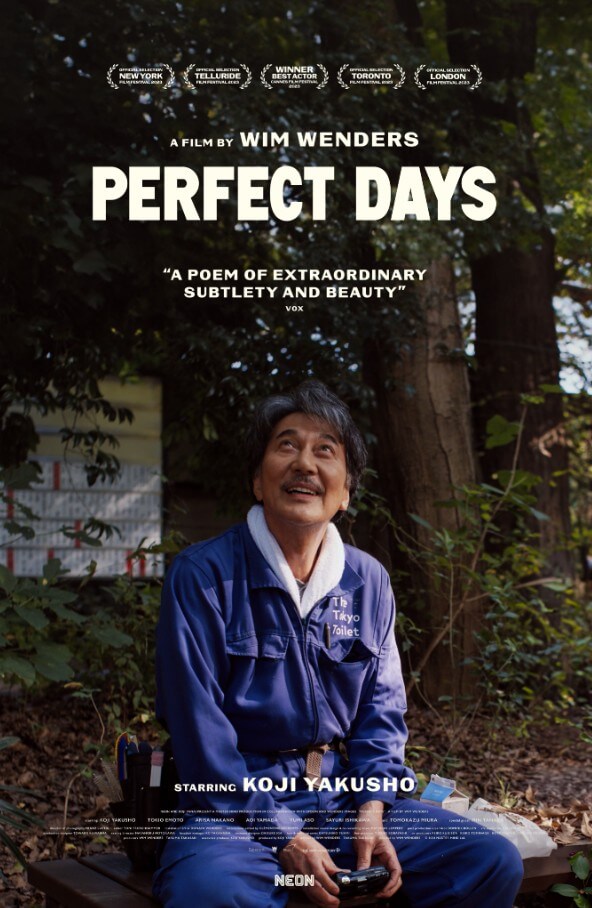
Directed by Wim Wenders, this gentle Japanese drama from 2023 made its way to the west in 2024. Having won a bunch of critical acclaim, and being nominated for Best International Film at the Oscars, we were eager to catch up with it.
Perfect Days has a breezy feel to it not too far removed from the excellent romantic drama Past Lives (2023).
Set in Tokyo, the film follows the daily routine of toilet cleaner Hirayama (Kōji Yakusho) as he enjoys his humdrum existence. It’s a relaxed and slow-paced film for a certain type of person, offering reflections on daily life and how to appreciate the apparently mundane.
An Exploration of Introspection and the Tokyo Toilet in Perfect Days
A lot of Perfect Days’ narrative is deliberately left unexplained. Instead, what we observe is the life of Hirayama as he goes about his modest existence cleaning Tokyo toilets, reading books, listening to music, and observing trees.
He’s quietly methodical and appears to have no interest in pursuing different work.
Hirayama follows the same intricately repetitive daily structure. He gets up, he has a coffee, he goes to work, he scrubs toilets, he finishes up for the day. One of his routines is heading to a small restaurant, with the owner greeting him the same cheerful way and with a glass of chilled water.
At the end of each day, Hirayama reads a book and then has a dream (displayed in the film as a brief, black and white abstract encounter).
Quite what’s happened in his life before any of this is left unclear. Instead, we’re left to observe this man’s life and how he goes about it—all of which makes for relaxing, contemplative viewing.
If you think of a book like How Do You Live? (1937) by Genzaburo Yoshini and Perfect Days is kind of the cinematic equivalent. A lesson in life, in many ways, and how to enjoy the moment.
Such as when Hirayama’s sister’s daughter visits and he teaches her some wise sayings.
Outside of meeting his daughter-in-law and sister (the latter clearly dislikes his current career choice), we don’t learn anything else about the man.
However, director Wim Wenders has since stated Hirayama was a high-flying Japanese businessman. But his alcoholism (only briefly hinted at towards the end of the film) and depression led him to reject his once lucrative lifestyle.
Now, he cleans toilets and finds harmony and humility in his simple life (Buddhism themes there).
Some viewers may wonder why you’d watch a film so heavily entrenched in the mundanity of working life. Well, we’d argue Perfect Days’ purpose is to highlight the opportunities available in those mundane hours—to find solace in routine and embrace unexpected happenings.
That’s what Hirayama does. He scrubs toilets, but in doing so has regular fleeting moments with random citizens and tourists. During this time he offers them respect and privacy.
These random encounters make up life. Little variations every day to learn from, seeing the differences in each sunrise and sunset, reading a book, listening to music. And watching Perfect Days is a reminder of that.
A slow-paced film, then, but one to watch and relish in the chaotic times we live in.
A Note on The Tokyo Toilet
We can’t speak for anywhere else in the world, but here in England public toilets are generally things you desperately try and avoid. Often foul-smelling and covered in bodily functions, they’re an unspeakable horror story us Brits just like to pretend aren’t really there.
In Japan, unsurprisingly, they do things differently.
Under the Tokyo Toilet urban redevelopment scheme, as funded by the non-profit organisation Nippon Foundation, modern and high-quality public restrooms have been built all across the city. In total, 17 structures have been built by some of Japan’s most skilled architects.
Businessman Koji Yanai conceived the idea and, to promote his concept further, contacted scriptwriter Takuma Takasaki to encourage a big name American director to create a film about them. Wim Wenders and Takasaki agreed to the project and wrote the script.
The renovated toilets feature throughout Perfect Days, notably with the transparent walled Yoyogi Fukamachi Park and Haru no ogawa community park units.
We’ve covered this before in Jun’ichirō Tanizaki’s essay In Praise of Shadows (1933). The Japanese take their restroom time seriously and view it as a chance for meditation.
“Every time I am shown to an old, dimly lit, and, I would add, impeccably clean toilet in a Nara or Kyoto temple, I am impressed with the singular virtues of Japanese architecture. The parlor may have its charms, but the Japanese toilet truly is a place of spiritual repose. It always stands apart from the main building, at the end of a corridor, in a grove fragrant with leaves and moss. No words can describe that sensation as one sits in the dim light, basking in the faint glow reflected from the shoji, lost in meditation or gazing out at the garden.”
In the west, particularly reserved nations such as England, that’d lead to much embarrassment. Tanzaki noted that.
“Compared to Westerners, who regard the toilet as utterly unclean and avoid even the mention of it in polite conversation, we are far more sensible and certainly in better taste. The Japanese toilet is, I must admit, a bit inconvenient to get to in the middle of the night, set apart from the main building as it is; and in winter there is always a danger that one might catch a cold. But as the poet Saitō Ryokuu has said, ‘elegance is frigid.’ Better that the place be as chilly as the out-of-doors; the steamy heat of a Western-style toilet in a hotel is most unpleasant.”
Not that Perfect Days relishes in showing you people going at it in the bathroom, more there’s a humble reminder that we all have to take a break from time to time.
And in that characteristic Japanese style, they’ve taken on the necessities of life with creativity and innovation.
The Production of Perfect Days
Watching the film, we were certain lead actor Kōji Yakusho and his handsome mug must be early 50s. We were surprised to find out he’s 69 (around 67 at the time of filming).
Yakusho has won a lot of acclaim for his performance, even though he barely says anything. He just has an incredibly expressive, subtle range of facial expressions that do all the talking. Although the soundtrack adds extra layers, especially if you’re a fan of the music by Lou Reed, The Velvet Underground, Nina Simone, and Van Morrison.
Other than that music, which Hirayama plays in his van on cassettes, there’s no other sound than what can be heard on the streets of Tokyo (diegetic sound, as the lingo goes).
The film is also a celebration of Tokyo’s sprawling magnificence, in the same way introverted classic Lost in Translation (2003) drew attention to its immensity.
Shot in the city (as you not doubt already guessed), it only took 17 days to film. Although filming was delayed by the COVID-19 pandemic.
Perfect Days was also called Tokyo Toilet as an intended film name, but was later changed due to clashing with the architectural project that various investors had backed. A wise choice anyway, we believe, as otherwise the toilet may have suggest this fine film was a slapstick comedy affair (or some such).
