
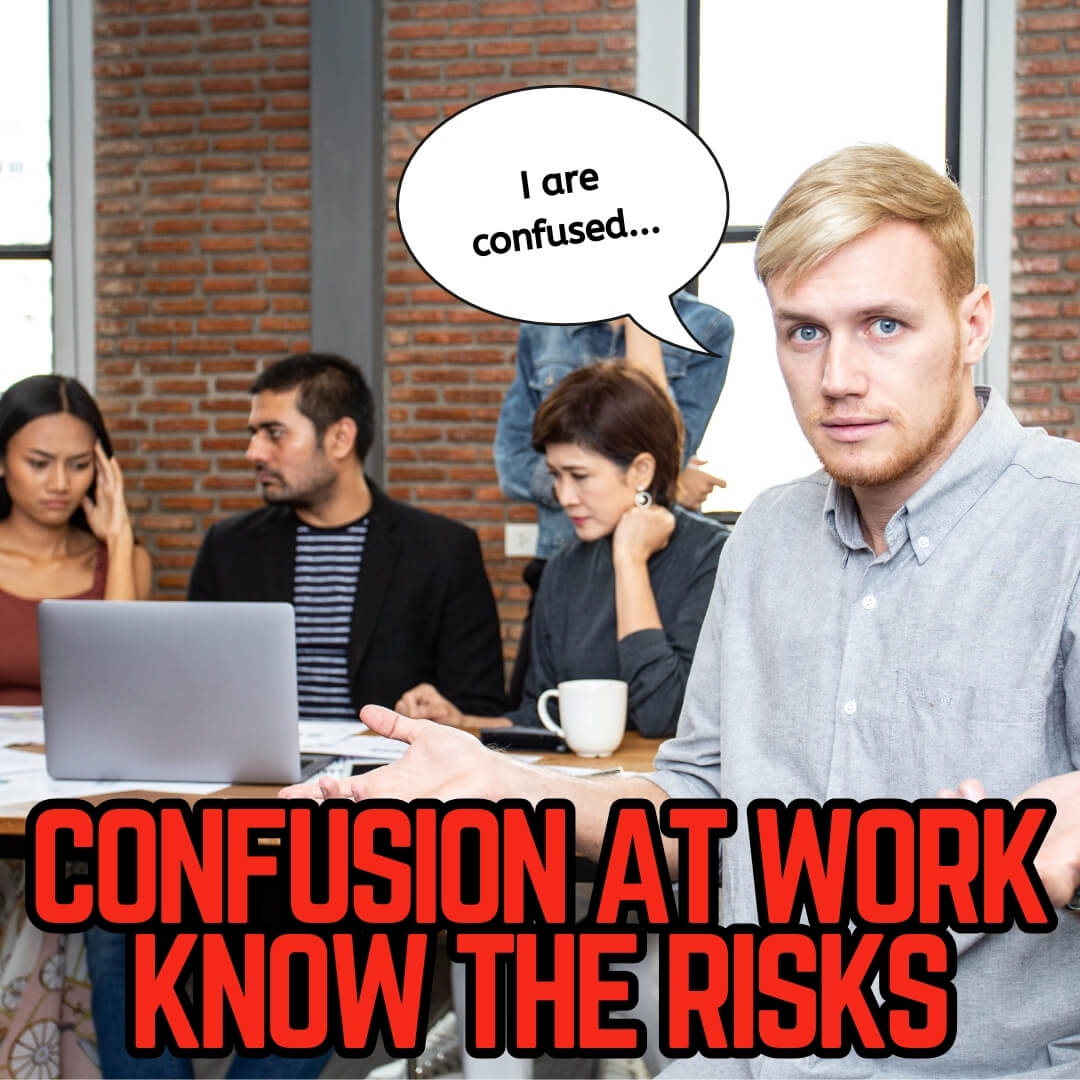
Confusion in the workplace can be confusing. As such, it’s good business practice to avoid moments of bewilderment before, during, and after the working day.
Confusion is bad for productivity as perplexity breeds a lack of progress that, in turn, hinders profit and creates annoyance for already overpaid employers like yourself.
As such, it’s good business practice to ensure NO ONE is ever left feeling muddled, befuddled, all at sea, or unclear in your working environment. THIS… guide ensures you can come out the other side in one piece.
The Basics: Employment Laws Regarding Workplace Confusion
The Confusion at Work Act 1974 legislates this matter. Said Act aims to deal with the issue of employees being unsure of what to do. To achieve this goal the, aforementioned, Act features some 17,000 sections with a page total of 234,000, with many paragraphs dedicated to trying to clear up any potential confusion created by previous paragraphs, sentences, sections, pages etc.
Despite this, many SMEs and larger organisations continue to find the Act wildly confusing.
As such, there was an attempt in 2019 to sharpen up, said, Act; but due to the often baffling nature of the, aforementioned, Act, with its endless segments of incomprehensible legalese and other jargon, attempts were abandoned two days after they began. Employment lawyers find the Act so confusing due to the abundance of:
- Simultaneous prose, as seen in novels such as The Reprieve by Jean-Paul Sartre
- Em dashes (—)
- Semicolons (;)
- Parenthesis and ampersands
- Pomposity
This means the unamended 1974 Act is here to stay, a convoluted mass of often conflicting information, leaving businesses to fend for themselves and hope for the best. Good luck with that!
Overcoming Obfuscation in the Office: The Fight Back Against the Act
An emergency helpline was established in 1975 to help thousands of businesses to try and comprehend the Act. Within 72 hours the helpline had melted down due to panic-stricken CEOs, directors, and managers calling in confused about the Act.
The emergency helpline was shutdown permanently in 1978 due to the catastrophic demands on national infrastructure to deal with relentless demand.
Businesses then began developing internal departments and structures to avoid mass employee confusion. This included:
- Dedicated wings in HR to deal with managers and staff baffled by the Act
- Confusion Units designed for employees to enter, become less confused, then alight to continue working
The Confusion Units (CU) were installed at workplaces from 1980 onwards, consisting of a 10ft by 5ft box with grey MDF walls.
Eventually, with befuddled mindsets dropping by the 1990s, many of the CUs were turned into workplace smoking shelters for employees to go and smoke themselves to death in.
Business owners got cocky and complacent.
The Act was considered a farcical remnant of bygone business era.
The belief was confusion at work was a thing of the past… but then the noughties arrived and brought with them TECHNOLOGY.
Business Confusion With New Technology and Stuff
With the arrival of the internal, PCs, and all that guff, The Confusion at Work Act 1974 returned to the fore of business mindsets circa 2010. This led to an influx in workplace:
- Bewilderment
- Befuddlement
- Muddlement
- Sketchiness
- Disorientation
Now, sadly, more professionals were more woolly about happenings than ever before and it led to a $371 billion loss in revenue from 2010-2015 due everyone being so all at sea about everything.
Eventually, in 2015, businesses realised they could overcome the issue by laying off staff. Fewer employees meant less indistinct professionals wandering about looking unhinged.
As such, it’s good business practice to lay off as many employees as possible, arbitrarily, and with vague reasoning, to ensure you keep confusion to a minimum in the workplace. Ultimately, it’s imperative to consider that famous quote:
“Keep your friends close, but your enemies closer.”
Confusion is your friend AND enemy. With it, you can disorientate employees and prevent them from getting salary reviews, bonuses, pay rises, and career advancement. But you must also deal with vastly inferior, dumb underlings screwing everything up as they’re too stupid to understand how to, for example, convert a Word document into a PDF.
It’s a careful balancing act, business owner, but one you can handle effectively by snorting a vast amount of cocaine.

I’m confused by this article?
A PDF?
– Polar Deferment Fund -? Something to do with the Santa posts?
LikeLike
No! A PDF is a type of sandwich, like a BLT, but with brown bread.
LikeLiked by 1 person
Potato, dill and fiddlehead sammies?
LikeLike
Sounds nice, tbh! With gravy.
LikeLiked by 1 person
🤢
LikeLike