
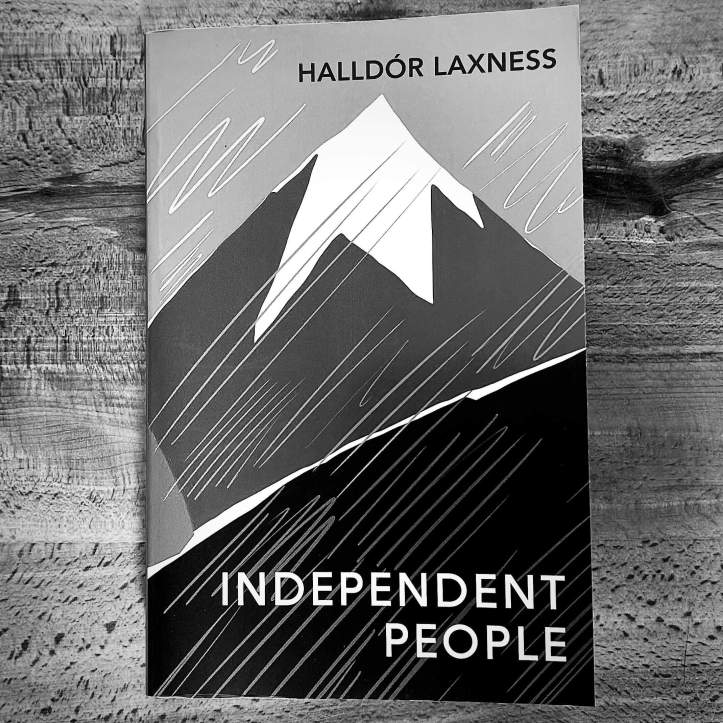
This is a book we’re still reading (as it’s 500+ pages), but we can highly recommend Halldór Laxness’s 1934 masterpiece Independent People (Sjálfstætt Fólk).
Considered one of the great Icelandic novels, it explores the life of stubborn sheep farmer Guðbjartur “Bjartur” Jónsson who yearns for material goods, financial independence, and the support of a good woman. Thusly, enter into this world of ice and obstinacy to discover what it means to be an moody man.
The Social Realism and Materialism of Independent People
“A new generation forgets the spectres that may have tormented the old.”
When you mentally prepare yourself for a book like this, you know what’s ahead. It’s about entering a vivid world of faithfully recreated scenarios (social realism) and you get to know the characters intimately.
James Clavell’s remarkable Shōgun (1975) was the last epic we read. And as with that masterpiece, within a few chapters of Independent People you realise Laxness is brilliant. There’s a darkly poetic nature to every sentence, always brooding away with a looming clarity. He’s vivid with descriptions, excellent with characterisation.
“And the spring breezes blow up the valley.
And when the spring breezes blow up the valley; when the spring sun shines on last year’s withered grass on the river banks; and on the lake; and on the lake’s two white swans; and coaxes new grass out of the spongy soil in the marshes—who could believe on such a day that this peaceful, grassy valley brooded over the story of our past; and over its spectres? People ride along the river, along the banks where side by side lie many paths, cut one by one, century after century, by the horses of the past—and the fresh spring breeze blows through the valley in the sunshine. On such a day the sun is stronger than the past.”
A sense of the vastness of time passing is a big part of the experience. The reader is always aware of Bjartur’s insignificance to the world, his fleeting moment in the world. And for his whole attitude to be quite insufferable, to be quite obnoxious to his new wife Rósa (convinced she’s mentally ill as she wants some meat to eat for dinner), says everything you need to know about the guy.
This is who we follow, but to keep up with his antics isn’t unpleasant. Bjartur is blockhead and lacking in critical thinking, but as a shepherd in Útirauðsmýri he performs his job diligently.
He discovers she is pregnant from another man and has a field day with that information.
All the while the while the weather broods over his existence, as it does play a significant role in the novel and shapes the narrative considerably.
“Shortly afterwards it started raining, very innocently at first, but the sky was packed tight with cloud and gradually the drops grew bigger and heavier, until it was autumn’s dismal rain that was falling—rain that seemed to fill the entire world with its leaden beat, rain suggestive in its dreariness of everlasting waterfalls between the planets, rain that thatched the heavens with drabness and brooded oppressively over the whole countryside, like a disease, strong in the power of its flat, unvarying monotony, its smothering heaviness, its cold, unrelenting cruelty. Smoothly, smoothly it fell, over the whole shire, over the fallen marsh grass, over the troubled lake, the iron-grey gravel flats, the sombre mountain above the croft, smudging out every prospect. And the heavy, hopeless, interminable beat wormed its way into every crevice in the house, lay like a pad of cotton wool over the ears, and embraced everything, both near and far, in its compass, like an unromantic story from life itself that has no rhythm and no crescendo, no climax, but which is nevertheless overwhelming in its scope, terrifying in its significance. And at the bottom of this unfathomed ocean of teeming rain sat the little house and its one neurotic woman.”
Spoilers here! Rósa dies during childbirth (mid-way through the book) whilst Bjartur is on an expedition. He decides to raise the child, Ásta Sóllilja (“beloved sun lily”), as his own daughter. The novel moves forward 13 years and we find he’s remarried, had more sons, but his obstinacy only continues to grow and when World War I commences, allowing him to finally find financial independence.
The fate of his daughter, however, is always perilous.
It’s a fantastic book, for sure, although as methodical in its pace as you’d expect. Its quite Shakespearian in its themes, with Bjartur seemingly hellbent on alienating all around him. All so he can be financially secure. Halldór Laxness was a pacifist, too, so the work’s anti-war themes are covered.
This makes it all a complex look at how independence can be destructive, leading to economic exploitation, alienation, arrogance, and obstinacy. A methodical indictment of destructive human tendencies and the capitalistic forces accompanying that.
“The tyranny of mankind; it was like the obstinate drip of water falling on a stone and hollowing it little by little; and this drip continued, falling obstinately, falling without pause on the souls of the children.”
Laxness weaves around this an intricate sense of Icelandic folklore and it’s a definite page turner. Despite its 500+ pages, a lot of readers will ravish their way through this one. It’s highly recommended.
The Legacy of Independent People
Independent People had a resurgence of late as actor Cillian Murphy, and author Max Porter (responsible for Grief is the Thing With Feathers), recommended it. Murphy has just starred in the 2025 film Steve where he plays a headteacher, based on Porter’s experimental novella Shy, which is on Netflix right now.
The pair were interviewed about their favourite books and one of them is Laxness’ work.
A note on our edition of the text, it was translated by J. A. Thompson (1913-2002). When the novel was first published in Iceland (as Sjálfstætt Fólk), it launched as two volumes in 1934 and 1935:
- Icelandic Pioneer
- Hard Times
There is a lot of suffering in the book, highlighting the seemingly inhospitable nature of the rural Icelandic landscape. But it is humane in that examination of human suffering, perhaps suggesting people look beyond fanciful long-term dreams and focus on the moment. Fostering strong interpersonal relationships, being empathetic, and relenting from the merciless drive for financial rewards.
Or… it’s a self-help book on how to get rich through sheep. Take from this glorious epic what you will, it’s a mighty fine read.
