
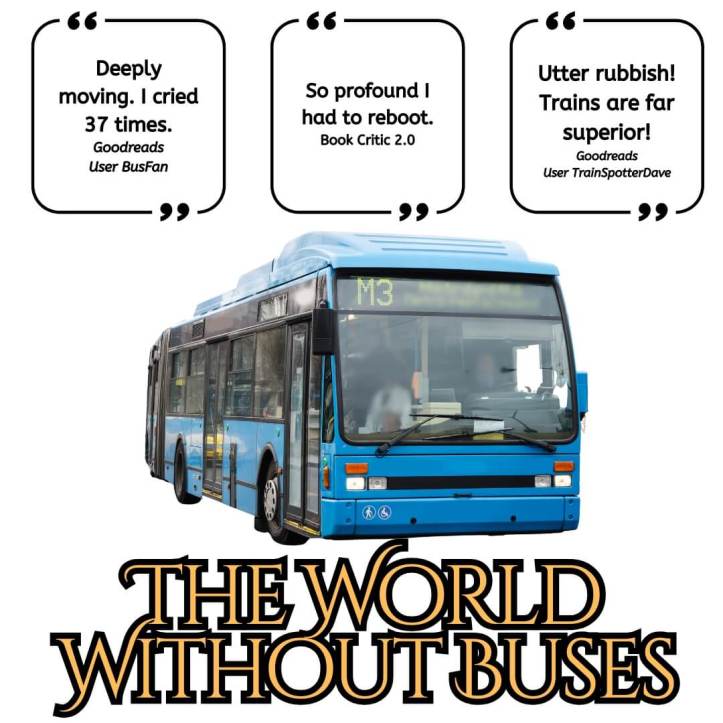
The World Without Us is a 2007 non-fiction work by Alan Weisman. It postulates what could happen if human beings were to suddenly disappear form the face of the planet (Earth, not Jupiter or anything).
Analogous to that famous work, but more heavily focussed toward automotives, is The World Without Buses (2008).
Written by a bus driver called Barry Smith from Bolton of Greater Manchester, it postulates what would happen to society if buses suddenly ceased to be. It’s a terrifying work, Barry’s magnum opus, and it’s so profound we fouled ourselves whilst reading the book.
A Horrifying Concept in The World Without Buses
“The only thing keeping modern civilization from collapsing is a double-decked Stagecoach bus. Those vinyl seat covers, consistent timetables, and cost-effective prices breed a righteous sense of cosmic security. Within that security there lies dormant the harsh reality that, one day, the bus may move beyond merely being late, moreover, buses my have a cessation of their being and all will be lost. A stranded humanity… the 501 to Preston isn’t going to arrive and we all have to accept that.”
This horrifying opening paragraph sets the scene. The 501 to Preston and, indeed, ALL buses aren’t going to be turning up at their, respective, bus stops. This is because buses no longer exists.
A conundrum of immense portent. Barry Smith argues the average person, when faced with this reality, would consider:
- Getting the train
- Getting a taxi
- Buying a car
- Flying (i.e. aeroplane, helicopter, or on an albatross)
- Using a boat
- Walking
Smith stresses walking would be a last resort as:
“Most people are so stunningly lazy they won’t even bother reading this book.”
Smith dubs the busless world as The Great Stranding. With tens of millions of people worldwide without access to a bus/coach, businesses would hit major financial repercussions and several would burst into flames at random.
The writer then argues a Bolton of Greater Manchester Containment Zone would have to be established for busless refugees, many of whom would get lost when attempting to navigate their way around minus a handy bus. However, towns and cities would soon be overrun by jungles as unused bus lanes would become overgrown with rare flora and the like, with lions, elephants, and zebras descending into the bus lane jungles and merging alongside regular.
Smith argues this busless world would be:
“Truly shit.”
And that:
“In this horrifying new world I’d be out of work, too, although that won’t matter if this book becomes a bestseller. Because then I can become a writer, my other idea, beyond this pseudoscience rambling, is a horror series of bus books in the style of Stephen King meets 50 Shades of Gray. Then I’d have that career and a busless world wouldn’t bother me that much then to be honest.”
Across 500 rambling pages, Smith continues in this way. We found it to be riveting! Just think about this concept: if your local bus route CEASED TO BE.
We find the idea so terrifying we’ve taken to going to bed with all the lights on, whilst playing bus noises like these on YouTube to act as a safety blanket.
Smith’s book is a work of genius. We’re 97.5% certain of that. You should read it and try to comprehend how society is only ever one bus stop away from total, hellish collapse.
The Response From the Train Industry
Train drivers responded angrily and in droves to The Would Without Buses. An angry mob of enraged train drivers stormed Bolton town centre a week after the book’s launch in August 2008. A total of £350s worth of damage was done to the town centre as a polite riot began, with train drivers kicking bins over and piddling in the street.
Local police responded by deploying water cannons and the train drivers were soon blasted into submission.
34 were jailed, with 17 of them receiving life sentences. As of 2026, 10 remain behind bars and are unlikely to see a bus or train ever again.

Well, that explains the state of things across the pond… No double deckers anywhere here!
LikeLiked by 1 person
Well, I use the street car. It is a nifty combo of train and bus. HA! So there!
LikeLike
A car? That’s SOOO last year, darling.
LikeLiked by 1 person
Not CAR…street car/streetcar.. it’s like a trolley car.
Sheesh! xox
LikeLike
Like a trolly at a supermarket?
LikeLiked by 1 person
Nnnnnnnnoooo….
LikeLiked by 1 person