
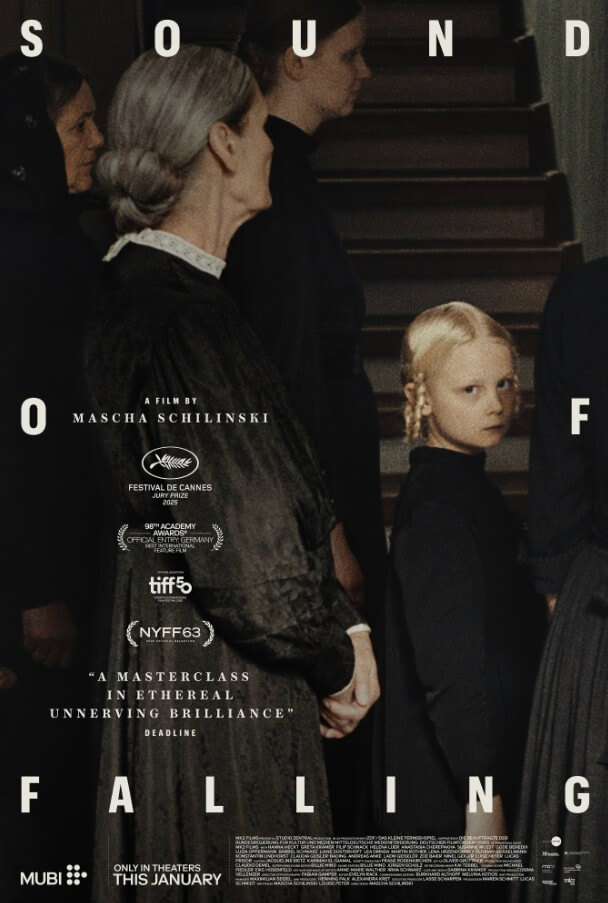
Directed by Mascha Schilinski, this 2025 German drama won the grand Jury Prize at the 2025 Cannes Film Festival. It’s easy to see why, as across Sound of Falling’s sprawling 155 minute run there’s psychological and visual wonder.
The narrative is non-linear, shifting between multiple families as they live in a farmhouse in the countryside. It’s a challenging film and, at its heart, we consider it a deeply feministic text about trauma and women lost to time.
Trauma and Timeframes in Sound of Falling
With its unusual narrative structure spread across just over a century, the film instantly made us think of Gabriel García Márquez’s classic One Hundred Years of Solitude (1967). But director Schilinski wrote the film after an inspirational summer holiday at a farm in Altmark, Germany.
There she saw a picture of three women at the farm in 1920, after which she imagined the intergenerational process of the lives then and ahead.
Sound of Falling (In die Sonne schauen) is spread across the 1910s, 1940s, 1980s, and 2020s. Essentially, it’s a teen drama with coming-of-age elements. But it’s also experimental.
Each era covers its own struggles, strife, and traumas. Set on a farm in the Altmark region, we discover different lives, different times, and different circumstances. Death, tragedy, and happenstance haunt every generation, but it’s the female characters who dominate proceedings.
In the 1910s we find young Alma (Hanna Heckt) who sees infant death and adult injuries all around her. Alma’s parents have recently enforced a major injury on their son (in which he loses his leg) so he avoids going into WWI. Meanwhile, she ruminates over the death of another young girl who looks like her.
The 1940s finds young women Erika and Irm, which switches forward to the 1980s when Irm (Claudia Geisler-Bading) is an older women and there’s no sign of Erika. This is one of the most striking parts of Sound of Falling, perfectly capturing its 1980s vibe. Rebellious teenager Angelika (Lena Urzendowsky) engages in provocative, sexually risky behaviours.
Finally, in the 2020s there’s young Lenka (Laeni Geiseler) who has all the joys of modern technology, but has low self-esteem and begins to idolise a cocky teenage girl called Kaya.
All told out with some very impressive cinematography, which really draws you into this stark world.
These stories twist and turn around one another, so you get a sense of changing social norms, economic struggles, and ideologies of the day. But at the centre of it all remains the concepts of the human condition, aligned with women dealing with what is still a very male dominated environment.
Played out on the remotest of all farmsteads, so there’s the sense these female characters are often just very alone, battling depression, trying to find some meaning in their lives.
Sound of Falling is often a very impressive film, but one that won’t appeal to everyone. Some viewers may accuse it of being a pretentious arthouse film where nothing happens. We don’t agree, we think it explores an enormous amount of themes, just without much dialogue, with a genuine feeling of intimacy.
It’s 155 minutes exploring the passage of time, merged into one moment, so the viewer receives a real sense of melancholy. Best watched alone, in a dark room, so when you emerge back into the world you’ll appreciate individual moments a little more.
The Production of Sound of Falling
The had its premiere at the Cannes Film Festival in May 2025. Mascha Schilinski became the first female director in 10 years to compete in the main competition, following on from Maren Ade’s excellent black comedy drama Toni Erdmann (2016) with the awesome Sandra Hüller (any chance to mention Sandra Hüller, we do it).
It’s Schilinski’s second feature film after 2017’s debut with Dark Blue Girl.
Sound of Falling only had a limited box office run in Germany, making $5 million. We watched it on the British streaming platform Mubi, who has the rights to the film. We’re not sure if it’ll receive a cinematic release further afield, but if you get to see this on a big screen we highly recommend it.
We’d be first in bloody line, the cinematography is amazing.
As for Sound of Falling’s production run, it stars unknown German actors. There were over 1,400 open auditions for the lead roles, with a casting focus on women whose faces would reflect each specific time period. This led to casting taking 12 months.
Filming took place in August to September 2023 for 34 days in Saxony-Anhalt, a state of Germany between Brandenburg, Saxony, Thuringia, and Lower Saxony.
Sound of Falling has received a fair amount of wider appeal since its 2025 launch, so the new attention brought to it in 2026 should put Schilinski more on the filmmaking map.
