
Okay, the issue of refrigerating food became a brief special interest of ours a few years back. Just how did people in the past store food without a fridge?!? It seemed such a laborious concept without one where you’d constantly have to be going out for food and preparing it on the spot.
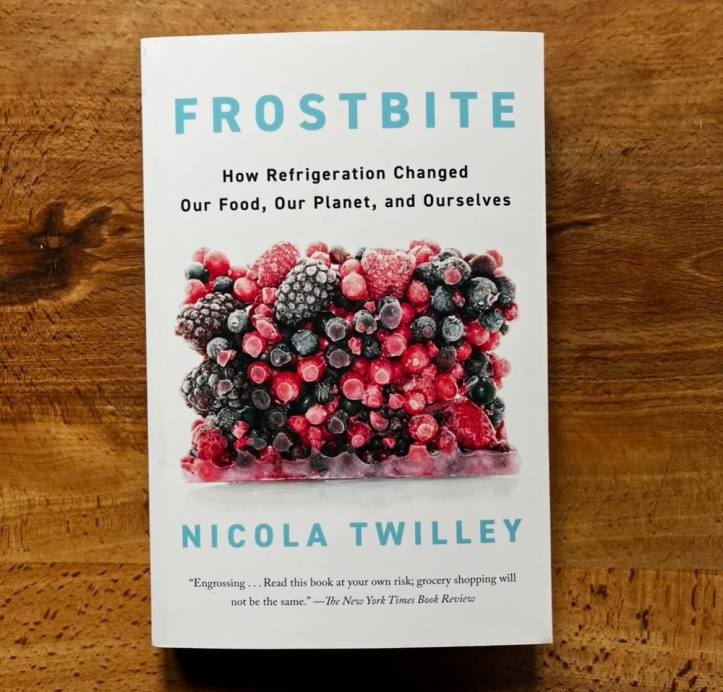
Well, good news, as Frostbite: How Refrigeration Changed Our Food, Our Planet, and Ourselves launched in June 2024 and has all the answers. Written by Nicola Twilley,
Blast Those Fridge Freezers on in Frostbite by Nicola Twilley
“None other than George Washington, first president of the United States, had problems keeping ice in a specially built cellar on his Mount Vernon estate. His diary entry for Sunday, June 5, 1785, records the disappointment: “Opened the well in my cellar in which I had laid up a store of ice but there was not the smallest particle remaining.”
Yeah, this book is a fascinating time of it. You may not think so when you look at your fridge, open it up, and stare at the half-used carton of almond milk inside. Or the kebab from last week’s rave still sitting there, just about edible.
But what did people do in the past? Ice storage. Many homes had a domestic icebox loaded with harvested ice on an upper shelf to keep food and drinks chilled. For a long time, the ice industry in the US and UK was the key way to store foodstuffs for longer. It was a luxury lifestyle, of course, and only rich people could hope to maintain ice near their home. Even then, it was far from reliable.
There were other tactics. Airtight food preservation being one, which the French inventor Nicolas Appert (1749-1841) experimented around with.
“A talented chef with no formal education, [he] wondered whether the method he used to put up sugared fruit in glass jars might be applied to the problem of conserving soup, vegetables, beef stew, and beans. ‘A dynamic and jovial little man,’ according to French historian Maguelonne Toussaint-Samat, Appert began his experiments by funnelling peas and boiled beef into old champagne bottles, corking them, and sitting them in hot-water baths for varying lengths of time. As curiosity became obsession, Appert sold his Parisian confectionery business and retired to a small town just outside the city, where he spent the better part of a decade perfecting his method. In 1803, Appert delivered the first batch of preserved food to the French navy for field-testing. The contents of his bottles received rave reviews: the beef was pronounced ‘very edible,’ while the beans and green peas had ‘all the freshness and flavor of freshly picked vegetables.’ Appert was awarded the prize and promptly used the money to finance more experiments. Rather than patent his technique, he published a book of detailed instructions so that anyone could master ‘l’art de conserver.’ Perhaps unsurprisingly, he died a pauper. Despite being formally recognized as ‘a benefactor of humanity’ by the French government, even his wife eventually left him, and he ended up buried in a mass grave.”
He’s considered the Father of Food Science. But as industrialisation ramped up, alongside the growing capitalist world, there needed to be much more than preserved produce and giant slabs of ice shifted around. And it came down to some money hungry mavericks to take on the challenge of creating storage units that could manifest cold.
The Very First Fridges Were Hell on Earth (sometimes)
Where Frostbite: How Refrigeration Changed Our Food, Our Planet, and Ourselves really kicks in is with the experimental arrival at modern refrigeration. English-American inventor Jacob Perkins came up with a vapor-compression system in 1834, the very first vapour compression unit that used ether.
In 1876, there was German engineer Carl von Linde’s ammonia refrigerator. This was closed-loop and relied on ammonia gas, a major step toward opening the path for grand scale commercial refrigeration units.
Not a big surprise, but early efforts were a bit all over the place and could also be dangerous.
“In the span of just a few decades, the public’s perception of refrigeration had flipped: something that had seemed risky, untrustworthy, and unnatural became instead essential to good health, in that it allowed consumers to consume perishable protein in the quantities necessary to achieve their full potential. This narrative not only appealed to the American enthusiasm for self-improvement but also reflected a widespread optimism about the power of technology to manage and, ultimately, improve upon nature.”
Yes, then, the public was highly sceptical (and sometimes hysterical) about these contraptions. People had reason to be, as sometimes food was stored in the units already in a state of decay, so when finally eaten people became ill. Cooling had been mastered, just not the scientific process of when is best to put certain foods into refrigeration.
Once thigs had calmed down a bit, Fred W. Wolf’s home electric fridge launched in 1913 and was the first unit available for consumers to add to their kitchen. The rest is history! For our generation over the last 100 years, these things are ubiquitous.
Plus, how your fridge works is a modern marvel.
“This system is called vapor-compression refrigeration and although it’s not the only means of making cold in use today, it is by far the most common. The evaporator, the off-whte circuit board, is the part that sits inside the back wall of your fridge, pulling heat out of the box and all the food in it. The compressor is typically housed in its own built in cubby at the back of the appliance, plugged into a power outlet. The condenser is always on the outside, either mounted on the back as a dusty set of coils, woven back and forth over a grid like a metal loom, or, in newer models, hidden behind a kickplate at the bottom.
The cycle relies on three key principles, all of which were vaguely familiar from high school science class: the thermodynamic truth that heat always moves from warmer to cooler; the law of physics that says the molecules in a liquid absorb heat when they boil, changing state to become a gas; and, finally, the fact that you can raise or lower the temperature at which a liquid evaporates by raising or lowering the pressure it is under.”
Nicola Twilley closes the comprehensive work out with her thoughts on where the industry is heading. There’s no doubt refrigeration has changed the world, but where will it be in a century from now? Is it sustainable?
We’ll leave off her theories her, but will conclude with saying this is an excellent book. The humble fridge may seem like a mundane household implement now, but it’s only in the last 100 years that it’s been a daily part of our lives.
Before that? Well, you no cake in your fridge, sir or madam. You’d have to eat it all in one sitting, or watch it rot.
And a Bit About Nicola Twilley
This book won Tilley the 2025 James Beard Award for Literary Writing and the Nach Waxman Prize (amongst various other accolades). Her other books include Until Proven Safe: The History and Future of Quarantine.
She’s also the co-host of the podcast Gastropod that consider popular foodstuffs through a scientific and historical lens.
As you can see above, she’s also provided a TED talk about refrigeration. It’s one of those topics you likely never thought much about, but it sure is interesting when you peel back the layers. Twilley’s focus on these obscure topics is rather glorious and we await her next project with frozen anticipation.

Very interesting. I like the cover too. I always thought back in the old days they had ice delivered several times a week. Thanks for the review and info.
LikeLike