
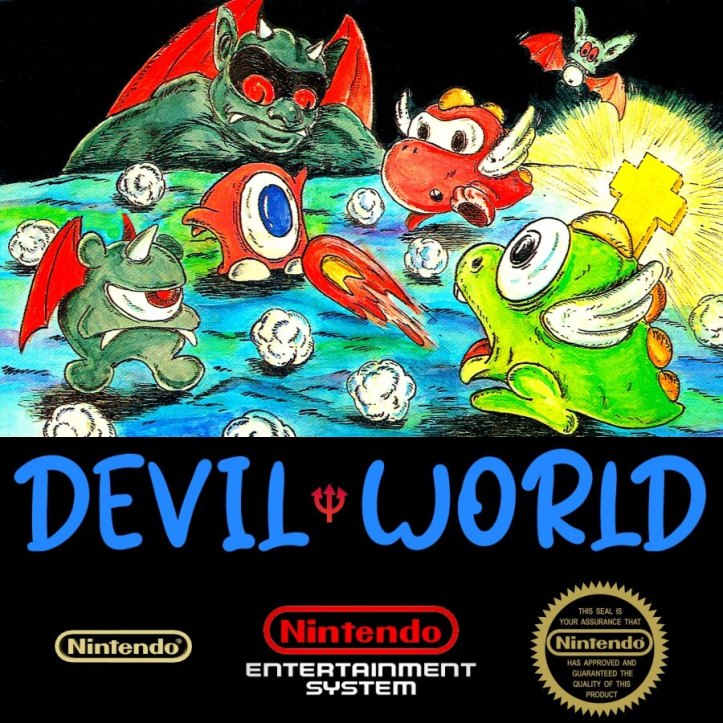
Devil World is one of the most obscure games from creative genius Shigeru Miyamoto, the man behind Mario, Zelda, Donkey Kong, Metroid etc.
Launching in October 1984 on the Nintendo Entertainment System, with help from Japanese developer Intelligent Systems, this was Miyamoto’s first ever console-only video game!
It’s a curious take on the Pac-Man arcade concept, with a strange focus on the devil, but it’s noteworthy as its creator went on to such astonishing creative heights. Let’s get demonic!
Enter the Satanic Maze Lair of Devil World!!!
Unbeknownst to us, previously this was launched on the Wii and Wii U virtual console. We finally caught up with it on the Nintendo Switch NES selection.
Miyamoto was enthusiastic about his first console-only creation. Nintendo had already let him spearhead the iconic arcade game Donkey Kong (1981), which was a huge hit and enormously influential on the gaming industry. He drafted in young game designer Takashi Tezuka to help him with the title in Nintendo R&D1.
Devil World, aside from its obvious Pac-Man influences, it adds in an ingenious twist—two players!
The first player controls a green dragon called Tamagon who’s decided to rampage through the satanic underworld.
A second player can join in, then navigate through the maze-like stages together, picking up crosses that let the player breathe fire and eat on-screen dots (Pac-Man influence there). You can also find copies of the Bible to wield. The goal? Get to the end of the stage to seal the level.
Whilst that plays out, the devil does a kind of merry jig at the top of the screen.
We gave this a whirl last night and it’s pretty good fun. Nothing memorable going on, although it does bear the hallmarks of Miyamoto’s trademark inventiveness.
That really kicked off from 1985 with the first Super Mario Bros. title, the influence of which resonates to this day in every single game you see and/or play.
The Fate of Devil World in America
Keeping in mind the NES (Famicom as it was called in Nippon) was a console aimed primarily at kids, with gaming still in its infancy, and it may cover off some of Devil World’s oddness.
In the early 1980s, more conservative families were on edge about video games, concerned they make people anti-social and violent (just a reminder, but there are plenty of non-violent games people can play—as we’ve flagged up on this blog over the years).
Miyamoto’s design decisions were innocuous enough, but seem custom made to outrage someone out there and trigger riots. The always affable game designer was just playing on famous cultural iconography, which he continued doing. For example, his Metroid NES (1986) game is a homage to Ridley Scott’s 1979 film Alien.
Weirdly enough, Devil World isn’t the only NES game to play on religious concepts. There were a series of Christian developer-led Bible games for the console.
Most of these were bizarre in their implementation, they were also an unofficial release and not endorsed by Nintendo. But that didn’t stop US advertising campaigns!
Satan also turns up in the notoriously, hellishly difficult Ghosts N’ Goblins (1986). A game so punishingly difficult playing it is, very much, like being in Hell.
Back to Devil World now—after it launched in Japan, Miyamoto flew out to see Nintendo of America’s (NOA) president Minoru Arakawa about a potential release in the US.
Nintendo’s stance has always been to balance out differences and avoid infuriating different cultures, which has led to its “family-friendly” image (which we think is more about Japanese sensibilities of politeness than being “soft” or anything). Arakawa didn’t want to release the game—NOA’s policy was to not use religious icons in gaming.
Result? Devil World didn’t launch in North America (Americans, you can now play the game on the Switch online NES selection).
There are some sensationalist, clickbait videos on YouTube about Devil World claiming (IN CAPITALS!!!) the game was BANNED (!!!) in America. It wasn’t banned, it just wasn’t released.
But it did get a European release in July 1987.
That three-year gap between the Nippon to Europe release was the norm in the 1980s and 1990s. It would just take years between releases, with many titles not even making it over here. These days, of course, everything tends to launch seamlessly worldwide.
Thus, the game launched and largely fell into near total obscurity, now standing only as a curious opening gambit in the otherwise all-dominating Miyamoto legacy.
