
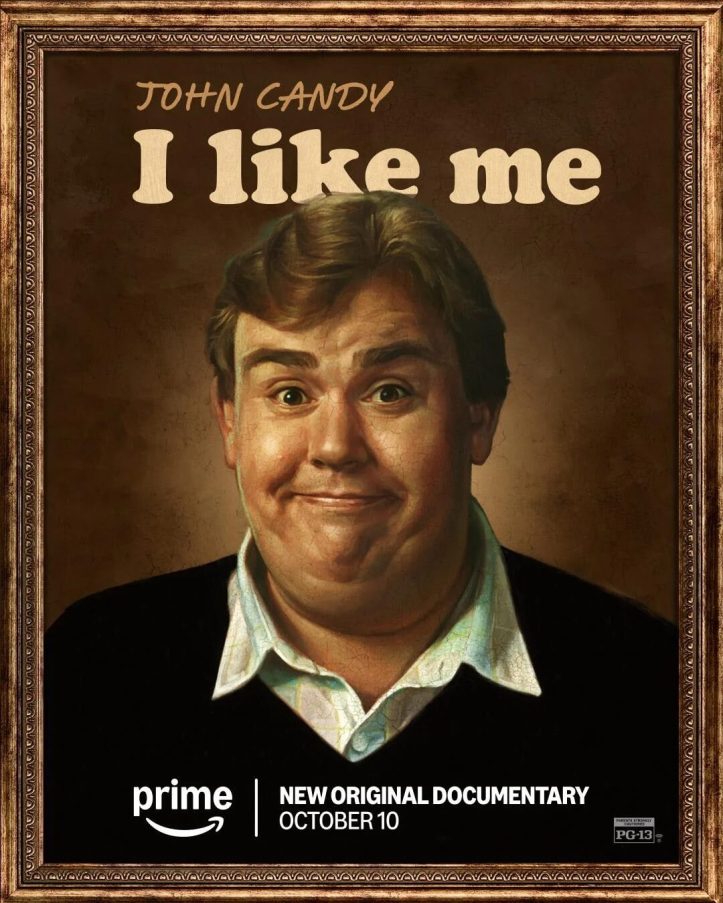
Here’s an excellent documentary that launched in October 2025 on Amazon Prime (streaming only, no cinematic release). Directed by Colin Hanks, son of Tom, it’s a two hour look into the life of a comedy legend.
John Candy: I Like Me explores the life of the comedian and actor, who died suddenly in March 1994, with extensive archival footage, modern interviews with A list actors, and input from his two children and wife.
Not a Dry Eye in the House for John Candy: I Like Me
If you’re an ’80s or early ’90s kid, you’ll know exactly who John Candy is. Look at this film roster: Cool Runnings, JFK, Splash, Spaceballs, Home Alone, Uncle Buck, Planes, Trains and Automobiles, Delirious, Brewster’s Millions etc.
I Like Me is an excellent documentary. It reminds us of Super/Man the Christopher Reeve documentary from 2024 as, like Reeve, Candy was a very genuine and honest person. There was no persona, no ulterior motive, just bags of charisma and smarts.
What the documentary explores is the build-up to Candy’s death in March 1994 aged just 43.
Many people will know his films, but not the man behind the actor. As there were a key moments in his childhood that shaped the rest of his life. Candy was born on 31st October 1950 and grew up in a working class family in Toronto, Canada.
A defining moment in his life came early when his father died of a heart attack at the age of just 35. His son was only 5 years old. This catapulted Candy into a figurehead role in his family and left him anxious and paranoid the rest of his life regarding the health of his family.
But with bags of energy and natural charm, he took up many responsibilities early in life, played the drums, and joined his college’s American football team. In his teens one of his knees went and, for the rest of his life, that hindered his movement.
He loved acting and turned to comedy instead, joining the cast of the popular Canadian improvisational comedy team The Second City. He immediately worked with pre-fame names such as Martin Short, Rick Moranis, Harold Ramis, Bill Murray, Joan Rivers, and John Belushi.
Working in that drew him to the attention of one Steven Spielberg, who gave him a small role in WWII comedy 1941. He then had a small part in cult classic The Blues Brothers (1980), starred in a lesser role to Bill Murray in Stripes (1981), then had a lead role in the American-Canadian production Going Berserk (the latter being a box office failure).
It’s after starring alongside Tom Hanks in Splash (1984) that he became a superstar. Despite all that extra attention, as you can see here interviewed in 1985, he remained very grounded and personable.
Films like Uncle Buck followed, where he got to show off his comedic chops like this. And also play into his loveable big guy character, often playing characters much older than he actually was (even though he was only 37 in the film).
Candy struck up a partnership with director John Hughes (1950-2009), which led to films such as Home Alone (1990). Candy’s role in the iconic Christmas film is brief, as he only had 24 hours to record all of his scenes. He adlibbed almost everything and stayed up for 23 hours to get everything done.
Then in 1992 he had a role as a smooth talking lawyer in Oliver Stone’s JFK.
This was his first dramatic role away from comedy and won a lot of praise. It hinted he was planning to move toward more serious roles and it’s clear he would have been very good in drama. Sadly, the clock was ticking and underlying health problems were piling up.
Notes on Candy’s Health
One of his defining characteristics was his size. He was a big man and he struggled to keep his weight down throughout his life, often eating, drinking, and smoking heavily. These were ways of handling his battles with anxiety and stress.
His knee injury as a teenager also kept him less active, as he had been very sporty in his youth until then.
I Like Me is very candid and upfront on his weight. Several interviewers in the 1980s even confronted Candy about it, with the actor batting away the questions. It was even referenced, in rather poignant fashion, in some of his early films.
With what happened to his father, he was aware about the problems of being overweight. At some stages of his life he weighed 375 pounds (26 stone) and attended a clinic to lose weight.
He did that (shifting some 7 stone), but in an industry so dominated by image his studio warned him not to lose too much weight. Part of his brand was the big jolly guy, so Candy felt the need to commit to that.
He was also just a very nice bloke and a people pleaser, wanting to make everyone happy and have a good time. This meant he forced himself through serious anxiety issues to deal with that, leading to further drinking and overeating.
Cool Runnings to Wagons East
One of Candy’s final films was the iconic Cool Runnings, which launched in cinemas on 1st October 1993. We remember watching it in the cinema and loving that a great deal. It was a big hit, earning over $170 million at the global box office. It also once again prove the actor’s star power and hit making success rate.
Candy also filmed Canadian Bacon in 1993 (the launch was delayed until 1995), then he began work on his next project in early 1994. This was Wagons East.
Under contract with Carolco Pictures, he had to appear in this. The shoot was in Durango, Mexico, with Candy and his fellow cast living in local hotels. Even though it was early in the year, it was baking hot and an unpleasant experience. The cast and crew were aware the film wasn’t going to be great.
After completing filming on March 3rd, 1994, Candy was exhausted and returned to his hotel. During the night he died of a heart attack.
As the film wasn’t finished, and Candy was the lead actor, director Peter Markle turned to CGI, body doubles, and script adjustments to wrap up production.
His death came just five months after Cool Runnings launched, one of the defining films from his career. For a young editor here, we remember our father (during a car journey) mentioning that Candy had died. Our editor was nine, so it wasn’t quite clear what that meant or how it could have happened.
Over 30 years later and it’s intriguing looking back.
The guy was a major film star at a time when Hollywood was a lot different to now. Many of the films back then were great, but twee and sentimental, and an unrealistic and fanciful take on reality. That might be more what you want from a film, but times change and we have a new era upon us.
But it is sad to see him left back there in 1994. Such a devoted family man not getting to see his two kids grow up.
What we do love is I Like Me marks the end of Candy’s film career in proper fashion. Not Canadian Bacon from 1995. But this considerate, thoughtful, moving documentary that examines his life and reminds us this was a great guy who brought a lot of love to the world.
The Production of John Candy: I Like Me
The above is an interview from September 2025 with director Colin Hanks and John Candy’s two children, Chris and Jennifer, who are both in their early 40s now. Movie star Ryan Reynolds was also one of the producers.
I Like Me had its premiere in September 2025 at the Toronto International Film Festival. Canada’s prime minister, Mark Carney, attended the premiere. He told the press:
“We’re in a more dangerous, divided, and intolerant world. In Canada, our sovereignty, our identity has come under threat. And when Canadians heard those threats, they channelled their inner John Candy. Stood up, elbows up, wrote our own lines.”
It’s now available to stream on Amazon Prime (you have to have a subscription to watch it).
One of the telling things about the whole project is Colin Hanks had to approach the documentary knowing there were no major revelations. Acrimony, conflict, controversy, and crime tend to draw people towards many films. There was none of that with John Candy and the documentary starts with Bill Murray being asked that. Is there any dirt on this guy?
No, he was just a good-natured man who wanted to do good in the world in his own way. This is very poignant at the documentary’s conclusion, as it’s revealed hours before his death in a poverty-stricken region of Mexico, he lowkey donated a large sum of money to a local hospital.
No bells or whistles, fanfare, or informing the press for positive publicity. He just did it to make a difference.
