
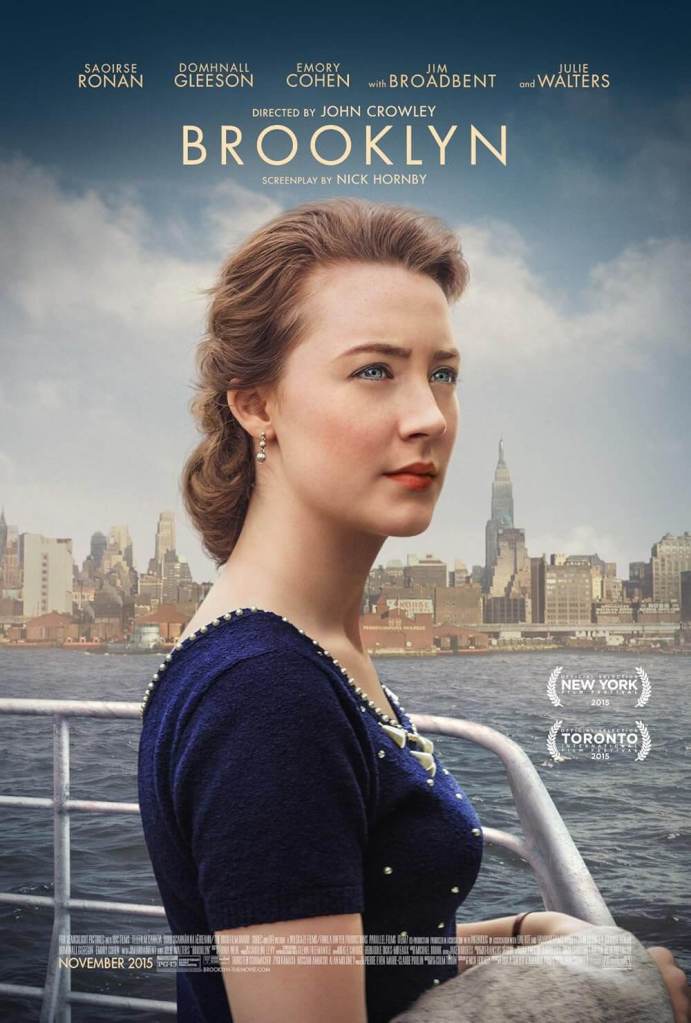
Directed by John Crowley, and with a screenplay by Nick Hornby, this 2015 romantic period drama follows the life of an early 1950s Irish immigrant and her new life in America.
It’s based on the real life events of the time, when Irish women headed to New York for work. The result here is very impactful, with a brilliant lead performance by the ever-awesome Saoirse Ronan.
From Homesickness to Home in Brooklyn
Homesickness is a big part of Brooklyn, as is being Irish. Set in 1951, the story follows the life of early 20s Irish immigrant Eilis Lacey (Saoirse Ronan).
As was common circa 1950, young Irish people (particularly women) left Ireland for New York in search of a better life. Post-WWII America needed new workers and the like, so along came eager people to start a new life.
Eilis leaves the town of Enniscorthy and it’s during her long boat journey to the US that Brooklyn shakes things up. This is no twee romp along, as we meet the feisty shipmate Georgina (Eva Birthistle), seasickness, a bout of toilet humour, and more Georgina being wildly charismatic.
Once in New York, Eilis struggles to come out of her shell. She’s shy, retiring, and gets batted around by the loud nature of city living.
She lives in a boarding house run by a certain Mrs Kohoe (Julie Walters on feckin’ glorious form), with her young immigrant Irish flatmates having lively BANTER across the dinner table each night. There are several scenes like that spread over several days, weeks, and months. The six of them bickering and giggling is arguably the best bit of them film.
Elsewhere, and with the help of her employer Miss Fortini (Jessica Paré), Eilis meets Irish émigré Father Flood (Jim Broadbent) and she’s put on to a local dance for Irish immigrants. It’s a weekly meet up to encourage socialising, meeting a fella, and getting married.
At the dance she hits it off with Tony Fiorello (Emory Cohen) and they begin dating.
The main plot arc to Brooklyn sees Eilis growing in confidence in a new land, flirting with Tony, and training with the goal of becoming an accountant.
In the second half of the film she returns to Ireland to attend a funeral (the death of a family member).
One alarming period detail that surprised us is when Eilis is back in Ireland for a funeral. She gets a lift in a car of four and no one is wearing a seatbelt. We checked the law and it was only in 1965 that seatbelts became a normal thing in cars, but most drivers and passengers didn’t use them as they were “uncomfortable”.
Anyway, whilst there she has wealthy local hunk Jim Farrell (Domhall Gleeson) take an interest in her. They have several semi-serious dates, all whilst Eilis takes a fancy to the Irish countryside all over again.
It’s it’s a film about a young lady overcoming her homesickness and finding her way in life. The temptations of Ireland, the familiarity of her early life there, are put to one side to escape the stifling routine.
The terrific cast make this what it is. And they’re headed up by the genuinely brilliant Saoirse Ronan (along with Mia Goth, she makes up two of the most talented young actors in Hollywood), who moves from a quite simpering character into a lively and confident woman.
Brooklyn does an excellent job of also capturing a sense of time and place.
The crew has made this look like the 1950s, all with the little attentions to detail (the car seatbelt bit), moving as it does from the bustling streets of New York to the isolated world of Ireland. Very good, then, as with its sedate pace and calm approach the film manages to still say a hell of a lot.
And it’s at its best as a funny, poignant, but ultimately uplifting film about a young woman finding her agency. She takes control of her life and makes decisions for herself, breaking free from common shackles of the time (i.e. marrying any old dude to ensure financial dependence). Feckin’ marvellous.
The Production of Brooklyn
Brooklyn was considered one of the best films of 2015, with a then 20/21 Ronan leading the cast confidently. Domhall Gleeson was still emerging as a big name back then and is one of the more lowkey movie stars around these days.
Happily, the film was a hit. Off an $11 million budget it made $62.4 million worldwide. Proof a quiet, slow-paced story like this can still resonate with a wide audience.
It also three Oscar nominations and won the Best British Film at the 2016 BAFTAs.
Nick Hornby adapted Colm Tóibín’s 2009 eponymous book for the screenplay. Tóibín later praised the film’s authenticity. To ensure that, the cast and crew filmed on Ireland in April of 2014 for three weeks, some filming in Brooklyn of New York to capture the required city scenes.
It’s intriguing to note the film’s historical context, too, as Irish immigration into American had been occurring since 1845 (during the Great Famine). That remained a constant for some time, only slowing during WWII, with most immigrants being Irish women.
This influx of women eager to work led to a chance in social norms, with marriage plans put on the backburner as a new sense of independence took over. You can see that in Eilis, who begins to flourish in her work and push for a more meaningful career.
