
Whenever we head to London we always like to visit the Wellcome Collection near Euston train station. The museum offers insights into medical marvels from there over the centuries.
It did used to have a fantastic library and shop, too, but last time we went (in 2021) there wasn’t a sign of it post-COVID. Dang.
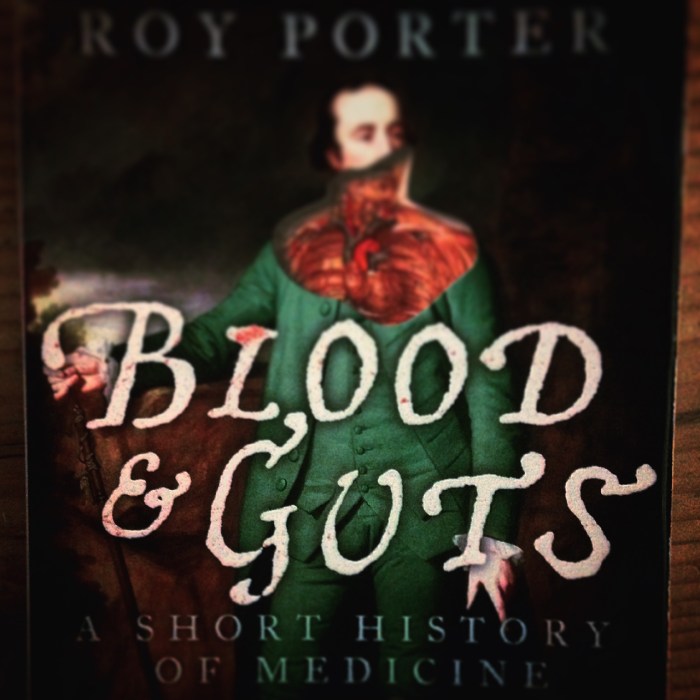
But it does make us cherish Roy Porter’s fantastic Blood & Guts: A Short History of Medicine all the more. It’s a brilliant work first published in 2002 and one we picked up on our first Wellcome visit in 2015. It’s been a firm favourite read of ours ever since.
The Path to Modern Medical Marvels in Blood & Guts: A Short History of Medicine
“The art has three factors, the disease, the patient, the physician. The physician is the servant of the art. The patient must cooperate with the physician in combating the disease.” Hippocrates, Epidemics, I, II
It’s fair to say we’re very lucky to be alive at a time when medicine is so advanced. Anything from circa 1950 below and you’d have a hellish time of it, with limited (even primitive) knowledge and very low understanding of mental illnesses.
That’s what makes Blood & Guts: A Short History of Medicine so infinitely fascinating. And bloody disturbing, too. It’s spread across eight chapters:
- Disease
- Doctors
- The Body
- The Laboratory
- Therapies
- Surgery
- The Hospital
We’re going to pick a few of these to have a look through, but be warned! Things get squeamish ahead.
But you’re likely here as you find that type of thing fascinating. Whether you’ve read Dr. Oliver Sacks before or R.D. Laing’s The Divided Self (1960), this is fine complement to the world of medical literature.
One that provides the layperson with a brilliant, concise introduction on how we got to the present day.
Now, get hold of your scalpel, down a shot of brandy as an aesthetic, and let’s explore this world of bacteria and other horrors.
Disease
“The war between disease and doctors fought out on the battle-ground of the flesh has a beginning and a middle but no end. The history of medicine, in other words, is far from a simple tale of triumphant progress. As is hinted by the story of Pandora’s box or the Christian Fall, plagues and pestilences are more than inevitable natural hazards which can, we hope, be overcome.”
Porter starts this work with a look at disease. The word itself is enough to strike fear into us mortal humans—disease.
Porter explains around five million years ago, Africa was home to the first signs of ape men (Australopithecines). Over three million years, they evolved into Home erectus.
Those clever clogs learned to make tools and light fires. They also spread out across the world around a million years ago, leading to Homo sapiens circa 150,000 BC.
As they were nomads who led brief lives, they must have missed many unpleasant diseases such as smallpox and measles. It’s actually when humans began colonising areas, creating villages, towns, and cities, that the chance for disease exploded.
“As humans colonized the globe, they were themselves colonized by pathogens. These included parasitic worms and insects – helminths, fleas, ticks, and arthropods; and also microorganisms such as bacteria, viruses and protozoans, whose ultra-rapid reproduction rates produce severe illnesses within a host but generally – the silver lining – provoke in survivors some immunity against reinfection. Such microscopic enemies became locked with humans in evolutionary struggles for survival characterized not by ultimate winners and losers but by uneasy coexistence.”
Agricultural practices could provide humans from starving, but this was one of the major bringers of infectious diseases.
Cities and empires arrived, such as Mesopotamia, but this brought with it the first and truly appalling outbreaks of savaging epidemics.
“Reputedly beginning in Africa, a dreadful pestilence hit Greece in 430 BC, its impact on Athens being recounted by the historian Thucydides. Victims succumbed to headaches, coughing, vomiting, chest pains and convulsions; their flesh became red with blisters and ulcers; and the trouble descended into the bowels before death spared them from further suffering. What was it? We do not know, but it was so catastrophic that it spelt an end to the ascendency of Athens.”
Such outbreaks led to the first “doctors”, which appeared in ancient Egypt as Imhotep (circa 2,600 BC). The Egyptians actually documented over 200 medical conditions.
The Greek physician Hippocrates is regarded as the father of medicine.
Not that there was much understanding about what was taking place with these major epidemics and pandemics. The onslaught of an angry God remained a constant consideration.
But the most common scourges for many hundreds (and thousands) of years remained in the form of smallpox, tuberculosis, and plagues.
Up through The Age of Discovery you had the likes of scurvy, which baffled the medical world until the 20th century. And we can’t discuss the Middle Ages without considering the horrors of the Black Death during the Medieval period.
It savaged Europe with its first outbreak in 1346 and changed the course of human history.
Alongside that were disturbing STDs, such as syphilis. Thanks to The Age of Discovery, it could spread with wild abandon. One individual, Joseph Gruenpeck, recorded:
“In recent times, I have seen scourges, horrible sicknesses and many infirmities affect mankind from all corners of the earth. Amongst them has crept in, from the western shores of Gaul, a disease which is so cruel, so distressing, so appalling that until now nothing so horrifying, nothing more terrible or disgusting, has ever been known on this earth.”
In modern times we can at least take solace in understanding, to some extent, why these diseases occur. But hundreds and thousands of years ago, it will have been baffling.
Porter’s chapter is a timely, terrifying reminder that:
“Until recent times life was everywhere lived under the empire of disease.”
And that’s certainly one thing we can’t complain about these days. No matter how long you have to wait the next time you’re at some NHS clinic, at least we can be thankful for where we are with modern medicine practices.
Doctors
Chapter two here covers what we now take for granted, as there was a time in human history when this wasn’t a profession.
It didn’t take long for some chancers to give it a whirl (shamans, for example), even if their knowledge would have been non-existent.
“But from early times, healing also became the craft of diviners and witch-doctors, fighting off the disorders raining down from above and offering remedies. Ancient cave paintings, some 17,000 years old, depict men masked in animal heads, performing ritual dances; these may be our oldest images of medicine-men. With the evolution of more complex settled societies, herbalists, birth-attendants, bone-setters and healer-priests followed.”
A lot of diseases were though to be caused by religious disturbances, with an illness being the work of a devil.
With little understanding, we find it incredible the reach of human ingenuity here. With regard to fabricating all manner of delusional ideas as a cure-all.
We refer here to Jack Hartnell’s excellent tome Medieval Bodies (2018), which explores some of the bizarre medical practices of the day. Asides from endless leeches, there was uroscopy that led to practitioners shaking, stirring, and tasting urine to determine illnesses.
Referring back to the Black Death, we read of one Italian doctor who tried smearing human faeces on buboes in the belief that’d do something beneficial.
It’s remarkable to think these often well-paid doctors, under the belief they were highly skilled and professional, were utterly hopeless.
That situation became prevalent in the Tudor era onward. By the time of the Georgian era (1714-1837) in the UK doctors had all manner of bizarre ways of dealing with issues. Such was depicted in The Madness of King George (1994) with the King’s lapses in and out of lunacy.
Looking back now, you can see the inherent black humour in the disastrous misunderstandings from doctors.
The excellent historical sitcom Blackadder II mocked that rather mercilessly.
In the Medieval era Blackadder II depicts, doctors believed in the four humours (Humorism). Again, this is credited to Hippocrates. These were:
- Blood
- Yellow bile
- Black bile
- Phlegm
These were believed to be massive influencers on the human body and its varying emotions. Although physicians moved away from it by the time the 17th century rolled around.
It completed cleared off, too, once germ theory arrived on the scene in the 1850s.
And from that point onward, doctors slowly began to get their act together. Slowly, anyway, with the likes of amputations still being an agonising process that often proved deadly.
There’s the famous example of Robert Liston (1794-1847), a British surgeon who was legendary (i.e. infamous) for his speed and efficiency. He could amputate a leg in just over two minutes, which was probably a handy thing in an era minus pain relievers.
But many other doctors were just there for show, really, to lend a sympathetic ear to the terminally ill.
Porter includes the below painting by Luke Fildes called The Doctor (1891), which cemented in the public’s mind the idea of a proper doctor—earnest, studios, and ideally set with a great big beard.

Just an FYI, but Fildes received £3,000 for that painting (a work commissioned by Henry Tate in 1890). That’s £137 million in today’s money (there or thereabouts).
To note, it was so well admired it received a tour of the UK. An urban legend has it that one person died when they saw it as they were so overwhelmed by its brilliance.
In the weekly satire magazine Punch, Bernard Partridge mocked that depiction in 1911. This was to make social commentary on the National Insurance Act 1911 affecting doctors.

A wider emphasis of The Doctor is picked up by Porter, where he flags up The Horse and Buggy Doctor. This was an autobiography by Arthur Hertzler (1870-1946) who noted in his book:
“The usual procedure for a doctor when he reached the patient’s house was to greet the grandmother and aunts effusively and pat all the kids on the head before approaching the bedside. He greeted the patient with a grave look and a pleasant joke. He felt the pulse and inspected the tongue, and asked where it hurt. This done, he was ready to deliver an opinion and prescribe his pet remedy.”
You may have noticed these days, but things are a bit more thoroughly and based on medical and scientific knowledge.
The Hospital
“Medicine initially made do entirely without hospitals; and for long they were marginal – indeed, many people were sceptical about their value.”
We’re concluding our nit-picked three chapter run with hospitals. These days, if you fell over and broke your leg you’d think nothing of heading to your nearest hospital to get it shipshape again.
When we first read this chapter in 2015, we were surprised to find a hospital visit used to be a dreaded, much-feared last resort for most in society.
A sign your end of days was here, as opposed to your route back to full health.
It’s actually Christian virtues that pushed for basic concepts of hospitals, in Medieval times under the bequests of nuns and monks (when not burning each other at the stake or heading off into total war for religious differences, that is).
But these buildings were always very modest, consisting of a dozen beds or so, and were lacking in the likes of ventilators, defibrillators, and X-ray machines (believe it or not). As Porter notes:
“Beyond London there were no medical hospitals at all in Britain as late as 1700.”
It wasn’t until the Crimean War (1853-1856) that there was a nursing reform and, with that, push for better hospitals. This was the work of the legendary Florence Nightingale.
Globally, across the 20th century, advances have been astonishing.
There were also major reforms. In the 1960s, the mass closure of psychiatric hospitals to house the “mentally ill” went ahead (deinstitutionalization in the US), as depicted in the likes of Ken Kesey’s One Flew Over the Cuckoo’s Nest. Hospices took their place instead.
And although these days no one likes going to hospital, they do so to receive treatment that can save their lives.
Not with a sense of intolerable dread that the place will, essentially, be a slum. Now that is progress!
Blood & Guts? Yes, Indeed!
The thing about Roy Porter’s work we really like? How he recounts humanity’s arrival at some semblance of knowledgeable medical control with good cheer.
His tone across the chapters, whilst sombre when needed, accommodates for the inevitability of all this. Of a medical mind aware of the vulnerabilities of human existence, so why not take a Camus style Myth of Sisyphus approach to it all?
As in, live your best days with a vengeance as life is fleeting.
It’s a taboo subject is death, one a lot of people refuse to engage in conversation about. That approach has led to some seriously anachronistic laws here in the UK (such as a total lack of any assisted dying policies), but works like this help you realise how lucky we are in present times.
As we’ve said throughout this review, modern medicine is a marvel.
Think back just a short while ago and dentists were yanking people’s teeth out minus an anaesthetic. Or worse, you had people stuffed into insane asylums as a solution to mental health battles.
And whilst Blood & Gut is over 20 years old now, it still encapsulates a long era of human history where people (medical professionals included) just didn’t have any idea what was going on. To read about it is always fascinating and dreadful in equal measure.

People in the old days believed putting a hole in the head was a good idea.
When you said that people removed the brain in order to cure the common cold, you had me fooled. Then again, it must be less weird than anything in that book.
LikeLike
Yes, those morons! Being a medical expert, I’ve since realised drilling a hole in my foot (with a drill) is a much more agonising way to alleviate a cold. Believe me, you really do forget about a cold when you do that! LOL!
LikeLike