
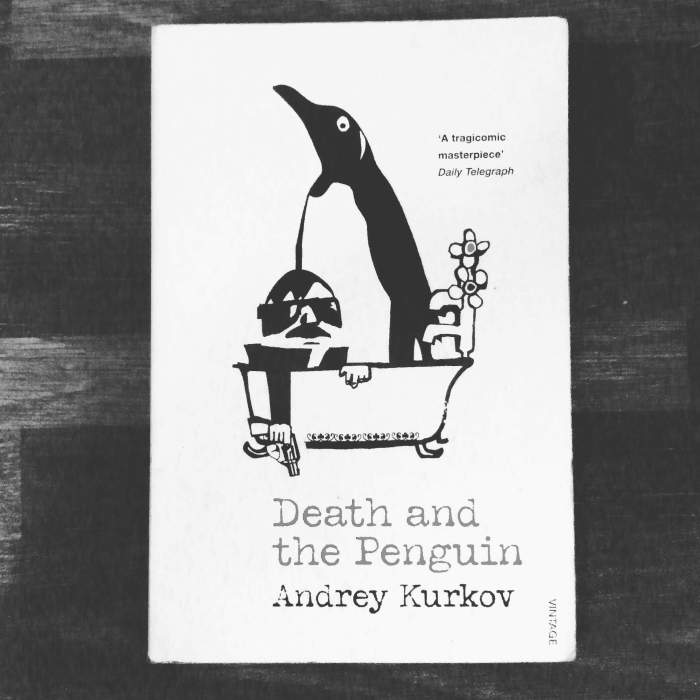
Here’s an excellent, macabre work by Ukrainian writer Andrey Kurkov. Death and the Penguin was first published in 1996 as Смерть постороннего (Smert’ postoronnego).
It wasn’t translated into English until 2001, at which point it received a wider publication (and we read it for the first time in late 2006).
The bleak work is packed with pathos, but also a lot of dark humour. It follows the life of Viktor Alekseyevich Zolotaryov, who acquires a pet king penguin as he drifts through life writing obituaries.
Obituaries, Paranoia, and Pets in Death and the Penguin
“The once terrible was now commonplace, meaning that people accepted it as the norm and went on living, instead of getting needlessly agitated.”
Kurkov introduces us to Viktor Alekseyevich Zolotaryov from the off, who’s a young writer in Ukraine with some big dreams.
Unexpectedly, he’s headhunted by a local editor for a job writing obituaries. These are published in a local newspaper and it proves a pretty lucrative freelancing position. One he’s highly praised for with his writing skills.
With the money he gains from that, he buys himself a pet king penguin. This is from a local zoo in Kyiv, which has shut down and has sold its animals (this is what actually happened in the region in the early 1990s).
He calls the penguin Misha and it lives in his small flat, taking daily swims in his bathtub filled with frozen ice water.
“Misha had appeared chez Viktor a year before, when the zoo was giving hungry animals away to anyone able to feed them. Viktor had gone along and returned with a king penguin. Abandoned by his girlfriend the week before, he had been feeling lonely. But Misha had brought his own kind of loneliness, and the result was now two complementary lonelinesses, creating an impression more of interdependence than of amity.”
As he bonds with his pet, Viktor writes obituaries.
There’s a yearning, maudlin sense of sadness to the work. Viktor has a lonely life, one with occasional bursts of longing for a better life.
“He sat with his cup of tea at the kitchen table. On the window ledge beside him stood the two bottles of cherry brandy, one half empty, the other full. Romantic thoughts stirred in the silence, touching again on unwritten novels and the past. He suddenly had the sensation of being abroad, out of reach of yesterday’s existence. This abroad was a place of tranquillity, a Switzerland of the soul blanketed in snows of peace, permeated with a dread of causing disturbance; where no bird sang or called, as if out of no desire to.”
Circa 2010 we contributed to the Wikipedia page for this book and our copy for it is still there. We think it’s pretty accurate.
“One of the striking themes of the novel is Viktor’s tendency to go from justifiably paranoid appraisals of his increasingly dangerous position to a serene, almost childish, peace of mind. As such there are many elements of existentialist thought in the text.”
Viktor is naïve, but in an endearing way; a likeable protagonist.
As Death and the Penguin’s narrative develops, it becomes clear Viktor’s role writing obituaries is a tad more fraught with peril than he could have realised.
His editor is cagey but forthcoming with some information, mainly with warnings to not pry into the true nature of the role.
“‘Your interest lies in not asking questions,’ he said quietly. ‘Think what you like. But bear in mind this: the moment you are told what the point of your work is, you’re dead. This isn’t a film, it’s for real. The full story is what you get told only if and when your work, and with it your existence, are no longer required.’ He smiled a sad smile. ‘Still, I do, in fact, wish you well. Believe me.’
It later emerges the obituaries Viktor has been choosing to write of local luminaries have created a hit list to bump off one-by-one.
As with Kurkov’s other works, such as The Case of the General’s Thumb (2003), there’s an underlining menace of political intrigue. One that the writer doesn’t provide the reader with full details, so you’re left feeling increasingly unnerved by developments.
It’s a great writing technique that works really well here. And with this book’s sequel Penguin Lost (2005).
Kurkov also ramps up Viktor’s rather desolate life, introducing a bizarre family set up to the Ukranian’s world. Along with his unusual pet, he has to look after the young girl Sonya. This is an order by Misha-non-penguin (a human also called Misha), an acquaintance of his.
Sona eventually becomes a friend, is left a large sum of money by her father (who’s clearly bumped off away from the plot), and the nanny Nina is hired.
So, these four form that strange family unit. One Viktor reflects on, although later developments in the story lead him to face a threat on his life and the desperate need to fly Misha off back to Antarctica.
Death and the Penguin may have a methodical pace over its brief pages, but it does steadily build towards a tense conclusion.
One that captures that sense of post-Soviet Union aimlessness.
When we read it in late 2006, whilst at university, we sure loved the work. Obsessed with existentialism at the time, and a sense of solitude and being a misfit, this story fits the bill (no penguin pun intended) on all accounts.
Kurkov is now a specialist in these page turners, which have a jaunty feel about them. His recent works, such as 2018’s Grey Bees, follow that trend.
But Death and the Penguin was the starting point. Kurkov’s quirky debut novel that still makes an impact now, not least as it feels more relevant than ever before.
A Few King Penguin Facts Right Here
This book will make you fall in love with penguins, for sure, and we sure did. But you can read about the antics of these weird little creatures in Apsley Cherry-Garrard’s The Worst Journey in the World (1922).
Although it’s the lively little Adélie penguins that have such a memorable role in that travel book.
In Death and the Penguin, Misha is a king penguin (Aptenodytes patagonicus).
They’re sociable animals, in the wild often travelling in big groups of up to 20 birds. They also have complex relationships, especially when courting mates.
That includes dramatic visual cues and vocal displays.
However, it’s not advised you keep them as a pet (unless you live in a region of the world that’s very cold). As is referenced in the book, Misha wouldn’t be happy in Viktor’s flat due to the temperature.
Andrey Kurkov Now and His Life in Kyiv
We visited Ukraine and Kyiv in September 2021 as part of a business trip. We thought it was a fabulous city and the people were wonderful, it’s just such a shame the events that have transpired.
Kurkov has been in the news regularly over the last few years as he attempts to defend Ukraine’s cultural and political future.
In an interview with The Guardian (I’m not scared of war any more) he had this to say in April 2022.
“The main thing is that you are tired all the time. Everyone is sleeping badly. Sirens are going off five times a night. You don’t necessarily have to get up and leave the house when that happens. But you wake up and fall asleep constantly and try to decide whether you should leave the house.”
He’s also actively documented his experiences on his Twitter account.
Kyiv’s metro, a boy preparing for school during air raid alert. pic.twitter.com/Cu23ocXni5
— Andrei Kurkov (@AKurkov) November 18, 2023
Kurkov is a classic example of the importance of culture.
Whether satirical in stance or otherwise, the world needs writers such as him to lead a coherent battle against the evil in this world.
And we believe, in the distant future, he’ll be much-celebrated as a shining light during dark times. That’s the power of satire, writing, and the strength of human spirit.
