
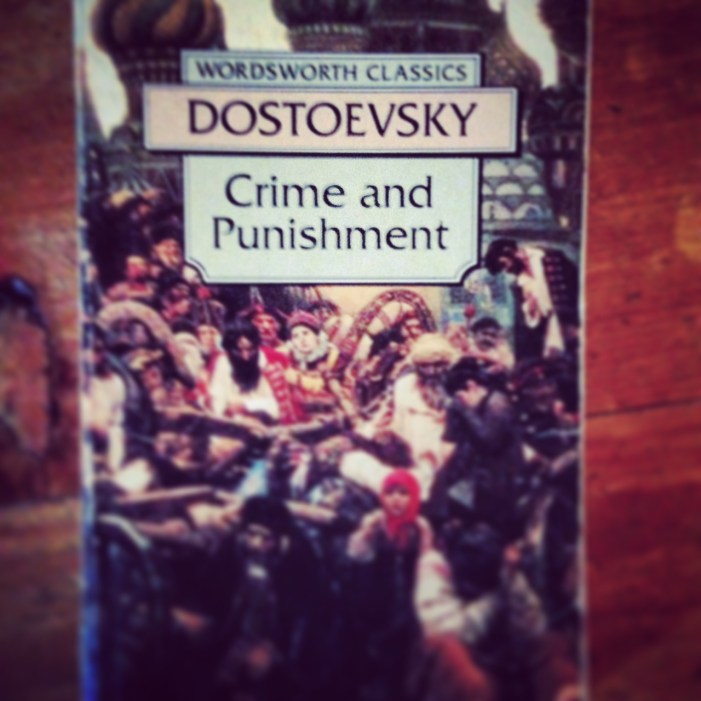
Published for the first time in 1866, Fyodor Dostoevsky’s Crime and Punishment (Преступление и наказание—Prestupleniye i nakazaniye) is a literary classic.
One of those great novels everyone has on their book shelf. Although, not necessarily to ever read it (more just to look clever).
The story of Rodion Raskolnikov and his alienation from society has a utilitarian reach—the difference between right and wrong. And Dostoevsky’s psychological brilliance in action is still remarkable to behold across this vast work.
Morality and Guilt Galore in The Epic Crime and Punishment
“Pain and suffering are always inevitable for a large intelligence and a deep heart. The really great men must, I think, have great sadness on earth.”
Dostoevsky (1821-1881) was way ahead of his time, focussing on the human condition with long narratives of psychological analysis.
However, this masterwork is of its time. Modern readers may find the meticulous detail of the prose heavy going, whereas great modern Russian writers such as Solzhenitsyn (see Cancer Ward) provide narrative structures we’re used to.
We first read Crime and Punishment at university in 2005 as a box ticking exercise (one of those books you just have to read).
It’s only later in life have we come to release the power of the work and what it stands for. Really, it was way ahead of its time. And there’s no denying it fully confirms Dostoevsky as a literary genius.
You can feel the foundations being laid for future writers, including the likes of Camus, Sartre, Solzhenitysn, and Bulgakov. That’s the might of this story and musings such as this.
“We’re always thinking of eternity as an idea that cannot be understood, something immense. But why must it be? What if, instead of all this, you suddenly find just a little room there, something like a village bath-house, grimy, and spiders in every corner, and that’s all eternity is. Sometimes, you know, I can’t help feeling that that’s what it is.”
Raskolnikov has existential dismay, nihilism, regret, self-hatred, angst… so many other issues deeply embedded in a fretful human experience.
That’s what keeps the work so relevant today, we believe. The work may be over 150 years old now, but you can see in it the traces of what makes us all tick.
And how becoming cut off from society can lead to serious crimes—ones we still see perpetrated across the world on a daily, weekly, monthly, and annual basis. Raskolnikov lives on in all of these crimes.
Raskolnikov’s Crime
There are six parts to the work, but stripping everything away and it’s actually quite simple. Rodion Romanovich Raskolnikov is the main character.
He’s a former law student who lives in extreme poverty in Saint Petersburg, where he rents a small room free from excesses.
Raskolnikov is feeling alienated from society and is isolated, alone. He’s prone to fits and bursts of melancholy.
“I used to analyse myself down to the last thread, used to compare myself with others, recalled all the smallest glances, smiles and words of those to whom I’d tried to be frank, interpreted everything in a bad light, laughed viciously at my attempts ‘to be like the rest’ –and suddenly, in the midst of my laughing, I’d give way to sadness, fall into ludicrous despondency and once again start the whole process all over again – in short, I went round and round like a squirrel on a wheel.”
Despondent, melancholic, and misanthropic, he hatches a plan to rob (and murder) a local pawn-broker.
This plan is eventually abandoned, but with murder on his mind he eventually gives in to his urges, acquires an axe, and heads to the pawn-brokers store. Once there, he attacks and kills the old woman.
Her half-sister stumbles across the scene and Raskolnikov wipes her out, too.
After stealing only a few items, he then flees the scene and is left shaken. His sense of foreboding grows and he plunges into a sense of delirium.
It’s the start of a long and torturous process of suffering for the young man, brough on purely by his appalling actions. As the reader, you’re left to turn pages and wonder as he drives himself further into a depressive spiral.
Raskolnikov’s Punishment
“The man who has a conscience suffers whilst acknowledging his sin. That is his punishment.”
To be clear, Crime and Punishment isn’t a work about prison life. Some people seem to think the “punishment” bit may refer to length courtroom antics.
That isn’t the case, as it’s only in part six that Raskolnikov confesses his crimes.
It takes him the entire novel to do so, with that quite light sentence of eight years being his punishment,
“Pain and suffering are always inevitable for a large intelligence and a deep heart. The really great men must, I think, have great sadness on earth.”
It’s only in the epilogue that Raskolnikov discusses his time in prison, which is a redemptive section of sorts. He finally gives way and begins to piece his life back together, with the help of Sonya (Sofya Semyonovna Marmeladova).
That’s a friend of Raskolnikov’s he met in a taven.
She’s actually the shining moral light in the work, helping to guide a guilty man towards a moral conscience and atoning for his ways.
Why Dostoevsky Wrote Crime and Punishment
It’s interesting to note we do know why the great writer wrote this work. Circa 1866 he owed his creditors considerable sums of money.
Following the death of his brother Mikhail in 1864, he was also trying to help his sibling’s family, too. Lots of pressure, then. And in need of money, he hatched a few ideas for a book or novella that’d bag him some cash.
He actually abandoned the first version of the work (for unknown reasons).
But after laborious and furious work, he penned Crime and Punishment loosely off a theme of radicalisation and its reasons. In November 1985 he had his first draft wrapped up, but then decided to totally rewrite the work with a third-person perspective.
This is quite similar to how Bulgakov wrote The Master and Margherita (1967) some 100 years later! He actually burned his entire manuscript in disgust, then changed his mind and typed it all out again from memory.
Dostoevsky also had considerable schedule pressures on him.
But he did it! And the first parts of the work began appearing in January 1866 in The Russian Messenger. This serialisation ran for the rest of the year until December.
A Final Bit About Crime and Punishment’s Adaptations
Whilst we can’t say there’s been a definitive adaptation of this work, we can note there have been over 25 films recorded.
One was a Soviet version from 1969 (in full above), another an American one in 1935, the BBC even had a stab at it in 2002 with a TV film.
Since then there have been a few smaller productions here and there, including a 2016 Australian feature film, and that’s about it.
Feels about time a major production went ahead and put this to rest! The definitive film adaptation with a gritty plot leading to the narrative close. Pretty please. With sugar on top.

I just started reading it this week. I also read this many years ago at an age when I probably couldn’t understand most of it. Rereading again and enjoying the experience
LikeLiked by 1 person
Glad to hear it! I shall return to it once again once I’m not so gosh darned busy. I hope you enjoy it, though!
LikeLiked by 1 person