
J. G. Ballard (1930-2009) was renowned for his controversial and provocative stories. After his experiences in WWII as a young boy, as an adult he wrote psychologically ballistic works such as The Atrocity Exhibition (1970).
However, in the early ’80s he turned his prose towards a semi-autobiographical story.
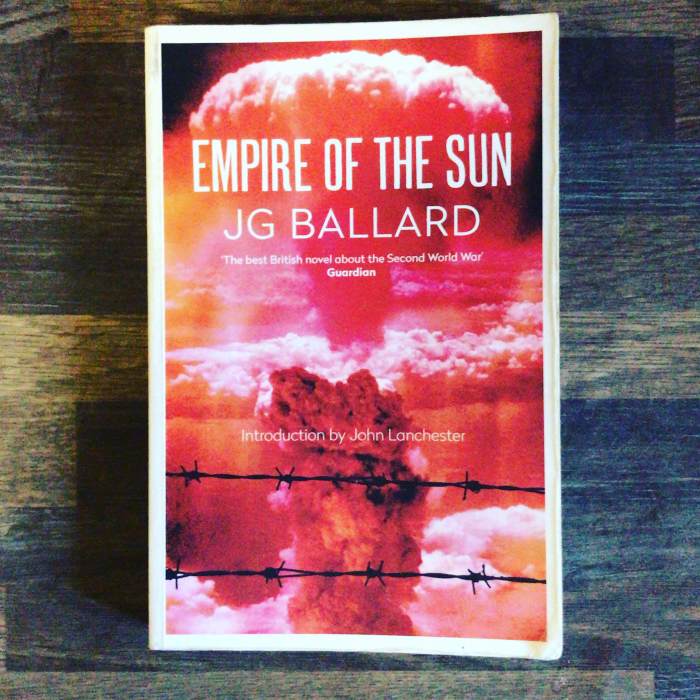
That turned out to be Empire of the Sun (1984). It was based on his time as a POW in China under close guard by the Imperial Japanese Army. We think it’s an excellent work and timeless in its dramatic delivery.
J.G. Ballard’s Empire of the Sun and Coming of Age During World War II
“To his surprise he felt a moment of regret, of sadness that his quest for his mother and father would soon be over. As long as he searched for them he was prepared to be hungry and ill, but now that the search had ended he felt saddened by the memory of all he had been through, and of how much he had changed. He was closer now to the ruined battlefields and this fly-infested truck, to the nine sweet potatoes in the sack below the driver’s seat, even in a sense to the detention centre, than he would ever be again to his house in Amherst Avenue.”
Whilst the work is fiction, it must be noted Ballard drew from a lot of his experiences during WWII. And we should imagine young Jamie “Jim” Graham was modelled on himself in some way.
In the book, Jim is from a wealthy family. He lives with his parents in Shanghai, but after the Japanese attack on Pearl Harbour the region is thrown into chaos.
This leads to Jim being separated from his parents.
What follows is Jim wandering aimlessly, hiding in abandoned mansions, before the need for food drives him out to try and surrender to the Japanese. He eventually ends up at the Lunghua Civilian Assembly Centre.
He worships pilots and finds himself identifying with the Japanese, but also in his naiveite Jim believes himself to be safe in Lunghua.
Along with many other POWs, Jim ends up at Suzhou internment camp and tries to get along with the American Basie. He also receives tutorage from Dr. Rawlins, a fellow Englishman, before the nearing end of WWII throws Jim’s life back into chaos.
Amongst the starving troop who emerge from the abandoned internment camp, Jim battles on in one final effort to find his parents.
First up, we must note the book is much more graphic and brutal than the film adaptation by Steven Spielberg (more on that further below).
Dr. Ransome, for example, in the book has a nasty head wound that’s infected. Whereas in the film, the character (called Dr. Rawlins in the film, played by Nigel Havers) remains ruggedly handsome throughout his screentime. The scenes of mass starvation are also nowhere near as bleak.
As death does haunt the pages of Empire of the Sun:
“All around them were the bodies of dead Chinese soldiers. They lined the verges of the roads and floated in the canals, jammed together around the pillars of the bridges. In the trenches between the burial mounds hundreds of dead soldiers sat side by side with their heads against the torn earth, as if they had fallen asleep together in a deep dream of war.”
But there are also some light-hearted digs at us Brits and our habit of whining about everything (an ongoing national characteristic):
“The British were especially good at complaining, something the Dutch and Americans never did.”
It’s a fine work. One that really takes the reader through the brutal survival nature for many POWs at the end of the war. One that people may be oblivious to.
The Japanese abandoned the camp, but roamed the land nearby, ready and waiting to strike down anyone as they pleased.
Jim’s involvement in around that marks constant danger, yet (as young lads tend to) he’s kind of blissfully ignorant to it all. And it’s that sense of childhood innocence that marks the work out as particularly noteworthy.
A coming of age tale like few others—loss of youth in wartime.
For us, we watched the film back in 2004 when at university and became quite obsessed with it (and, subsequently, the book). It has a certain resonance with us as a story, perhaps as it reminds us of being a young boy and oblivious to current events.
When at university in London back in late 2006, we did have a chance to see J. G. Ballard at a talk. We can’t remember why we didn’t attend, but it’s something we’ll always regret now. We should have been there.
As Empire of the Sun remains a strong classic of WWII literature. Amongst the very best.
Ballard’s Take on the Atomic Bombings in The End of My War
“Some historians claim that the war was virtually over, and that the Japanese leaders, seeing their wasted cities and the total collapse of the country’s infrastructure, would have surrendered without the atom-bomb attacks. But this ignored one all-important factor – the Japanese soldier. Countless times he had shown that as long as he had a rifle or a grenade he would fight to the end.”
In 1995, Ballard wrote an essay called The End of My War. This is included at the end of our edition of Empire of the Sun and makes for a fantastic, brief read.
In it he goes on to defend the atomic bombings on Japan.
He also states his time as a POW was where he’d been, “happiest and most at home”. As a young boy, Ballard learned to accept the rules the Japanese imposed upon him and welcome them.
It’s an interesting essay and well worth reading in full.
Empire of the Sun’s Excellent Film Adaptation
Steven Spielberg directed Empire of the Sun and it launched in 1987. The film adaptation received Ballard’s seal of approval, although he noted it differs from his book in numerous ways. But he described it as a, “fine piece of work”. Which it is!
The main difference is the involvement of Americans in the narrative is brought forward a great deal. In the novel, Basie isn’t quite so prevalent.
It’s a brilliant film and something of a forgotten gem, which is odd considering the big name director behind it. But for Spielberg you can see why he’d be interested in this.
That sentimental value of a young boy lost. He was executive producer on animated film An American Tail (1986), where a mouse is lost at sea and has to face an ordeal to find his family again. Empire of the Sun has the same plot! Just there are no mice.
A young Christian Bale provided an outstanding performance in the film. John Malkovich was also on terrific form. It’s a great film! Give it a watch.
