
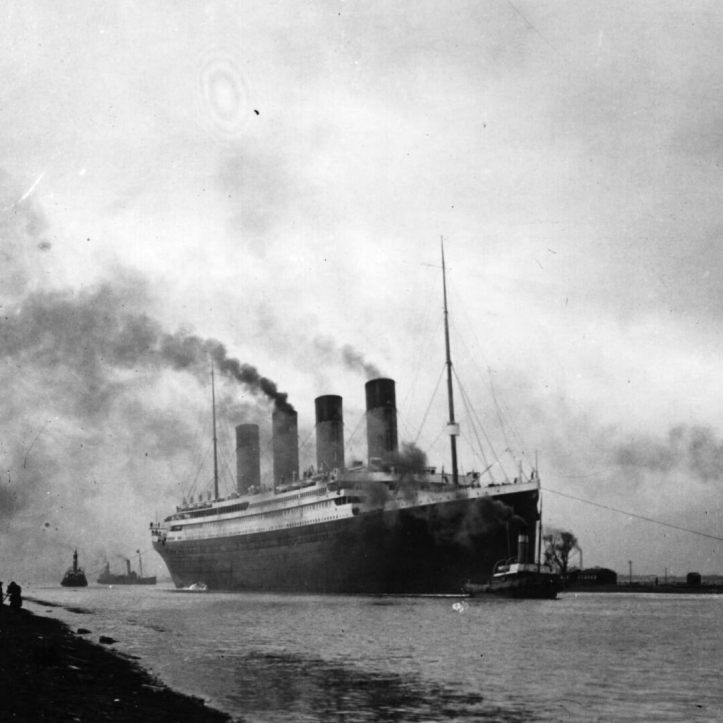
After the recent Titan submarine episode, we’ve been paying attention to the ever-fascinating topic of the Titanic.
Titanic is one of those things we’ve sporadically obsessed about over the years, along with much of the rest of the world. There’s something about that story to really pique human interest.
We remember James Cameron’s Titanic (1997) starting our love affair with the doomed ship.
But there are actually 16 movies about the Titanic and the first three were in 1912 (Saved from The Titanic, La hantise, and In Nacht und Eis) only shortly after the horrendous incident. This clearly indicates how the event captured the world’s attention and hasn’t let go over 110 years later.
But as you’d expect, cinema has dramatised aspects of the sinking. Notably with the Titanic’s final moments.
The Moonlight and the Titanic’s Final Moments
There have been many dodgy Titanic films. Hammy acting and unusual special effects. But James Cameron highlighted across his production how a set of world-class actors can transform something into seeming reality.
You’ve got Victor Garber, Jonathan Hyde, Ewan Stewart, and the legendary Bernard Hill as the tragic figure of Captain Edward J. Smith (who chose to go down with his ship).
And in the film’s famous closing sections, with the Titanic’s vast stern up in the air, Cameron made took artistic license with the production.
That wasn’t just his choice. Every single film did the same thing. Including artistic renditions, such as German artist Willy Stöwer’s take on the event in 1912 below.
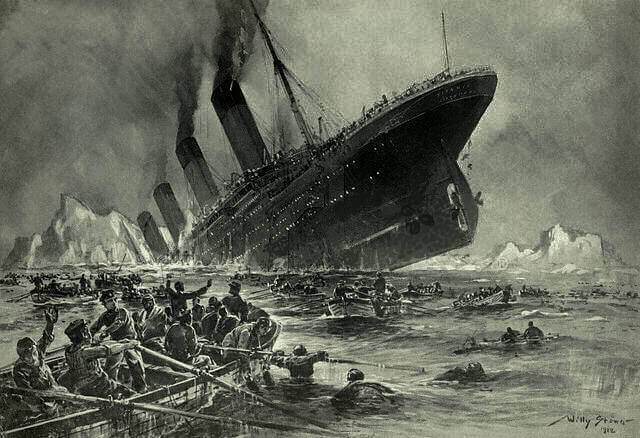
Yes, so popular opinion now is the Titanic sank in full view of those in the lifeboats. All due to a spectacular backdrop of the Moon shining down.
The reality is there was no Moon that night.
It was an incredibly starry night in the early morning of 15th April 1912 when the ship went down. But there was no Moon.
The idea there was moonlight lends itself well to the way humans are. Our need for overdramatisation and finding some sort of solace in horrors that occur.
Yet the reality is the ship went down with only a shadowy outline to the backdrop of the starry night. This is portrayed brilliantly in the clip below we found on the excellent YoutTube channel Oceanliner Designs.
From the 13 minute mark, you can see what may have played out. It’s a terrifying concept to think about—one those in the lifeboats had to endure.
For those in the lifeboats, what they would have heard is much cracking, whooshing of seawater, fizzling, and after the Titanic sank the worst of everything.
The sound of over 1,000 souls stranded in freezing water howling in agony. Survivors reported this noise was so horrendous it haunted their later lives, such as when attending sporting events (the sounds of fans replicating the carnage).
Add to that they just wouldn’t have seen much of the ship going down.
It’s a curious example of how historical reality can, almost immediately, be skewed by a romanticised version of events. Primarily by people who were hundreds of miles away when the disaster occurred.
We must also highlight that, although one of the most horrendous maritime disaster from history (one born out of pompous hubris and a cavalier attitude) there were so many tales of heroism and brilliance it’s impossible to find the best of humanity here, too.
And Notes on the Heroic Carpathia
You can watch the above short documentary about the RMS Carpathia for the story, but it’s quite a beautiful tale of heroism.
Upon hearing the news of the Titanic’s impending fate, Captain Arthur Henry Rostron (1869-1940 of Bolton, Greater Manchester) jumped to action and ordered full steam ahead to the Titanic’s location.
Whilst firing flares ever 15 minutes to let the Titanic know help was on its way, Captain Rostron ordered all lighting and heating be turned off to ensure the ship could travel at full speed unhindered.
The Carpathia raced ahead with the crew well aware it could also hit an iceberg. Eventually, when nearing the Titanic (by that time having sunk), Carpathia had to agonisingly navigate through an iceberg field to reach the survivors.
Rostron was no fool and realised the risks involved. He just also realised the people onboard the Titanic had little chance of survival unless he risked everything in that moment.
He was knighted for his efforts and helped save over 700 lives.
The passengers on the Carpathia (supposedly off on holiday) went out of their way to comfort and look after the Titanic’s passengers in just one of those glorious moments of human kindness.
Compare this to the behaviour of captain aboard the SS Californian, which was stationary within five miles of the Titanic as it foundered. Captain Stanley Lord (1877-1962 and also from Bolton) was informed by his crew of some eight flares launching from the nearby Titanic.
Now, it’s debated whether Lord’s total inaction over this was obstinacy.
Titanic’s crew, probably in a panic over what was unfolding, didn’t follow maritime law—at that time, distress signals were supposed to be sent up in a set time limit to indicate there was a crisis. They didn’t do this, leading the SS Californian crew uncertain over what was happening.
However, not to even consider heading over is bizarre. At the very least, the crew could have woken their wireless operator to send out a message of help. They didn’t do that.
Due to this, one historian has even suggested Lord (who was hounded over his inaction for the rest of his life and spent decades trying to clear his name) was a sociopath. In part due to his unemotional responses regarding the deaths he could have prevented.
That’s speculation. But there’s a stark contrast between Captain Rostron’s actions with those of Captain Lord’s.
Either way, we’re quite amazed the tale of the Carpathia and SS Californian hasn’t been turned into a movie.

Excellent post!
LikeLiked by 1 person
Thank you kindly.
LikeLiked by 1 person
Bienvenu!
LikeLiked by 1 person
I agree – an unsung hero aboard the Carpathia and a possibly unsung villain aboard California need their own stories. I always thought Cameron’s Titanic movie was silly from the sociological perspective – strapping modern-day social sensibilities across a century-old social divide. NO WAY would a first-class passenger have hooked up with a third-class waif in the day, still less got out to the bow of the ship to wave-ride. Not sure about the technical side of the movie either – I always understood that the structural failure in shear (aka ‘the back fell off’) occurred after the ship was already underwater. But as you say, dramatic license, and movie-goers kind of expect something spectacular. A picture of an empty night-time ocean with various ‘glub glub’ noises arriving via some creative Foley artist wouldn’t really cut it.
LikeLiked by 1 person
Cameron’s film is daft, but the action elements are extremely well done. The hitting the iceberg scene is amazing, although not accurate on a historical point I believe. But I do find the whole upper class/wealthy rich snobs thing a bit difficult to take as a plot point. Primarily with the Rose/Jack relationship as you put.
It’s not as bad as Braveheart, at least, for the history bit. The ship did hit an iceberg after all and they got that bit spot on.
Give it a few years and there’ll be a film about the Titan submarine I should think.
LikeLiked by 1 person