
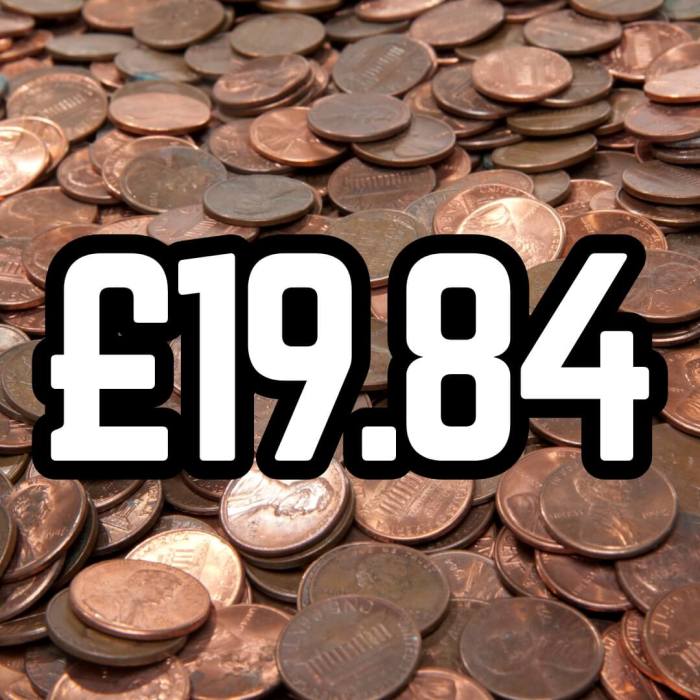
It’s fair to say George Orwell’s 1984 (1949) is one of those famous books everyone likes to claim they’ve read.
But of course, somebody had to go and taint its legacy by writing £19.84. It’s a book about buying things that are priced £19.84. Not 1p either way is acceptable for the crazed OCD person in this obsessive tale.
The work is an examination of life with such constraints, making it analogous to great works of literature such as Spot the Dog by Eric Hill.
Living a Life Spending £19.84 One Transaction at a Time
The novel is 770 pages long in really small print, too, so reading each page takes a solid five minutes or so. This hits a stumbling block very early on as after about 20 pages you’ll be bored out of your mind by the finicky antics of lead character Johnathon Farthing.
Farthing tootles around from one shop to the next in his local district of Leicestershire.
Carrying exactly £19.84 in loose change he annoys the bejeezus out of shop owners by haggling to reduce products to the, aforementioned, amount. In the giant rucksack he has on his back are many little baggies containing the exact amount of money.
Farthing regularly crosses the haggling line, at one point going into an electronic entertainment store and demanding a PlayStation 5 be reduced to from £495 to £19.84. Upon refusal by the shop assistant, Farthing has a bad-tempered rant about the nature of state control and totalitarianism.
This is the only real comparison with Orwell’s work, as after this chapter the author (who’s still unknown but at large in society) details more plodding accounts of buying:
- Satsumas.
- Giant blocks of cheese.
- Backs of cement dust.
- Filling up his Reliant Robin with petrol.
Despite the general boredom one gets from reading £19.84, there are some highlights. For example, in chapter 35 there’s an account of Farthing ram-raiding an off-licence after the proprietor refused his haggling over a multi-pack of cranberry juice.
With his Robin Reliant destroyed, Farthing must resort to taking the bus. There he baffles bus drivers by insisting much cheaper bus fares must be £19.84 and, no, he doesn’t want the change.
The Economics of Johnathon Farthing
Literary scholars believe £19.84 to be a masterpiece of subtle economics.
They consider the work an intended statement on the free market and how charging consumers wildly in excess would actually be great for the economy. Additionally, it’s believed the author’s focus on haggling would encourage everyday citizens to barter for their goods, which would be complemented by cheeky banter.
As such, many a libertarian considers £19.84 a grand statement of free will. Specifically, they cite page 456 in paragraph three when Johnathon Farthing states:
“But what is that not is what is not but? The money I have is the money I do not have; up until there is no more of it to the point of expenditure to further my need.”
Many believe this to be the finest piece of prose thus far in the 21st century. However, a small contingent (i.e. leftist scumbags) believe it to be gibberish. Who’s right? You decide, righteous and pure capitalist types!
£19.85 the Sequel and Controversy Over AI Generated Books
Although the author’s whereabouts are still unknown, it is known the sequel will launch in 2025 and is titled £19.85.
The book is believed to be 1,000 pages long and follows the nature of the £19.84 work. It’s just, this time, Johnathon Farthing now believes £19.85 should be the haggling amount for all goods and products.
However, the rapid turnaround of such a vast work has led some to question the veracity of the “author”.
Indeed, some human beings now believe £19.84 is the work of AI. Even the front cover of £19.84 appears to be AI generated, as is evident in its extreme low quality and overall tackiness.
Is AI the culprit?!
We have no empirical evidence to suggest so, but we’re going to say that yes, absolutely, AI is responsible for all of this. And what a work of art it is, too!
The use of “nincompoop” is particularly effective—all 13,451 uses of it across the work. Masterly!

One price for everything! I demand it! It’s only fair
LikeLiked by 2 people
Agreed! I’d happily pay £19.84 for a house. That’d be most excellent.
LikeLiked by 1 person
You can do that in the states, but this is one of the times that you get what you pay for
LikeLiked by 1 person
$19.84 for a mud hut in a field? I’d go with that take my money. 💰
LikeLiked by 1 person
G-gibberish?? Of COURSE it isn’t gibberish! It’s, um, discourse so pro-FOUND and E-levated that I can’t under-STAND it without the help of good, decent, red-blooded not-even-close-to-woke COM-mentators, that’s what it is!
LikeLiked by 1 person
Please donate £19.84 and we’ll make sure the gibberish improves. 👍
LikeLiked by 1 person