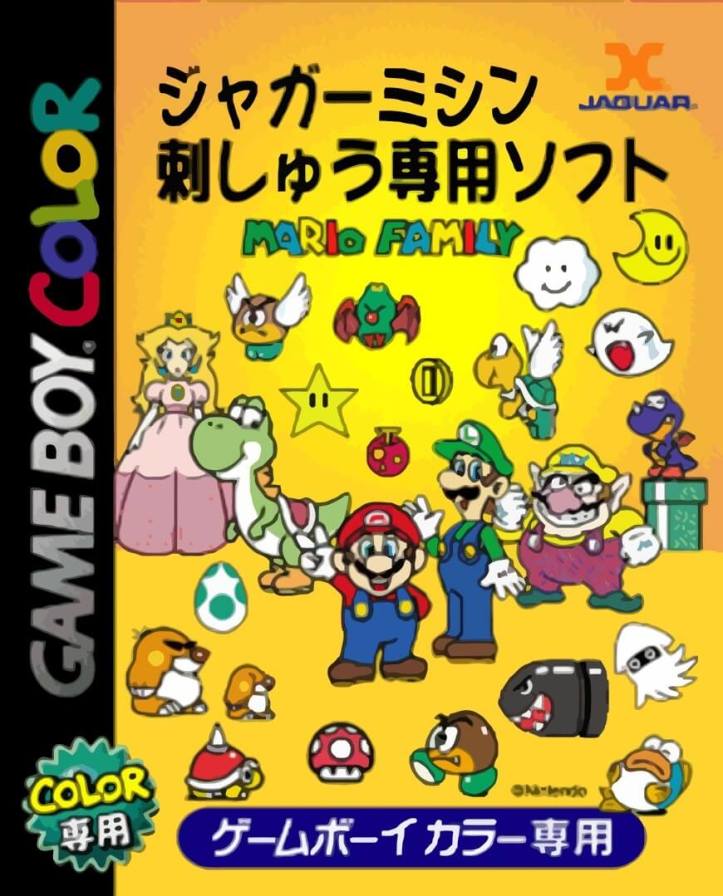
Okay, this is Mario Family: Jaguar Sewing Machine Embroidery-Only Software (ジャガーミシン刺しゅう専用ソフトマリオファミリ). Nintendo didn’t license this one and it launched (kind of making it illegal, technically) on the Game Boy Colour in August of 2001. Only in Japan, we should add.
A developer called Natsume worked on this one with Jaguar (a popular Japanese sewing machines company). However, this wasn’t a new concept as it followed on from I am a teacher: Super Mario Sweater (naturally, we’ve already covered that one) on Nintendo’s Family Computer Disk system in August of 1986.
So, yeah, there are more Nintendo sewing-based games than you may realise. Two! Intrigued?! You ruddy well should be.
Sew it Up a Notch in Mario Family: Jaguar Sewing Machine Embroidery-Only Software
Although there isn’t a huge amount of detail on this one, we were able to work out some core details. Namely, you plug the Game Boy Colour into a sewing machine using a JN-100 cable. You, the player, can then pick from various famous Super Mario characters.
The sewing machine will then replicate the in-game design onto fabric (see the above video of this in action).
With some 32 patterns available, players really were spoiled for choice on this one. They could pick between the likes of Mario, Yoshi, Mega Mole, Lakitu’s cloud, Banzai Bill, a Super Mushroom etc. These are all printed out from the classic SNES era games such as Super Mario World.
Asides from being one of the few sewing-based video games we can think of, the wider question from us to developer Natsume on this is… why!?
Why not just create some standalone new game or other concept? We guess there’s the element of using Nintendo’s’ enormously popular name and characters to bring in interest. But you’d need some seriously dedicated sewing fanatics to get behind this thing.
Just for comparison purposes, Super Mario Sweater (アイアムアティーチャースーパーマリオのセーターAi amu a Tīchā: Sūpā Mario no Sētā) looked like this.
Despite being licensed by Nintendo, the gaming giant had little to do with this one. Instead, they handed the rights to Japanese sewing company Royal Industries Co. Ltd. and left them to it. The goal? Design sweaters on an image of Mario.
Players could then send the image to Royal Industries Co. Ltd. who’d knit them out for the cost of about £20. Neat? We guess so, but entirely bettered in 2001 by Natsume’s do-it-at-home version.
But Wait! Then There Was America’s Game Boy Color Sewing Machine OBSESSION!
Note with the ecstatic voiceover from the lady, this was the joy of sewing thanks to the Game Boy Color! Lucky Americans had the Singer Corporation, a US manufacturer of sewing machines.
As it turns out, there were THREE models for Game Boy that all launched circa 2000 (clearly the year for peak Game Boy sewing mania). The models were:
- IZEK 1500
- Jaguar JN-2000
- Jaguar JN-100
The JN models were exclusive to Japan, so those were the ones for Mario Family. Whereas Americans had to make do with the IZEK.
If you’re still wondering what the hell was going on here, the Game Boy could be inserted into the sewing machine. After that point, it was used as an interface (menu) to direct the sewing patterns and all that jazz.
Not a video game, then, but some weird gimmick type thing. One with instructions on how to embroider Nintendo slogans into t-shirts to then brainwash the masses into buying more gaming gear.
If you still think it sounds weird there is a reason for it all. Shonumi’s excellent Edge of Emulation: Game Boy Sewing Machines feature explains:
“Some may laugh at how bizarre it sounds to combine Game Boys and a sewing machines, yet all 3 models are rather historically important for both gaming and home-based sewing. Although industrial sewing machines already had programmable stitching for years, the consumer market lagged behind in terms of options and price. Today, cheap digitized sewing is the norm, but at the turn of the century, Jaguar sparked a sort of revolution by giving consumers affordable and easy to use equipment. Using a Game Boy as the primary interface reduces complexity (there are only a few buttons, menus can be colorful, and you can display as much information as you want, even tutorials). It also saves on cost by using known components instead of creating hardware from scratch. Furthermore, it’s not uncommon to feed sewing machines instructions from an external source. Current sewing machines often connect to PCs via USB to transfer embroidery designs, and perhaps smartphone apps communicating over Bluetooth represents the future. At any rate, Nintendo’s handheld system became the first (and only???) such device to work in conjunction with a sewing machine and did its part to bring digital stitching and embroidery to the masses. Though it seems like a strange marriage, both sides work well together in practice.”
We must flag up the brilliant Shonumi’s retro gaming website for this, as he also added a lot of this to his YouTube channel.
Shonumi writers long-form articles and books on these things, such as the Game Boy’s wide range of peripherals. All very intriguing! Retro gaming of yesterday saved for posterity.
