
Ah, yes, good old ISO 3103—that household term that just rolls off the tongue. Proposed in 2019 by the International Organisation for Standardisation (ISO), the abstract for the thesis denotes:
“The method consists in extracting of soluble substances in dried tea leaf, containing in a porcelain or earthenware pot, by means of freshly boiling water, pouring of the liquor into a white porcelain or earthenware bowl, examination of the organoleptic properties of the infused leaf, and of the liquor with or without milk or both.”
This is all very important in England, what with our long tradition of tea consumption (even if most Brits prefer coffee these days). George Orwell wrote of this previously in the essay A Nice Cup of Tea (1946). As he noted:
“Tea is one of the mainstays of civilisation in this country and causes violent disputes over how it should be made.”
Indeed! Thus, and therefore, we’re going to explore this topic a little further as we Go Scientific on tea consumption and pontificate pompously over the nature of ISO 3103.
Tea Prep Down to a Tee—Unlocking the Mysteries of ISO 3103
Right, so the law of the brewing land was laid down in BS 6008 by the British Standards Institution in 1980, before getting the updated overhaul in 2019.
There’s been debate about this online as some believe ISO 3103 argues about how to make the ideal cup of tea.
This is not the case, you foolish fool.
Rather, the standard simply documents a tea brewing process. The idea behind that was to make comparisons with other tea making ideas, such as with Japanese tea ceremonies. From which has emerged a set of guidelines you can follow (if you so wish), which are millimetrically precise.
Guidelines of ISO 3101
Some people have taken this way further than us. Michael Grauslund Andersen wrote an extensive analytical take on all this. See: Understanding ISO 3103 The Standard for Brewing Tea. He states this in a handy graph.
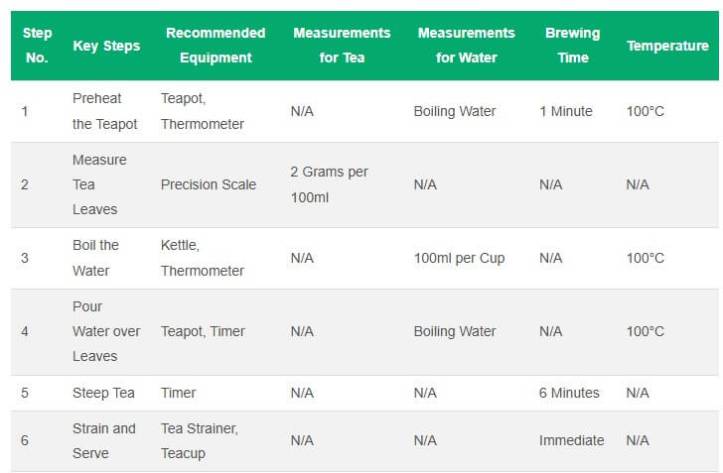
All very specific then, but there is a quality control purpose here. Andersen’s thorough analysis of this concept includes this insight.
“Without standardisation, it would be nearly impossible to compare teas fairly. Each person’s brewing method might introduce variations that skew the results, making it difficult to maintain high-quality standards in the industry.
During the early 1980s, the tea industry faced the challenge of subjective evaluations. Different tasters used various methods, leading to inconsistent results. To address this, the ISO developed ISO 3103 in 1980.
This standard transformed how tea was evaluated, making it more scientific and less reliant on individual preferences. Today, tea professionals worldwide use it to maintain quality and consistency.
I remember my first encounter with ISO 3103 during a tea tasting workshop. At first, it seemed unnecessarily rigid, but as we started brewing different teas using the standard, the benefits became clear.
Each cup tasted as it should, allowing us to appreciate the subtle differences between tea varieties. It was an eye-opener, showing that even something as everyday as brewing tea could benefit from a bit of scientific rigour.”
Again, refer to Andersen’s excellent feature if you want the comprehensive analysis. We’re not here to rain on his parade, he did the hard work with his study.
We picked up on ISO 3103 this week after Depths of Wikipedia flagged it up. Which did have us thinking about George Orwell’s pontifications, alongside our pre-existing knowledge of Japanese tea concepts.
George Orwell VS Kakuzō Okakura: Posh British Sipping or Teaist Revelations?
The standard highlights how seriously some of us take our tea consumption. As it is a contentious topic in the UK. There’s much bickering about the “right” process, such as whether to add milk or sugar.
There’s a longstanding British tradition of how to do it “proper”, which has created a stereotype English people are always drinking tea. It’s true for some of us but, again, coffee and fizzy drinks are more prevalent (along with beer and wine).
But for those of us who do still do the tea thing, George Orwell’s tome A Nice Cup of Tea (that link takes you to the full essay) is the tome of tomes. With its twee title and polite British sentiments, we’ve always had a soft spot for this aside at the end of a long list of Orwellian standards to follow.
“Lastly, tea—unless one is drinking it in the Russian style—should be drunk without sugar. I know very well that I am in a minority here. But still, how can you call yourself a true tea-lover if you destroy the flavour of your tea by putting sugar in it? It would be equally reasonable to put in pepper or salt. Tea is meant to be bitter, just as beer is meant to be bitter. If you sweeten it, you are no longer tasting the tea, you are merely tasting the sugar; you could make a very similar drink by dissolving sugar in plain hot water.”
Whereas in Japanese culture, things are more philosophical and spiritual. As Kakuzō Okakura highlighted in his 1906 essay The Book of Tea.
“Teaism is a cult founded on the adoration of the beautiful among the sordid facts of everyday existence. It inculcates purity and harmony, the mystery of mutual charity, and romanticism of the social order. It is essentially a worship of the Imperfect, as it is a tender attempt to accomplish something possible in this impossible thing we know as life.”
Now, for our own tea making preference here at Professional Moron we’re very much on the side of the Japanese.
The Brits tend to load up tea with sugar and milk. That’s a massive no-no for us; as Orwell flags up, we’re of considerable minority. A lot of English folks go a step further and dunk biscuits in their brews, creating a glorious tribute to the joys of sugar (as opposed to appreciating the subtleties of tea).
Builder’s brews—an overpowering mass of milk and sugar. But… each to their own, we guess, it just depends how soon you want congenital heart failure or not.
We’re not patriotic or nationalistic, we view those things as very silly.
But ISO 3103 derived from a British standard for tea, based on British levels of pedantic rule following (such as queuing politely and/or getting furious if you walk past someone and they don’t say “Good morning!”) alongside millimetric, military levels of precision.
As why make a cup of tea when you can turn it into a committee meeting requiring complex organisational manoeuvres?
Exactly! It’s the British way. Thanks for ready. Tally, bally ho! ☕🍵
