
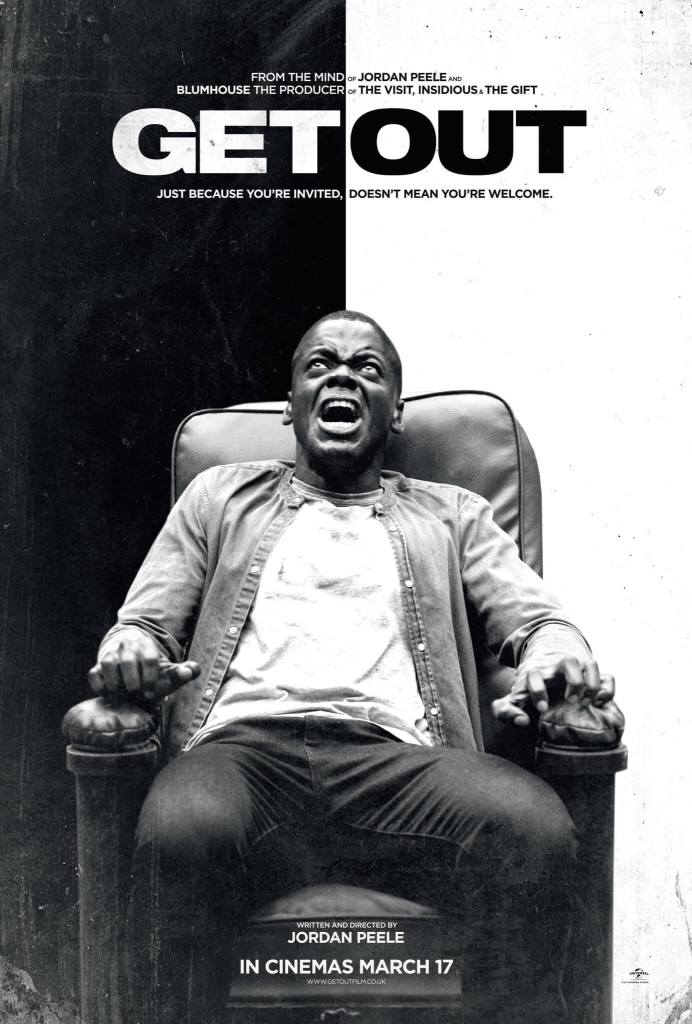
This 2017 psychological horror film was an instant classic. Written and directed by Jordan Peele, Get Out explores deep-seated themes of overt, racism, neoliberalism, and liberal complacency.
It’s a funny, clever, thought-provoking, and goddamn frightening movie that explores increasingly prevalent societal themes. Heading for 10 years since its release, we’re here to remember its excellence and relive the nightmare all over again.
The Psychology and Body Horror of Get Out
Last year, we did a podcast covering people complaining that modern movies are rubbish due to feminism and diversity (see Are 99% of Modern Films Rubbish?). That was in response to the Critical Drinker’s videos, in which he complains about how women and diversity have ruined Hollywood.
We’re glad to see, on YouTube in particular, there’s been a strong response to this over the last 12 months with many channels addressing the stupidity of Critical Drinker’s critiques.
As when there are modern films like Get Out, you really don’t have much of an argument.
This is a flat-out masterpiece and a very eerie modern classic, which also shows there’s plenty of room for the horror genre to still excel.
The plot to Get Out is pretty disturbing, though, involving the fate of Chris Washington (Daniel Kaluuya) as a young black photographer. With his girlfriend Rose Armitage (Allison Williams), he travels to see her well-to-do middle class family in the countryside.
The Armitage family is very nice, but keep forcing him into oddly uncomfortable conversations and try very hard indeed to show they’re not racist. Chris also meets various black servants around the estate who behave in a slightly off way—as if they’re not all there.
Despite the awkwardness, Chris is kind of enjoying the time with his girlfriend and shrugs off the Armitage family’s efforts as excessively nice.
Then, at a party Chris photographs a guest called Logan, who suddenly becomes hysterical and begins shouting at him to, “Get out!”
This is where the film takes one hell of a disturbing twist (spoilers ahead), with Chris plunged into one of the most disturbing concepts in recent memory.
A body horror notion where the Armitage family is befriending black people and then performing brain transplants on them—trapping the previous occupant in the subconscious of their own body.
Wealthy visitors, meanwhile, get to take over the body as a kind of avatar. Chris is next up for this treatment.
It’s fair to say the ending of the film (which we don’t want to spoil too much) ends up as a total bloodbath. There is, at least, a somewhat elevating ending to it all. As Get Out’s themes are pretty bleak and prescient.
Whilst that’s all very disturbing, there are lashings of black comedy, satire, and social commentary.
The cast is terrific across the whole film, but what’s telling is we watched it and came out cursing the very nature of our white privilege and the relatively easy time of we’ve had in our lives. We’ve not had to experience the casual bigotry many face every day, which Get Out channels by taking that and turning it into a horrifying concept.
The Production of Get Out
Get Out took 23 days to shoot in February 2016, with a small budget of $4.5 million. It was instantly a critical sensation and sent film buffs to the cinema in droves, bagging it $255.4 million at the box office.
Over $124 million in net profit.
That massive success was back up by Oscar wins for Best Original Screenplay and was nominated for Best Picture, Director, and Actor (for Kaluuya).
Lead actor Daniel Kaluuya got the role after one audition, providing millimetric precision across five takes to impress director Jordan Peele. That and Kaluuya’s performance in a Black Mirror episode bagged him the job.
Co-star Allison Williams was cast at the same time (November 2015).
As for Peele, Get Out made him the first African-American to write, produce, and direct a debut film that earned so much moolah. Full credit to him, he did an excellent job.
He was initially concerned about whether the film had any chance of success, considering the nature of the film—white people depicted as villains. Perhaps it was the success of 12 Years a Slave (2013) that helped smooth the waters a little there, but audiences worldwide were very receptive to both films.
