
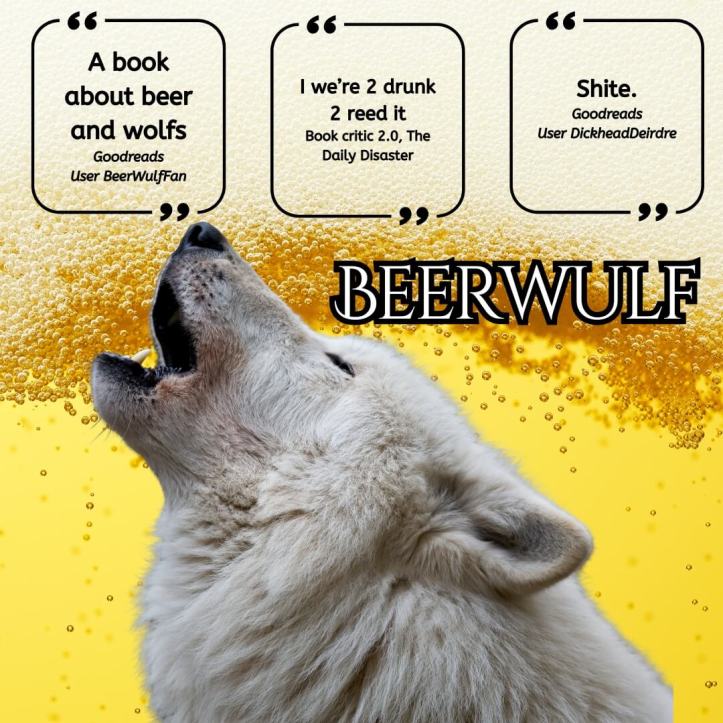
Beowulf is a great work of Old English Literature. No one knows who wrote the damn thing. It was penned circa 975… or something. However, did you know the book Beerwulf was written in 976 as the sequel to Beowulf and everyone knows who wrote it and why?
T’was written by Old English Poet Lord McVerisimilitude whom owned 37 acres of land and, whilst his slave did stuff for him, he drank beer and wrote about it. That was until he died in 977 of acute pancreatitis, but there we go… the perils of hedonism!
But as we cover today, this work is actually quite interesting (unlike Beowulf).
The Drunken Stupidity of Beerwulf: A Literary Classic
“It is always better to avenge beer ones than to indulge in mourning. For every one of us, living in this world, means waiting for our beer (and wolves). Let whoever can win glory before beer. When a warrior is beer, that will be his best and only wolf.”
Little is known about Lord McVerisimilitude, other than that he owned 37 acres of land, was fond of cheese, enjoyed a grand game of chess, and detested sheep. Historical records confirm his death in Old English jive:
“Se guma wearð þurh deofles ingange oferswiðed, and þær wæs micel geómrung and unblis. Séo unblis geendode mid þæs déaðes tōcyme; þæt ende his hellican wómes wæs fram his geférum swíðe þancwyrðe.”
Translated into English, that reads:
“The man succumbed to demon insertion and there was much wailing and dissatisfaction. The dissatisfaction ended with the arrival of death, with the cessation of his infernal wailing being greatly appreciated by his peers.”
Scholars postulate that “demon insertion” was likely to either be:
- Acute pancreatitis
- Rabies
- Scurvy
- Alien abduction
- Ingrowing toenails
As for the book itself, verily, and with much joy, we must note it’s a bit rubbish. It’s clearly a spinoff of Beowulf and not a very good one at that, too, following the adventures of the Geatish hero Beerwulf who travels to Bolton of Greater Manchester to defeat a monster called Dennis.
This almost backfires as Beerwulf gets drunk on beer. When he turns up at Dennis’ address he’s a bit wobbly, but it turns out Dennis is also a bit out of it on wine and the two end up getting on famously.
The Old English Poem ends with Beerwulf and Dennis agreeing they’re “best bloody mates”, dancing in the street, then passing out in a ditch. By morning time, it’s presumed neither of them will have any memory of the other and Beerwulf’s search for violence will continue.
Notes on Beerwulf Having Nothing to Do With Wolves
Famously, Beerwulf has nothing to do with wolves. Many publishers fail to pick up on that element, which means various editions of the work feature an image of a wolf (and beer) on the front cover.
As the manuscript of the work has first discovered in 1972, some have suggested it’s a fake poem and not a real work of poetry at all. Scholars have since realised such claims are gibberish nonsense, instead inventing the genre of Old Drunkish to celebrate how even people from ages back enjoyed getting drunk.
Particularly realistic is on page 5 when Beerwulf stays in the pub until 11pm, before staggering out to vomit in the street, and having some coppers give him a good wagging for his anti-social behaviour.
Lord McVerisimilitude was clearly a keen mind big on social commentary, even if his narrative arc is somewhat stale and predictable. Much like an old man pub filled with geezers whining about the good old days… perhaps that was the point of his Old English work.

I prefer an Airwolf myself but to each their own
LikeLiked by 1 person
Does Airwolf drink beer? No? So, Airwolf LOSES.
LikeLiked by 1 person
My helicopter runs on Monster energy drinks so it’s possible
LikeLiked by 1 person
Sounds ideal. I’d like to see a great white shark on Monster energy drinks, I bet that’d be a great experience for all concerned.
LikeLiked by 1 person
Now I’m imagining sharks withy Monster Energy logos tattooed on them – it’s the logical next step in advertising.
LikeLiked by 1 person
Agreed. Can’t believe marketers hadn’t thought of that one. Easy advertising!
LikeLiked by 1 person
From your list of insertion postulations, I’m guessing this is a “family friendly” site?
LikeLike
Not at the moment, this is a Radical Leftist Platform listed for demolition.
LikeLiked by 1 person
… And historical erasure!
LikeLike
I just finished The Wake, a novel that uses a basically understandable mix of Old and Modern English and no non-Anglo-Saxon words at all. It’s an interesting one, and it made me think of us trying to read the original Beowulf in middle school and failing. Maybe it would have gone better if we’d been reading Beerwulf.
LikeLiked by 1 person
Written by Paul Kingsnorth? Now that is a proper British name, it makes me proud to be English to see and hear a surname like that.
At uni doing my English degree, the first book they forced on us (September 2003) was Beowulf. I read it, got bored, and began reading wildly outside of my course expectations. I have Beowulf to thank for that. Woof.
LikeLiked by 1 person
That was my thought too. Wondered if it was a pen name at first! I just finished a post about the novel, pretty unique one.
We had a better time with the Canterbury Tales in that class, some fun stories in there.
LikeLiked by 1 person
When I was at high school they made us read Shakespeare (the plays, so that was dull). And George Orwell. The Shakespeare decision wasn’t a good idea, trying to get a bunch of bored 15 year olds to read Romeo & Juliet. Not gonna happen.
LikeLiked by 1 person