
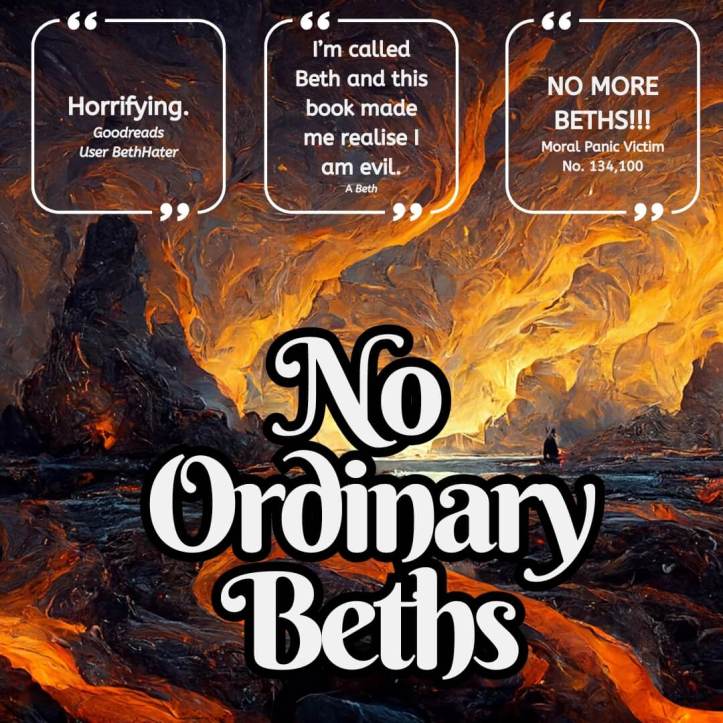
Following on from our review of Molly Conisbee’s No Ordinary Deaths (2025), it intrigued us to learn there’s a 1889 pseudo-science work called No Ordinary Beths.
Written by the author Sir Charles Rupertson Twistleton Jeffery III and published by his wealthy publisher uncle Sir Jeffery Rupertson Twistleton Charles Jeffery III, it explores the topic that human females (and some human males) called Beth have supernatural powers and are a grave threat to the future of humanity. This family-friendly tome makes for great bedtime reading for kids!
On the Peril of Beautiful Dames in No Ordinary Beths
Okay, so this is a weird book and one that doesn’t make a great deal of sense. But under the modern gaze of 2026, it’s actually quite amusing in its rambling oddness.
The book is written in a pompous, prolixity heavy style befitting elitist sorts from the 19th century. Sir Charles Rupertson Twistleton Jeffery III was extremely well educated and had the biggest vocabulary in all of England (or, at least, so he claimed). But his obsession with the Beths of this world takes the literary form of this type of thing.
“To be possessed of every virtue requisite for the elevation of the female mind, and yet to reject the hand of a superior suitor upon the mere, trivial technicality of prior wedlock, is a contradiction that can only be explained by the presence of the Dark Arts. It was during the summer of the year 1875; an era, one notes with chagrin, before the current decay of our great social institutions had fully taken root, that one first chanced to encounter a creature bearing the name of Beth.
She was, one must freely concede, a woman of most commendable and conventional aesthetic facial symmetry. Recognising that one’s own exceptional station, unparalleled wit, exceptional handsomidity, and remarkably lofty spirit would serve as the ultimate elevation to her otherwise ordinary existence, one condescended to offer her my hand in holy matrimony without delay. It was an act of profound generosity on one’s part, driven by the sheer nobility of one’s character. Astonishingly, the woman displayed an audacity so profound, and a vanity so entirely unbecoming of her gender, as to refuse my magnanimous suit. Her defence for this egregious slight? The absurdly pedantic protestation that one was already legally bound in matrimony to another! This may be correct, by all modern standards, but a lady does not turneth down the pursuit of a man of one’s standing. Ever!
It was in that singular, chilling moment of rejection that the scales fell from one’s eyes. Such a defiance of natural order and superior masculine being could not be attributed to mere feminine whim. No, sirs; t’was the unmistakable mark of Witchcraft. By logical extension, and through rigorous deductive reasoning befitting a gentleman of one’s formal higher education, one had arrived at an absolute truth: All women who answer to the name of Beth are, in fact, practitioners of the Occult.”
There are 761 pages of that type of thing. Translated into modern English, the above paragraph reads as this.
“I met this bird called Beth last week. She was hot as shit, so I demanded she marry me for my charming personality, extreme intelligence, and 10/10 looksmaxxed jawline. She was arrogant enough to REJECT ME when I mentioned I’m already married! FFS!! That’s when I knew she’s a bitch!!! lol roflmao. This topic needed exploring, so I downed a can of Red Bull, had a vape, booted up TikTok, and went off on one about how women called Beth are tramps. It went viral, got three million shares, and got me a modelling contract.”
Generally, No Ordinary Beths comes across as a wildly paranoid work about a man baby whom was spurned by human females by the, aforementioned, name.
We did some digging into historical records and found Sir Charles Rupertson Twistleton Jeffery III was, indeed, rejected by every woman by the name of Beth whom he proposed to (a grand total of 3,124 women of the name of Beth).
Quite what Sir Charles Rupertson Twistleton Jeffery III thought he was doing we don’t know, but he should have realised after around the 500th rejection this game wasn’t working out for him. Silly fool.
In 1901, he eventually gave up on it and married a woman called Belle. There’s a Be in the name so, we guess, that’s some sort of consolation for the crazy damn fool.

Beth = witch. Witchfinding made easy!
LikeLiked by 1 person
I concur. I know a few Beths and they are pure evil.
LikeLike