
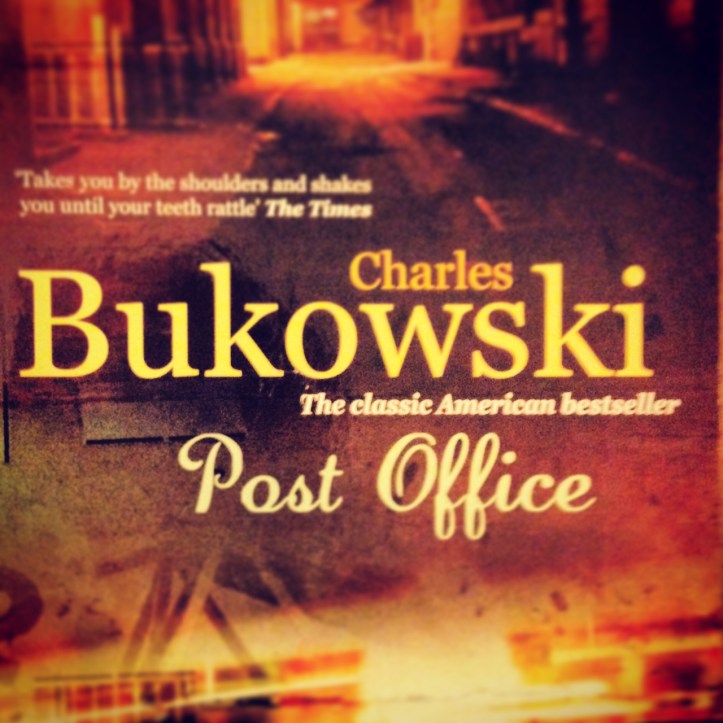
Charles Bukowski’s Post Office (1971) is a very funny book. We spent a bit of time thinking exactly why and it’s down to that down-on-his-luck narrative of the anti-hero Henry Chinaski.
He’s the alter-ego of Bukowski—a zero fucks given drunk who drifts from one disastrous work encounter to the next.
This wasn’t an accurate portrayal of the 15+ years Bukowski spent working for the American post service, but the works publication did prove a smash hit. And it launched his sudden literary career at the age of 50.
The Drunken Resilience of Bukowski’s Post Office
“In the morning it was morning and I was still alive.”
Bukowski took things a step further for his drunken follow-up Factotum (1975). A book so sodden in deadbeat slovenliness it’s a remarkable achievement.
But for his literary debut, the writer sure got the ball rolling.
Bukowski worked as a mail carrier and sorter for the United States Postal Service between 1952 and 1969. He quit once (in 1958), but then returned to the job. It was one he found very stressful, so much so he drank heavily after work.
He had many sick days due to how bad his hangovers were.
As a literary escape, he created his alter-ego in the form of the aloof Henry Chinaski. The man who doesn’t give a shit and sticks it to authority, man. Who views develops like the following with a world-weary sense of dread.
“I want you to understand that we’ve got to hold down the budget! I want you to understand EACH LETTER YOU STICK – EACH SECOND, EACH MINUTE, EACH HOUR, EACH DAY, EACH WEEK – EACH EXTRA LETTER YOU STICK BEYOND DUTY HELPS DEFEAT THE RUSSIANS! Now, that’s all for today.”
The main element of the work is Chinaski’s constant bemusement of what’s demanded of him. The bizarre way in which higher-ups behave about their jobs, or towards him, and his obvious resentments of the stupidity of it all. As he notes.
“Any damn fool can beg up some kind of job; it takes a wise man to make it without working.”
We’ve all been there (most of us, anyway). We’ve had crap jobs, with crazy bosses, and weird demands that don’t really benefit us at all, they just make higher management wealthy.
Yet we’re supposed to turn up and act astonishingly privileged to be there for rubbish pay and whilst being treated like crap.
That’s what Bukowski captures in Post Office.
The brilliant thing is he was able to turn it away from being a depressing read. As with George Orwell’s equally inspiring Down and Out in Paris and London (1933), here you have a work that takes the mundane and makes it amusing.
It’s all portrayed through Chinaski, the anti-hero as part of a picaresque narrative structure. He’s doomed to a lowly existence but, by heck, he’s not going to make it easy for anyone else, either.
It’s All About Chinaski’s Drunken Drudgery
‘You’re a wise son of a bitch, aren’t you?’ – ‘I’d rather you didn’t curse me, sir!’ – ‘Wise son of a bitch, you’re one of those sons of bitches with a vocabulary and you like to lay it around!’ He waved my papers at me. And screamed: “MR. JONSTONE IS A FINE MAN!’ – ‘Don’t be silly. He’s an obvious sadist,’ I said. ‘How long have you been in the Post Office?’ – ‘3 weeks.’ – ‘MR. JONSTONE HAS BEEN WITH THE POST OFFICE FOR 30 YEARS!’ – ‘What does that have to do with it?’
The plot is simple. Semi-autobiographical, it follows the life of Henry Chinaski. He signs up to the postal service thinking he’ll have an easy job delivering the mail.
It is not an easy job delivering the mail.
Most of the humour in Post Office derives from the constant misfortune Chinaski faces. Readers are left to revel in the situations he finds himself. Such as an extraordinary section early on when he’s delivering mail in an apparent monsoon.
“The water got higher and higher but mail trucks are built high off the ground. I took the shortcut through the residential neighbourhood, full speed, and water flew up all around me. It continued to rain, hard. There weren’t any cars around. I was the only moving object. Betty baby, yeah. Some guy standing on his front porch laughed at me and yelled, ‘THE MAIL MUST GO THROUGH!’ I cursed him and gave him the finger. I noticed that the water was rising above the floorboards, whirling around my shoes, but I kept driving. Only 3 blocks to go! Then the truck stopped. Oh. Oh. Shit.”
What emerges is a tale of unpleasant work, battling against an enormously bureaucratic organisation with red tape 20-miles wide, and one guy trapped in the system half-arsing it all.
During downtime, Chinaski gambles at the race tracks and drinks a lot.
It’s classic deadbeat literature. An an advance on what great beat generation minds such as Jack Kerouac had been writing in the likes of On The Road (1957). The youthful hedonism is gone, replaced by world-wearying acceptance of crap.
There’s an in-depth review of Bukowki’s Post Office we found of someone who also briefly worked at the Royal Mail (in the UK). Of Bukowski’s writing the review states this.
“His writing style, and public appearances, were fueled by the many everyday, unfortunate situations he found himself in, such as defecating in a public toilet one time at a racetrack (he loved his gambling) and reaching over only to see his wallet plunge into the u-bend.
Naturally, there’s a small part of us all that revels in other peoples’ misfortune, whilst also delighting in the knowledge other people are as clumsy as yourself. Arguably, this is why his books were (and still are) so popular – it’s learned misfortune which keeps you turning those pages.”
Regardless, none of this is a glowing endorsement for the postal service. We’re pretty sure the organisation wasn’t happy with its depiction when the book launched.
We suppose it was what Bukowski had always dreamt of.
That giant, two-fingered salute to the workplace that had driven him to the point of madness and despair over a decade. Key workers of the world can certainly unite on that front, which is another reason why we think Post Office has such a lasting legacy.
Any Sign of a Post Office Film Adaptation? No…
Despite Post Office being a surprise bestseller upon publication, there’s sill no sign of a film adaptation.
Director Taylor Hackford (who directed An Officer and a Gentleman) bagged the rights after the book launched, but nothing came of that.
There was a 2005 film adaptation of Factotum starring Matt Dillon. That was pretty decent, thanks to Dillon’s excellent performance.
But no Post Office. Although Hackford did produce the 1973 documentary Bukowski, which was directed by Richard Davies.
Another documentary followed in 2003 called Bukowski: Born Into This.
Given the nature of modern capitalism and its unrealistic demands on poorly paid employees, with it’s about time a Post Office film launched. It’d be very timely. Alas, there’s no sign of it. Bummer.

Such an awesome book. Thanks for sharing!
LikeLiked by 1 person
Snot a problem, it most certainly is a groovy one!
LikeLike