
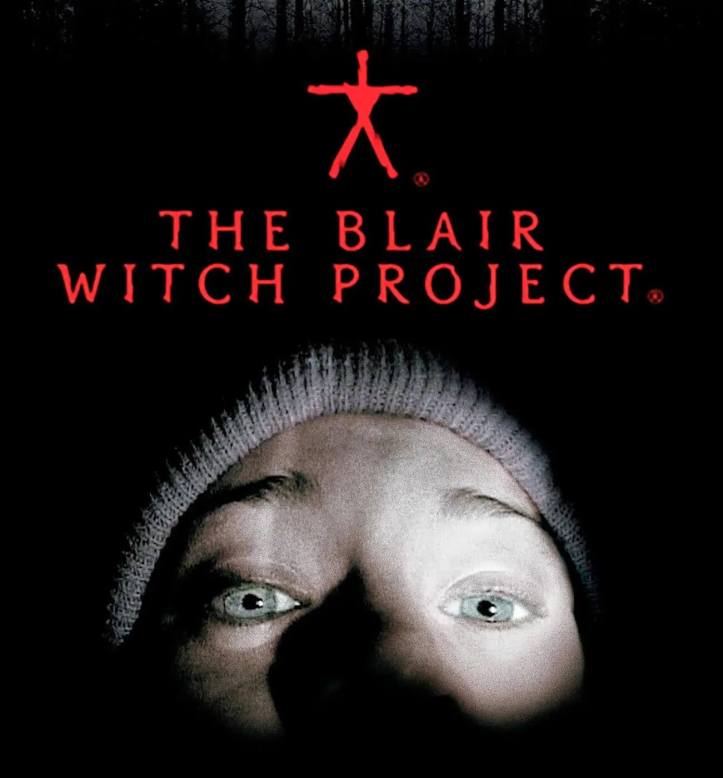
This iconic psychological horror moved launched back in 1999 and helped launch the whole found footage genre of pseudo-documentaries. Written and directed by Daniel Myrick and Eduardo Sánchez, it remains one of the most successful indie films ever!
We remember the huge fuss about it back in 1999. Its innovative marketing campaigns took advantage of the internet (still in its infancy) and earned $248.6 million off its $500,000 budget.
Even if you haven’t seen the film, and have no intention of watching The Blair Witch Project, you’ll know it—it was a cultural phenomenon! Thus, let’s revisit the scares and see what all the fuss was about.
When You Go Down to the Woods Today in Blair Witch Project
Set in October 1994, the film follows a three-strong set of university students as they make a documentary about a “Blair Witch” legend in Burkittsville, Marlyland of USA.
Prior to the film starting, we’re informed the footage presented is REAL and the events happened. The three leads in the film of Heather Donahue, Joshua Leonard, and Michael C. Williams, all use their real names throughout.
With that setup, they head off into the woods to document the witch out there.
It’s intended as a history/joke documentary, but as the trio go further into the woods they begin discovering all sorts of weird crap. Before long, it’s apparent they’re being stalked by someone—quite who they don’t know. They are, however, hopelessly lost and increasingly cranky.
They’re aware they’re safe during the day, but at night they hear noises, children laughing, and something attacks their tent.
Once Joshua is kidnapped one night, right from the tent in which they’re sleeping, things really get serious. In one of the memorable scenes from this low-budget horror, we hear the witch taunting Heather and Michael by torturing Joshua (whose screams can be heard in the unknown distance).
There’s also the iconic shot where Heather records a confessional, with many spoofs continuing to this day of the view right up her nostrils.
There’s long been a debate since The Blair Witch Project launched about whether it’s any good or not.
Some film buffs dismiss it as rubbish, some students lost in the woods getting increasingly hysterical. For us, we do think it’s a good film—it’s full impact perhaps now lost to time.
You never see the witch. As with other horror classics like Steven Spielberg’s Jaws (1975), limiting access to the monster leads the viewer to create their own horror. In that sense, the psychological trauma from this found footage film will be very real for some viewers. It isn’t a merry time of it.
Granted, it doesn’t have the nuances of a psychological film such as Misery (1990). Where viewers get an alarmingly intimate portrayal of Annie Wilkes’ madness.
What The Blair Witch Project offers instead is primal fear.
The students are being stalked in the woods, they’re lost, it’s damp and horrible. Then they’re picked off slowly in a very scream happy final few minutes. Memorable stuff, even if it remains divisive.
Blair Witch Project’s Unique Marketing Campaign
The film was very possibly the first promoted mainly across that thing called the internet. You have to remember, in 1999 it wasn’t anywhere near as prevalent as it is now.
Getting online was a pain in the backside, expensive, and slow. It just hadn’t taken off on a mainstream level. Heck, when we went to university in 2003 we didn’t even have access to the internet in our halls of residence, you had to go down to the library and book in on a computer if you wanted to head off surfing the net. It wasn’t until 2006 that it became pretty much essential to have.
But the marketing worked for Blair Witch all the same, as there were enough geeky people online in 1999 to still see the campaigns and be wowed by them.
That included fake “MISSING” posters for the three main actors.
With the inclusion of found footage elements, people were actively debating online whether or not this was a real documentary or a horror film. That drummed up a lot of interest in the film and helped it succeed. Without this marketing, it’s arguably whether it would have been such a big success.
Thus, we can claim The Blair Witch Project was the first ever film to go viral. And it did that before social media was even a thing! Ah, the good old days! Remember when X didn’t exist? Lovely stuff.
The Production of Blair Witch Project
The three leads recently reunited onstage at NJHC in March 2025. They’re all now in their early 50s. Heather Donahue has also changed her name to Rei Hance.
Joshua Leonard has had a particularly prolific career, performing in many films and TV shows. He’s also been a director and writer on various other projects. Meanwhile, Michael C. Williams has starred in the likes of Law & Order.
Rei Hance pretty much left acting around 2005 and is now a business owner.
The actual production of the film began in 1993, with writers/directors Daniel Myrick and Eduardo Sánchez only casting in June 1996. There were 2,000 auditions eventually narrowed down to the final three. Of course, no one knew the film was going to be such an enormous hit! We should imagine it would have seemed like another daft B movie horror romp.
Filming began in October 1997 in Maryland and only lasted a week! A CP-16 camera was used, notable for their use in small productions and at film schools.
Given the unique nature of the film, it’s actually the actors who recorded it—they’re the ones lugging the cameras around filming everything. This means viewers only get to see the snippets they record of their ordeal. And they genuinely were just wandering around in the woods feeling cold and miserable.
Other crew members hid messages on their next location to camp etc. in film canisters, instructions the actors then followed. And then the crew would attack the actors’ tent at night to freak them out.
Method acting at its finest.
Prior to post-production fees and marketing costs, the film’s budget was only $60,000. The eventual total reached between $500-$750k. Still, not half bad considering the $200+ million it went on the scream back into the void.

I remember seeing this in the theater, and half the people there were all like “whoa, awesome” and the other half BOOED. They booed a movie theater screen.
LikeLiked by 1 person
I guess the movie screen goddamn deserved it, stupid bloody thing. But yeah, it’s either love or hatred for this film. Indifference is not an option!
LikeLike
Hilariously spot-on. That “psychological horror and snot” label is peak truth—I’d forgotten how the gross spec, breathy panic, and nasal close-ups made it feel terrifying and absurd all at once.
You’re right: it’s not just horror, it’s found-footage existentialism. They weren’t just lost in the woods—they were lost in their own fear, stripped down to trembling in the mud. And the internet-era viral push? Genius. I love that the Authenticity Filter of 1999 actually worked, turning audiences into amateur conspiracy theorists.
Great nostalgia trip that feels both low-rent and high genius. Thanks for reminding us how profound fear can be when it’s just camera, sweat, and silence.
LikeLiked by 1 person
Thanks, a great comment! Seems you liked the film, too, which I sure do. Appreciate why some people may not like it, but I think it’s clever and genuinely goddamn scary at certain points. Keeping the monster hidden works wonders in horror. Plus, snot… Lambert in Alien had a similar problem time with it, she’s a bit of a snotty mess for the second half of that film. Pure body horror magic.
LikeLike