
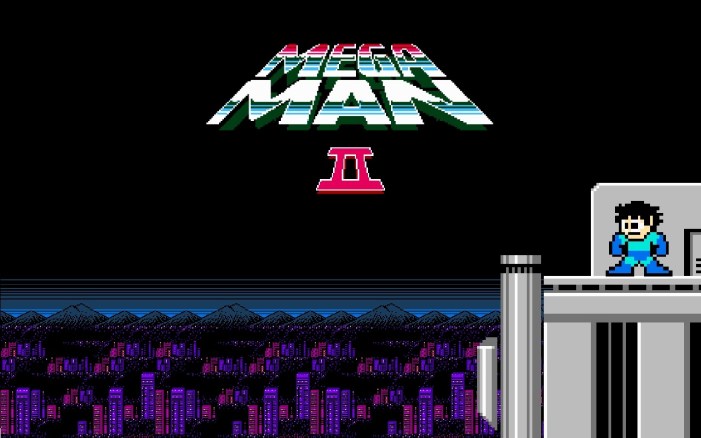
For whatever reason (we like to think due to youthful stupidity and ignorance), the Mega Man games passed us by for decades.
We had a NES in the late ’80s and SNES in the early ’90s, but we never got a Mega Man game. Ever. Only when the Wii U launched did we finally get round to trying Capcom’s utterly ironic Mega Man 2, which is a hugely influential platformer.
Its impact on the indie game scene stands to this day, with many modern indie games riffing off it. But we’re here to celebrate the robotic legend that started it all.
Classic Retro Game Platforming in Capcom’s Iconic Mega Man 2
One of the legendary Capcom’s finest classics, this title hit she shelves in time for Christmas 1988 and became an immediate critical and commercial success.
The series eventually spawned six games for the console in a frantic bout of creativity from Capcom.
But most gamers seem to agree Mega Man 2 is the best of the lot—it’s an enthralling, intense, and uplifting platformer. And one that’s as close to perfect as the NES could muster with its technological limitations.
It rewards bravery and skill in equal measure without being too unfair.
But yes, the game is notorious for being bloody difficult. Not that it ruins the experience, just go into this one expecting a tough time of it.
Mega Man 2’s Plot
Right, the plot! Keeping it simple (most of the best games always keep the plot concise), antagonist Dr. Wily has built a fortress and an army of evil bastards. Including eight Robot Masters—the bosses you’ll face.
Dr. Light, the creator of the robot Mega Man, sends his protagonist (you) once more into the fray to shoot stuff up a notch.
It’s standard stuff, in others words, but what Capcom did on the NES with this 2D platformer is still ahead of what many blockbuster budget modern day developers can achieve.
From the confines of the limited technology, the company crafted a piece of glorious perfection. And that’s all down to the outstanding level design, which to this day is top-tier stuff. It’s barely aged at all.
Paying Tribute to Mega Man 2’s Brilliant Level Design
Capcom allowed players to choose what level they wanted to start off with, which was a bit of a radical decision in 1988. The level of freedom with that was very unique.
There are eight stages to choose from. And at the end of each stage, once you annihilate the end level boss, you gather the character’s power which you can then use in subsequent stages.
A bit Nintendo’s Metroid (1986) influences going on there.
Our favourite? We’d always had a thing for the Heat Man stage. We’re not sure why… certainly the score helps, but there’s something in the relentless jumping precision we find positively compelling.
Let’s not waste any more time and state it here—as you’d expect from a NES game, it’s bloody difficult (if you do give it a go, the legendary disappearing blocks will mess with your mind).
It’s riveting stuff, though, and one of the finest games on the NES.
With its relentless pace, a stunning soundtrack, and sublime gameplay innovations, you’re ensured a brilliant time of it. To this day it just holds up so very, very well.
And you can see its influence on many modern indie games, perhaps most notably with the much-celebrated series Shovel Knight by Yacht Club Games.
More indie games continue to pay homage to Capcom’s series, though, most recently with this humdinger of a hidden gem in 2023.
If you’d like a modernised take on Mega Man 2, then you really can’t go wrong with the excellent Gravity Circuit (2023) by Domesticated Ant Games.
It’s available on PC, PS4/5, and Nintendo Switch.
Mega Man 2’s Ongoing Speedrunning Legacy
Due to the frantic nature of the game, it’s no surprise Mega Man 2 has become one of the most hotly contested speedrunning titles.
This was all documented in the quite brilliant Summoning Salt channel (just a total nerd’s dream if you don’t know about it yet—get yourself subscribed).
It’s pretty obvious why the game attracts speedrunners. It’s:
- Fast-paced and difficult as all hell.
- Requires nerves of steel.
- Requires precision jumping.
- Elements of luck rear themselves constantly.
- Gamers can exploit plenty of late ’80s bugs.
The world records for these titles change a lot, but it’s worth reflecting on the impact of this game over 30 years on from its release.
Gamers are still enjoying it in every capacity it has to offer! Now that is a glowing tribute to Capcom at its brilliant best.
You Can’t Ignore Mega Man 2’s Epic Soundtrack
Mega Man 2 has one of the best soundtracks from the NES era. Frankly, you’d say it’s one of the best video scores ever!
As with the game, it’s a pulse-pounding and toe-tapping time of it. No matter how frustrated you get, jumping in again and hearing those beeps and boops will liven your day. The music just demands you keep on Mega Manning!
Takashi Tateishi was responsible for all this iconic work, although the composer uses the alias Ogeretsu Kun. He no longer works with Capcom, but he was responsible for leading many of the Mega Man musical projects.
He also introduced the equally iconic Mega Man stage clear jingle, which first appeared in the second outing of the series.
Unlike other video game composers of his era, Tateishi wasn’t a classically trained composer. Instead, he’d been in bands.
And he made the decision for Mega Man 2 to shift away from classical to focus on the exciting rush you get at a gig. In 2010 he told VGM Online:
“I aimed to create melodies that people could hum along with, or play in their bands. At that time Capcom’s sound staff was primarily comprised of people who majored in Music at music schools or technical colleges. I didn’t go to a music or technical college, but while I was majoring in economics at a normal college I was in a band. So I liked the kind of music that bands perform.”
And the results were damn thrilling indeed! We mean, this in 1988 would’ve just been groundbreaking.
Full credit to Tateishi and his vision. That helped redefine what a video game soundtrack could be and helped shape the future of music scores in the ’90s.

I do remember its RED casette! And you are right. It was impossibly difficult…
LikeLiked by 1 person
Red cassette? Whoa, that must have been weird. As for its difficulty, it’s those disappearing blocks which stump me. It’s much easier these days as with the NES Mini and Wii U, you can create save points to advance quite easily… but in the ’80s it must have been brutal.
LikeLiked by 1 person
Like you said “perfect”. This is one of the greatest games on one of the greatest systems ever. So hard but so good! Yet another one I wish I had never pawned off at some point in history.
LikeLiked by 1 person
Yeah, I’ve been quite addicted to this again since the NES Mini (I don’t mean to show off!) came out. I was surprised to find it’s on the iPhone as well.
Speaking of pawned off, I got my parents to sell my NES in the early ’90s as I’d picked up a SNES and figured I wouldn’t be playing it again. Bloody hell, that was a mistake.
LikeLiked by 1 person