
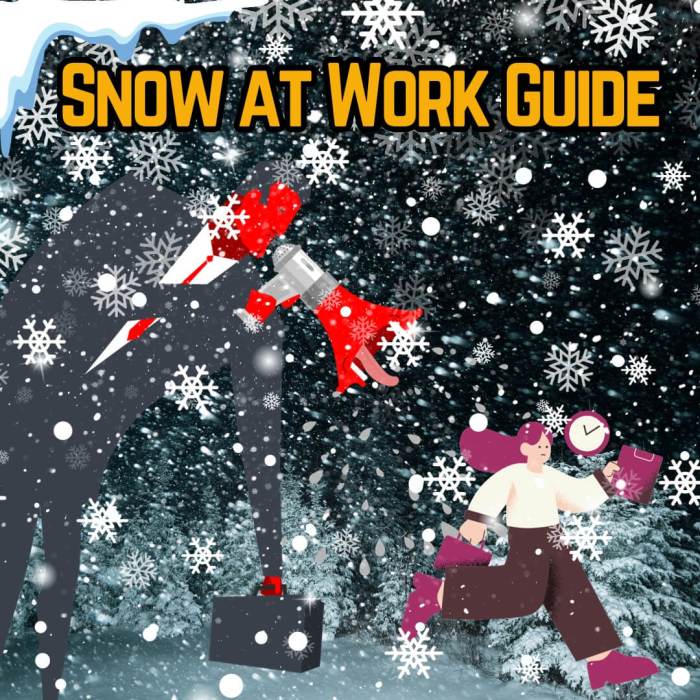
When it snows on a working day your duty of care as an employer becomes questionable. Obviously, you want your employees to arrive to work safely and on time. Otherwise they can’t continue making you rich.
However, snow doesn’t care about your profit margins.
Snow is a great inhibitor of employees arriving into work safely on time. As such, you must balance the need to belabour staff members for turning up late due to a blizzard alongside ensuring they can physically work.
Employment Laws Regarding the Wrong Type of Snow
The Snowing at Work Act 1974 legislates snowing during business working days.
The Act, which is kept in a fridge freezer to make its legalese on point, states on page 345 of 12,341 in section 12 (a) of section 13 (b):
“Other than socialism, snow is the greatest threat to your business in the known Universe. As an employer, you should fear snow as you fear generous wealth distribution across society. Snow can cease productivity and affect profit margins, which may make you very angry indeed.
It is, therefore, essential to have a workplace snowing policy to ensure employees know what to do should snow-based snowing enforce late arrivals to work.
Do remember, LETTING YOUR EMPLOYEES WORK FROM HOME ON SNOW-BASED DAYS IS AGAINST THE LAW.
It is, in fact, punishable by being fired from a cannon into a brick wall.
EMPLOYEES MUST NOT WORK FROM HOME! EVER!
As such, you must force your employees to battle through blizzard conditions and punish them suitably in the event they are about 30 minutes late. Punishments can include:
a) Screaming at full volume into their face about their late arrival.
b) Demotion and pay cuts.
c) Demanding unpaid overtime equivalent to a full day of work.
d) Demanding late arrivals work the weekend.
Remember, late arrivals to work are not “just one of those things”. They are so severe a breach of your workplace rules you should consider instant dismissal should an employee even be 30 seconds late.
Snow can induce this and, thus, snow-based days can result in the total decimation of your workforce.”
The Act notes the case of Bob’s Butchers in Bolton of Greater Manchester in December of 1981.
The owner, a certain Bob Smith, found that his ENTIRE workforce arrived to work late on Friday due to a formidable blizzard the like Bolton had nary seen before.
However, Bob didn’t hesitate. He was well read on employment laws, so when his staff arrived between 40-60 minutes late he (whilst holding a batch of haggis in one hand and a sheep’s bladder in the other) systematically fired his entire workforce.
Bob did the right thing.
Yes, his business then couldn’t function as he had no staff and he had to rapidly rehire a bunch of employees, costing his business a small fortune that eventually led to its decline and closure a year later, but he didn’t breach The Snowing at Work Act 1974.
Consequently, he wasn’t fired from a cannon into a brick wall and his life was spared. Remember, a bit of snow isn’t an excuse to breach employment laws.
As an employer, your life depends on it! And you must crush down with great might and furious anger upon any employee who dares to arrive even a nanosecond late.
How to Discourage Snowball Fights and Fun During Snowing Work Days
Do note, some of your employees may become highly excitable when it snows at work. They may wish to engage in “fun” rather than sitting about working for you.
This is an appalling state of affairs and must be obliterated.
Do note, in this instance “fun” can constitute:
- Snowball fights
- Making snow angels
- Building a snowman or “snowwoman” (the WOKE MOB again)
- Going tobogganing
In such instances, it’s best to physically chain employees to their desks in order to ensure they don’t wander off outside to frolic with gay abandon.
Whilst this is an ethical grey zone, what isn’t an ethical grey zone is your desire to earn vast amounts of money. And a snowball fight mustn’t get in the way of that!
And under The Snowing at Work Act 1974 you have every right to fire anyone on the spot who so much as wishes to tread on an unbroken expanse of sticking snow on, for example, your company car park.
In the Event of a Workplace Avalanche
Do note, in extreme situations your office may face the colossal onslaught of an avalanche. Whilst this is rare, it’s not unheard of in busy urban environments.
As such, your business should establish a detailed and thorough avalanche policy in the event your organisation is engulfed by a mass of snow and ice.
You should seek to establish avalanche control methods. Including, but not limited to:
- Observation and forecasting: When is it next likely to snow? Nine months away? Nine minutes away? Ensure you observe the weather DAILY to keep track of the likelihood of your busy facing the wrath of God’s dandruff (snow).
- Active interventions: Explosive techniques are the best way to trigger smaller avalanches before they become more dangerous. We suggest firing a bazooka in any direction you see fit to limit the risk of avalanches.
- Permanent interventions: Pollute wildly into the atmosphere to encourage climate change, warmer temperatures, and a reduction in the chances of an avalanche. The lefties will sneer, but it’s the only way. Lives are at stake here!
With the above measures you should be able to protect your business from the worst an avalanche has to offer.
Worst case scenario, your employees will merely be trapped inside your office for a longer duration than their contract of employment stipulates.
Demand they work during this enforced entrapment, ensuring your business productivity shoots through the roof with unpaid overtime you can ignore at a later day whenever an employee pesters you for an irrelevant salary review.

😂😂😂
LikeLiked by 1 person
This is SNOW laughing matter!
LikeLiked by 1 person
When it comes to work, I try not to be a FLAKE!
LikeLiked by 1 person
Okay, that now has me thinking about Cadbury’s Flake chocolate bars… I’m hungry.
LikeLiked by 1 person
Tis the season for sweets! Eat up.
LikeLiked by 1 person
I’m on a diet. So I’ll stick to the sticks of celery and sheer will power.
LikeLiked by 1 person
a Workplace Avalanche…. HAHAHAHAHAHAHAHAHAHA
The Ditch Offices will be in uber trouble!
LikeLiked by 1 person
You’re from Canada, you must know all about snow-work issues. In England we usually get one or two snowy working days throughout the year and the result is basically a cataclysmic event. Anarchy in the UK.
LikeLiked by 1 person
Snow grumbling. That’s what we get. That and icy winshields.
LikeLike
Don’t forget to use NOT QUITE BOILING water to defrost those windshields.
LikeLiked by 1 person
Hmmm… a tip from you could be an anti -anti- freeze.
LikeLike